The artist who brought opera to life
Retrospective of influential Chinese painter Guan Liang
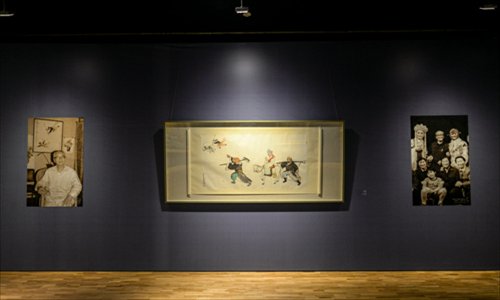
Among the first generation of modern Chinese painters who studied art abroad, next to the household names of Xu Beihong (1895-1953) and Lin Fengmian (1900-91), Guan Liang (1900-86) has been unfairly neglected. Works on display at the retrospective exhibition of Guan Liang at the Long Museum West Bund Photos: Courtesy of the museum
However an exhibition commemorating the 115th anniversary of the Guangdong-born artist's birthday at the Long Museum West Bund until August 8, shows something of the delights most art lovers have been missing.
The exhibition which spreads through Gallery 3 and Gallery 6, is the largest Guan Liang retrospective to date with nearly 200 items on display, ranging from water and ink paintings, oil on canvas, watercolors, to some rare calligraphy and works on fans and porcelain plates.
In chronological order, Gallery 3 showcases water and ink paintings of Peking Opera characters, an unmistakable leitmotif of the artist, from the late 1930s to the 1980s.
An enthusiast and amateur opera performer himself, Guan Liang was friends with many of the A-list opera stars of the time and brought a serious passion and profound understanding to his opera works.
These small paintings on paper cleverly and economically illustrate some Peking Opera themes, drawn with a simple, almost child-like approach. At the same time he uses color boldly giving the costumes of his opera characters vivid and distinctive yellows, purples, reds and greens.
Influence evident
In this the influence of post-impressionism is evident - Guan Liang studied oil painting in Japan in the late 1910s and the 1920s, at the Kawabata Institution and Pacific Art Association where the focus was on masters like Van Gogh, Cezanne and Gauguin. It was after he came back to China that he started to work on Chinese ink and water paintings.
"Guan Liang's efforts to grab the essence, instead of the form, and to use contrasting colors in large proportions, is at the core of all his Chinese ink and water paintings despite the different dates," Du Jinghui, a researcher from the curator's department, told the Global Times. "Before him, the Western-style use of color in Chinese traditional art was totally unknown."
Peking Opera paintings continue to dominate Gallery 6, this time categorized by themes - the works based on important scenes from the four great Chinese classical novels take center stage.
It is with a seemingly effortless skill that Guan Liang creates the distinctive eyes of his subjects. He manages to convey a great deal in two dots or tiny strokes. By placing these eyes in the sockets so deliberately he brings to life the reckless anger of Li Kui from Water Margin and the sentimentality of Lin Daiyu from The Dream of the Red Chamber.
Love is another theme in this exhibition, represented by the romances of emperors within and outside the confines of their palaces, and love between men and female demons, the well-bred and prostitutes.
Du pointed out that Guan Liang shows respect and sympathy for his female subjects. "For example, when painting the story of the Ming Dynasty (1368-1644) emperor Zhengde and the commoner Li Fengjie, he deliberately makes the emperor a comical caricature and lovingly illustrates the eventually abandoned Li," Du said.
Less is more
Curator Wang Wei, who is also the museum owner, is a longtime fan of Guan Liang's operatic artworks. "Though his works are small in size, they exude a sense of grandeur and magnificence. Their delicate intricacies are hidden by the apparent simplicity of his work. From his works we can really appreciate how 'less is more.'"
This echoes a point made elsewhere by Liu Haisu (1896-1994), a prominent artist and founder of the Shanghai Academy of Chinese Painting, who said Guan Liang's work looked simplistic but was packed with an inner strength and Eastern aesthetics. They were totally distinctive and unparalleled.
"As a pioneer of the portrayal of opera characters, Guan Liang used one of the most traditional art forms in China to explore the soul of the nation as well as its art. It is this magnificent vision and sense of energy that make his work emotionally contagious for generations of viewers," Liu once said.
The starting point
Gallery 6 also has several oil paintings reflecting the starting point of Guan Liang's career.
One of them, Stone Gate, Guan Liang's largest work in 1980 is based on a sketch of the Stone Gate in Shaanxi Province during a trip there. A beautiful crystal river runs between mountains of mesmerizing hues dotted by large chunks of brown stones.
"Nothing says more clearly than the broad, wild outlines and the use of seemingly unrealistic colors here that Guan Liang is a true disciple of Matisse and Cezanne," Du said.
Guan's obsession with Peking Opera paintings also affected his oil on canvas works.
In Dance (pictured below), he used palette knives to accentuate the movements and expressions of two Thai dancers, giving this a dramatic, theatrical feel similar to the traditional Chinese form.
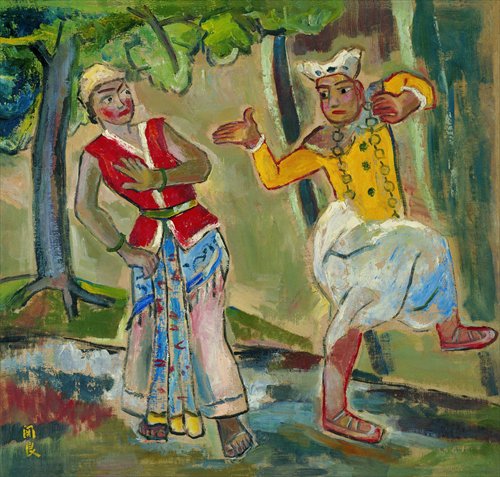
"His work integrating Chinese and Western painting techniques opened up some brand-new possibilities for the development of art and refreshed Chinese people's understanding of artistic aesthetics," Wang said.
"It is this innovative contribution that has earned him a unique position in the history of Chinese painting. The open-mindedness and innovative spirit he demonstrated with Western painting techniques and ideas have been inspiring."
Date: Until August 8, 10 am to 8 pm, Tuesday to Sunday
Venue: Long Museum West Bund
Address: 3398 Longteng Avenue
Admission: 50 yuan ($8.17)
Call 6422-7636 for details