HOME >> BUSINESS
Trade decline seen continuing
By Zhang Ye Source:Global Times Published: 2015-6-8 22:58:01
Export drop less than expected
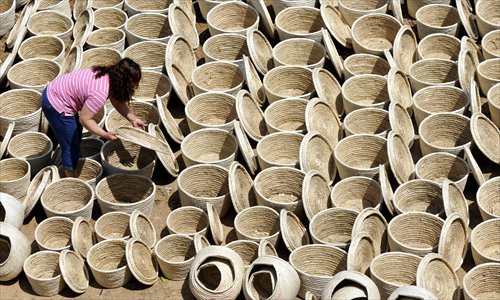
A farmer dries straw baskets that will be exported in Linyi, East China's Shandong Province. Photo: CFP
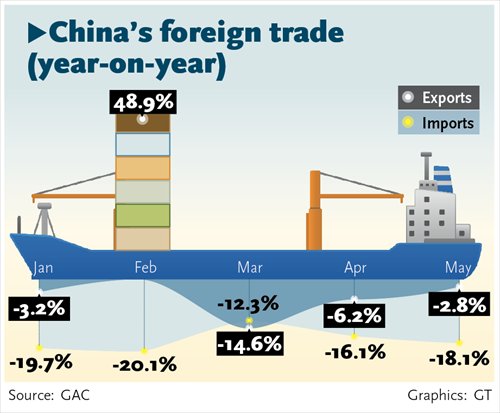
China's foreign trade continued to weaken in May but with a narrowing year-on-year decline in exports, official data showed on Monday.
The country saw its overall trade drop 9.7 percent in May from a year earlier to 1.97 trillion yuan ($317.6 billion), according to a statement posted by the General Administration of Customs (GAC) on its website.
Exports dipped 2.8 percent year-on-year in May, less than economists' estimates of a decline of up to 5 percent, following an unexpectedly sharp 6.2 percent year-on-year drop in April.
"The better-than-expected exports data for May was in part driven by the economic recovery in developed economies," Xu Gao, chief economist at China Everbright Securities Co, told the Global Times Monday.
Exports to the US, for instance, increased 7.8 percent in May year-on-year in yuan terms, in comparison with a 3.1 percent rise in April.
But economists believe that the external trade situation has not yet fully recovered.
"Foreign demand still looks subdued," Julian Evans-Pritchard, China economist with Capital Economics, said in a research note e-mailed to the Global Times Monday.
The GAC export index fell to 35 in May, down from 35.9 in April and marking the third consecutive monthly decline, indicating "relatively big pressure" on the country's exports, the GAC statement said.
Imports fell more heavily in May, dropping 18.1 percent year-on-year to 803.3 billion yuan, following a 16.1 percent decline in April.
The import decline is mainly a reflection of lukewarm domestic demand as well as the slide in global commodity prices, Tian Yun, an economist at the China Society of Macroeconomics, told the Global Times Monday.
"The low prices have dampened domestic importers' willingness to refill their inventories, which may further drag down the prices," Tian said.
Data from the GAC also showed that in the first five months the import volumes of iron ore and crude oil saw a slight 1.1 percent drop and 4 percent rise year-on-year, respectively, while the average prices of both items dropped more than 40 percent in the same period.
There has been no obvious improvement for either exports or imports, which may threaten the central government's 6 percent trade growth target for 2015, said Tian, noting that the poor trade performance gives the central government more reasons for further stimulus measures.
Recent monetary easing by the People's Bank of China, the central bank, has generated some positive effects for the overall economy, propelling housing sales in May to the highest level seen in the month for six years, according to a report released by the China Real Estate Index System on June 1.
Average new home prices in the county's major cities dropped 3.73 percent year-on-year in May, narrowing from a 4.46 percent decline in April, said the report.
In May, the central bank cut interest rates for the third time since November. And on June 2 it offered pledged supplementary lending (PSL) worth 263 billion yuan for financial institutions to fund housing renovation projects.
Traditional monetary easing measures cannot improve the current financing situation for the real economy, so more tools like the PSL program are needed to help move funds from the financial market into the real economy, said Xu.
Economists at Australia and New Zealand Banking Group (ANZ) forecast in a research note sent to the Global Times Monday that both consumption and investment are set to pick up in the second and third quarters, thanks to "fast implementation of fiscal policy and much-eased monetary policy."
In addition, ANZ said that China's imports may soon see a "modest pick-up," following the Ministry of Finance's reduction of tariffs on various consumer products.
Posted in: Economy