A closer look at old Shanghai
China Cultural Heritage Day tours lesser-known architecture
On the afternoon of June 13, which marked the 10th annual China National Cultural Heritage Day, a group of visitors consisting of 28 foreign consulate officers, entrepreneurs and artists from 18 countries experienced a special tour in Yangpu district, catching a glimpse of an almost forgotten history in the late 1920s - the Greater Shanghai Plan.
In 1927, the Kuomintang government of the Republic of China (1912-1949) drew up a plan to build a new downtown area in northeastern Yangpu district, as at that time the old downtown areas were occupied by foreign concessions.
The plan, however, was interrupted in 1937 after the Japanese army invaded China, leaving a few newly constructed buildings behind.
"Even though the plan was stopped by war, the few buildings constructed at that time were very beautifully designed and worthy of visiting," said Chen Jie, organizer of the tour, who noted that the plan could have completely altered the city's layout.
Greater Shanghai Plan
Led by a couple of local guides and a history expert, the group visited the headquarters of the Shanghai Special Municipal Government (1927-1937), the Former Shanghai Municipal Stadium, the Former Shanghai Municipal Library, and the Old Shanghai Municipal Museum.
The then government headquarters, a palatial four-story building with a roof covered with green glazed tiles, was completed in 1933. Being seriously damaged during the World War II, the building was later repaired in the 1950s. Today it is used as the main office building of the Shanghai University of Sport.
Unlike the typical ancient Chinese-style government headquarters, the other three buildings had a perfect combination of Eastern and Western construction styles.
Standing in front of the elliptical former municipal stadium, the tour guide noted that the entrance of the stadium was designed in the appearance of traditional memorial arches, which were commonly seen in southeastern China in Ming (1368-1644) and Qing (1644-1911) dynasties.
"But some decorations of the stadium, like the carved patterns on its arched doors, were typical Western style," said the guide.
Lesser-known history
"That is partly why this year I'd like to show our foreign friends the old architectures of Yangpu district," Chen told the Global Times, adding that most people are more familiar with the two most prominent styles of old buildings in this city: the ancient Chinese structures like in Yuyuan Garden, and the Western style such as on the Bund. "In fact we also have lesser-known historical buildings that combined the merits of both styles; these were built under the Greater Shanghai Plan."
The tour was organized by the Shanghai Study Culture Research Centre, a local organization that provides cultural education and exploration events for expatriates and visitors to this city. "This year also marks the 70th anniversary of the victory of World War II, and it's meaningful to visit these Greater Shanghai Plan buildings and learn about their history," said Chen, the center director.
For visitors, the tour was a good opportunity to have a closer look at the old Shanghai. "I've been living in Shanghai for 14 years, but it's a pity that I still don't know much about this city," said Jun Sung-jin, an adviser with the Korean Chamber of Commerce in Shanghai, who added that the old government headquarters impressed him most on this trip. "I've heard of this building and the Greater Shanghai Plan before, and I'm happy to visit the building today. It's great to see that it is under good preservation."
"My wife and I have studied a lot of old buildings, we have intense interest in this field, and we have visited many historical buildings in and out of Shanghai and read lots of materials about them," said Rolf H. Koehler, vice chairman of the German Chamber of Commerce in Shanghai, who has been in Shanghai for 11 years. "Luckily, more and more historical architectures here have been protected as cultural heritages. They are an important part of Shanghai's history."
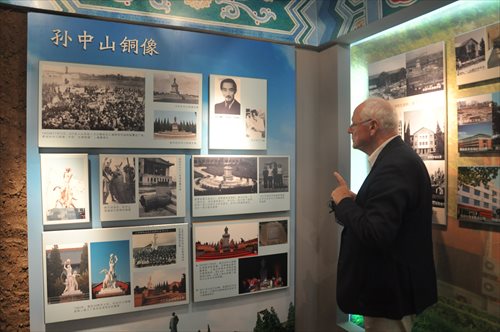
Rolf H. Koehler, vice chairman of the German Chamber of Commerce in Shanghai at the the Shanghai Special Municipal Government Photo: Huang Lanlan/GT
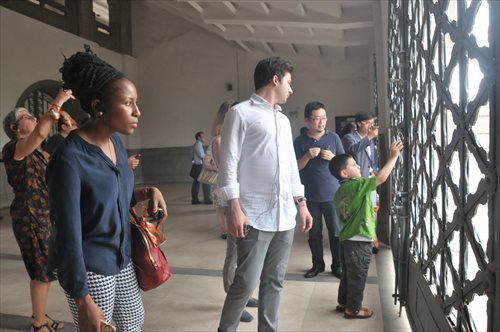
Visitors at the Former Shanghai Municipal Stadium and the Former Shanghai Municipal Library Photo: Huang Lanlan/GT
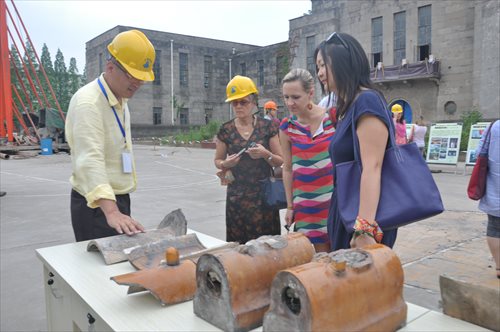
Visitors at the Former Shanghai Municipal Stadium and the Former Shanghai Municipal Library Photo: Huang Lanlan/GT