HOME >> BUSINESS
Heilongjiang struggles to save its troubled corn processing industry
By Liu Tian in Suihua Source:Global Times Published: 2015-7-1 19:48:02
Corn deep processing enterprises in Northeast China's Heilongjiang Province have been struggling since 2008, when the central government started a temporary purchasing and storage policy there. The price support policy benefits farmers, but also hurts local processing enterprises, putting many of them in financial difficulties. Local governments and enterprises are now working toward improving the situation. Global Times reporter Liu Tian reports on the situation from Suihua, south-central of Northeast China's Heilongjiang Province.
After years of losses, the corn deep processing enterprises in Northeast China's Heilongjiang Province have gotten excited recently about the prospects of an increase in government subsidies this year.
"It is almost certain that there will be a big increase in both State and local subsidies, though no official documents have been issued yet," said Li Zhuyuan, head of industry guidance department at the Grain Bureau of Heilongjiang Province.
As China's largest grain producer, Heilongjiang grows more than 10 percent of the country's grain, according to National Bureau of Statistics (NBS) data from December 2014. It also ranks as China's top corn producer.
Unfortunately, Heilongjiang has not been a major corn processing base for more than 10 years. About 20 percent of its corn is processed in the province, the Heilongjiang Bureau of Statistics said on March 18.
Li attributed the contradiction to insufficient corn producing capacity within the province. "The central government strictly limited new corn processing projects in Heilongjiang before 2014," Li told the Global Times on June 30. "It hoped that the province would supply corn to the entire country to ensure food security nationwide."
"Because of the lack of corn processing companies, Heilongjiang is unable to digest its tremendous output of corn," said Liu Yong, vice general manager at Suihua-based Heilongjiang Longfeng Corn Development Co.
Many of the province's corn processing enterprises lost money last year, according to a report by Economic Information Daily in January. Some have been shut down.
The industry's troubles are a result of rising corn prices upstream and falling prices for downstream processed corn products, such as alcohol,the report said in January, citing Pan Sheng, head of the provincial grain bureau's regulation and control department.
The sluggish demand from downstream sectors such as pharmaceuticals, food products and breweries, stems from China's distressed economy, Li said.
Both Li and Liu agreed that the cause of the rising price of corn is mainly rooted in the high prices farmers receive from government's temporary purchasing and storage policy.
The consequences of subsidies
Under the temporary purchasing and storage policy, the central government purchases grain from farmers at a fixed price that it determines on an annual basis. This government price is usually higher than the market price.
The policy's purpose is to ensure the country's food security and protect the interest of farmers, who receive a better price for their crops.
The temporary purchasing and storage policy of corn that started in 2008 only applies to Heilongjiang, Jilin and Liaoning provinces in Northeast China and the Inner Mongolia Autonomous Region. China Grain Reserves Corp (CGRC) runs the policy under the authorization of the State Council. CGRC is responsible for managing the corn storage through its own granaries and the warehouses it contracts its behalf.
CGRC has entrusted the State-owned companies, China National Cereals, Oils and Foodstuffs Corp (COFCO) and Chinatex Corp, to take responsibility for the purchasing and storage of up to 5 million tons and 1 million tons of corn, respectively.
The region's corn deep processing enterprises have been complaining about the policy for years, blaming it for their reduced profits and losses. Farmers now prefer to sell corn to granaries because they can get a higher price from the government. The policy has caused a shortage in the corn market.
Consequently, companies have to participate in government-sponsored auctions to get the corn they need to run their business. But auctioned corn comes at a higher price. There are also additional costs, such as those for storage. In addition, enterprises have to bear other expenses such as loading and unloading fees and transportation costs. They also have to pay other incidentals to remove the corn from the granaries.
To make matters worse, CGRC's purchasing price has been rising every year, forcing the deep processing enterprises to assume a growing burden, as corn accounts for 70 percent of their total costs. State Administration of Grain data show that the price of corn in Heilongjiang had risen by 50 percent from 2008 to 2013, though it was stable in 2014.
The high corn prices have undermined the competitiveness of deep processing enterprises in Northeast China. Their competitors in South China can sell their products at a lower price because they can buy corn that hasn't been inflated by a temporary purchasing and storage policy.
Liu complained that his company had to suspend production for the month of April in 2014 due to a corn shortage. "My company couldn't buy corn on the market in April 2014 because CGRC can buy unlimited quantities," Liu told the Global Times on June 9. "We had to wait until May for the State's temporary storage corn auction, but we still had to pay wages and interest during that period."
Liu said that few farmers, but a great number of middlemen, benefit from the policy. These middlemen buy large quantities of corn from farmers in advance and then sell it to the government at the subsidized price. "These middlemen also bid up prices at auction, further distorting the market," Liu said.
Coping mechanisms
Central and local governments try to help the region's processing enterprises by offering them subsidies that amount to 100 yuan per ton of corn purchased from State granaries, hence the excitement over the possibility of a increase. Although no official amount has been released, rumor has it that the subsidy could rise to more than 200 yuan. Still, it might not be enough.
"This amount of subsidy is not enough to make up for enterprises' losses," said Li, the grain bureau official. "That would take a subsidy of at least 300 yuan."
The Heilongjiang government is also lobbying the central government to give large-scale private corn processing enterprises in the province the same responsibility for purchasing and storing corn as COFCO.
Liu said that his company could save at least 170 yuan per ton of corn this way. "We could make some profit then. We make only a small profit now, though it's better than most enterprises in the industry," he said.
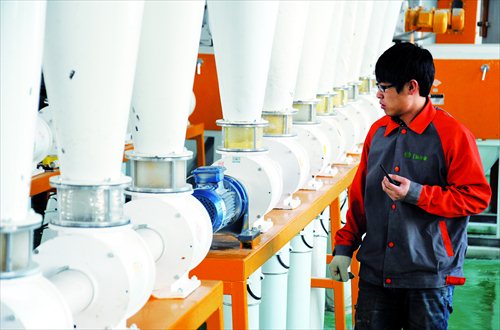
An employee works at a corn flour processing plant on March 26 in Jiamusi, Heilongjiang Province. Photo: CFP
After years of losses, the corn deep processing enterprises in Northeast China's Heilongjiang Province have gotten excited recently about the prospects of an increase in government subsidies this year.
"It is almost certain that there will be a big increase in both State and local subsidies, though no official documents have been issued yet," said Li Zhuyuan, head of industry guidance department at the Grain Bureau of Heilongjiang Province.
As China's largest grain producer, Heilongjiang grows more than 10 percent of the country's grain, according to National Bureau of Statistics (NBS) data from December 2014. It also ranks as China's top corn producer.
Unfortunately, Heilongjiang has not been a major corn processing base for more than 10 years. About 20 percent of its corn is processed in the province, the Heilongjiang Bureau of Statistics said on March 18.
Li attributed the contradiction to insufficient corn producing capacity within the province. "The central government strictly limited new corn processing projects in Heilongjiang before 2014," Li told the Global Times on June 30. "It hoped that the province would supply corn to the entire country to ensure food security nationwide."
"Because of the lack of corn processing companies, Heilongjiang is unable to digest its tremendous output of corn," said Liu Yong, vice general manager at Suihua-based Heilongjiang Longfeng Corn Development Co.
Many of the province's corn processing enterprises lost money last year, according to a report by Economic Information Daily in January. Some have been shut down.
The industry's troubles are a result of rising corn prices upstream and falling prices for downstream processed corn products, such as alcohol,the report said in January, citing Pan Sheng, head of the provincial grain bureau's regulation and control department.
The sluggish demand from downstream sectors such as pharmaceuticals, food products and breweries, stems from China's distressed economy, Li said.
Both Li and Liu agreed that the cause of the rising price of corn is mainly rooted in the high prices farmers receive from government's temporary purchasing and storage policy.
The consequences of subsidies
Under the temporary purchasing and storage policy, the central government purchases grain from farmers at a fixed price that it determines on an annual basis. This government price is usually higher than the market price.
The policy's purpose is to ensure the country's food security and protect the interest of farmers, who receive a better price for their crops.
The temporary purchasing and storage policy of corn that started in 2008 only applies to Heilongjiang, Jilin and Liaoning provinces in Northeast China and the Inner Mongolia Autonomous Region. China Grain Reserves Corp (CGRC) runs the policy under the authorization of the State Council. CGRC is responsible for managing the corn storage through its own granaries and the warehouses it contracts its behalf.
CGRC has entrusted the State-owned companies, China National Cereals, Oils and Foodstuffs Corp (COFCO) and Chinatex Corp, to take responsibility for the purchasing and storage of up to 5 million tons and 1 million tons of corn, respectively.
The region's corn deep processing enterprises have been complaining about the policy for years, blaming it for their reduced profits and losses. Farmers now prefer to sell corn to granaries because they can get a higher price from the government. The policy has caused a shortage in the corn market.
Consequently, companies have to participate in government-sponsored auctions to get the corn they need to run their business. But auctioned corn comes at a higher price. There are also additional costs, such as those for storage. In addition, enterprises have to bear other expenses such as loading and unloading fees and transportation costs. They also have to pay other incidentals to remove the corn from the granaries.
To make matters worse, CGRC's purchasing price has been rising every year, forcing the deep processing enterprises to assume a growing burden, as corn accounts for 70 percent of their total costs. State Administration of Grain data show that the price of corn in Heilongjiang had risen by 50 percent from 2008 to 2013, though it was stable in 2014.
The high corn prices have undermined the competitiveness of deep processing enterprises in Northeast China. Their competitors in South China can sell their products at a lower price because they can buy corn that hasn't been inflated by a temporary purchasing and storage policy.
Liu complained that his company had to suspend production for the month of April in 2014 due to a corn shortage. "My company couldn't buy corn on the market in April 2014 because CGRC can buy unlimited quantities," Liu told the Global Times on June 9. "We had to wait until May for the State's temporary storage corn auction, but we still had to pay wages and interest during that period."
Liu said that few farmers, but a great number of middlemen, benefit from the policy. These middlemen buy large quantities of corn from farmers in advance and then sell it to the government at the subsidized price. "These middlemen also bid up prices at auction, further distorting the market," Liu said.
Coping mechanisms
Central and local governments try to help the region's processing enterprises by offering them subsidies that amount to 100 yuan per ton of corn purchased from State granaries, hence the excitement over the possibility of a increase. Although no official amount has been released, rumor has it that the subsidy could rise to more than 200 yuan. Still, it might not be enough.
"This amount of subsidy is not enough to make up for enterprises' losses," said Li, the grain bureau official. "That would take a subsidy of at least 300 yuan."
The Heilongjiang government is also lobbying the central government to give large-scale private corn processing enterprises in the province the same responsibility for purchasing and storing corn as COFCO.
Liu said that his company could save at least 170 yuan per ton of corn this way. "We could make some profit then. We make only a small profit now, though it's better than most enterprises in the industry," he said.
Posted in: Insight