Ancient Greece meets future China
Scholars in Shanghai discuss the influence of historical Greek styles on Chinese architecture
While the world is closely following the debt crisis in Greece that has sent ripples of panic around the globe, the Greek Consulate General in Shanghai recently tried to draw the public's attention away from the present to its proud past.
An event themed "Innovative Design: Ancient Greece meets Future China" was arranged by the consulate to invite historical scholars and architectural insiders to discuss the importance of design in ancient Greece and its potential future influence in China.
Greek Consul General in Shanghai Evgenios Kalpyris said during his address that Greece contributed the basic technical and scientific principles of architecture that have become foundations of the modern world.
"The word 'architecture' in Greek means art built in the space to satisfy the needs of mankind. Classical architecture is consistently the solid foundation of world architecture," he explained.
"Of course, the contribution that Greece has made to world architecture and design didn't happen only in ancient times. Byzantium shaped some basic architectural concepts in the West and Arabian and Muslim countries. Churches in the West and the places where Muslims worship are witnesses of these influences," Kalpyris added.
Greek influence in Shanghai
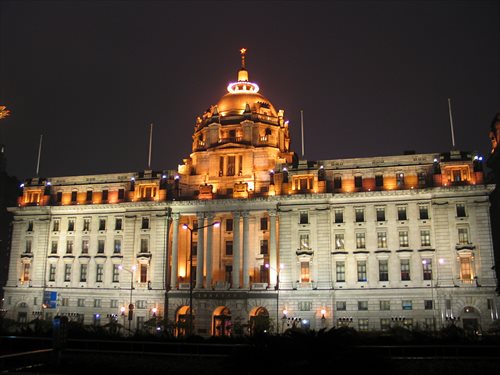
A stroll along the Bund in Shanghai is in fact a visual feast of classical Greek architectural concepts and an integration of architectural styles from other European countries. One can find all the three ancient Greek architectural styles simply by walking along the Bund.
As explained at the event, ancient Greek architecture has three canonical orders: the Doric, the Ionic and the Corinthian. The No.1 building along the Bund adopted Ionic-style columns for its exterior. The No.13 building on the Bund features the Doric-style columns while the No.16 building presents the typical Corinthian-style columns.
"In ancient times, Doric columns stood directly on the flat pavement of a temple without a base. Later this order referred to round columns which form a vertical angle with a flat top," said Lazaros Asvestopoulos, commercial director of Kleemann Group from Greece, at the event. "When you visit the Parthenon Temple or acropolis, you can find the existence of such an architectural style, which is one of the most ancient construction styles in the world."
Asvestopoulos explained that the Ionic order, which originated in eastern Greece, is more delicate, refined and graceful compared with the Doric. And the Corinthian order is a revised version of Ionic, which adopted more details. "Surprisingly, it is very hard to track this architectural style (the Corinthian order) among modern Greek constructions today," he said with pity.
"But in general the practical architectural styles designed by ancient Greeks have successfully withstood the test of time and have remained quite popular these days."
Asvestopoulos listed quite a few famous structures, such as the White House in Washington D.C. and the Roman Arena, where apparent Greek architectural styles can be observed. Although Greek architectural elements have apparently influenced some structures in China's past, Asvestopoulos hopes that more Greek styles can be integrated into the design of future modern constructions in China.
China's Greek Dynasty
Dr Han Jiawen with Xi'an Jiaotong-Liverpool University said that based on her knowledge, Nian Xiyao, a minister of construction in the Qing Dynasty (1644-1911), was one of the first Chinese officials that brought the concepts of Greek architecture into China.
"In the late 17th century, Nian became fascinated with Greek geometry. The principles of visual perspectives and linear perspectives started to get recognized in China. People began to pay more attention to the geometric forms of constructions, which they didn't notice before," said Han when commenting on ancient Greek architecture's influence in China.
While architecture is evolving all the time, Dr Han believes that Greek architectural designs in China need to directly parallel the country's social conflicts, just as they did in ancient Greece.
"In China, we are readjusting our architecture and urban planning all the time. I believe it's the trend that we integrate ongoing social conflicts into these designs or plans and I'm confident that more innovative designs will be seen here in China in the future," Han said.
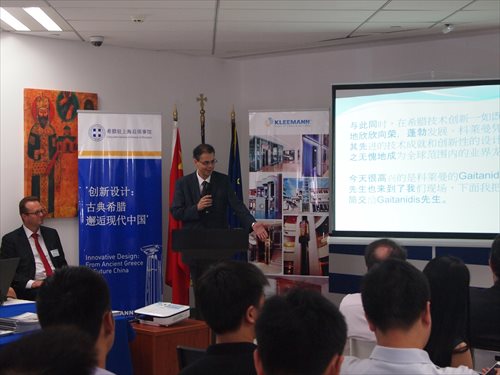
Evgenios Kalpyris, Greek Consul General in Shanghai Photos: Ni Dandan/GT and CFP
Evgenios Kalpyris, Greek Consul General in Shanghai Photos: Ni Dandan/GT and CFP