HOME >> METRO SHANGHAI
Raising wolves
By Huang Lanlan Source:Global Times Published: 2015-7-12 18:08:02
Many Chinese people, especially table-tennis fans, are quite familiar with the term "wolf-raising plan," used to describe the country's efforts in recent years to cultivate and train foreign ping-pong players.
As China has been dominantly undefeatable in this sport for several decades, it is now eager to see more qualified foreign rivals who can make table tennis tournaments more competitive and dynamic.
The seven-day ITTF World Hopes Week & Challenge, jointly organized by the International Table Tennis Federation (ITTF), the Chinese Table Tennis Association and the China Table Tennis College (CTTC), is one such way of "raising wolves."
Thirty two ping-pong talents under the age of 13 from five continents gathered at the CTTC in Shanghai last week after a series of selections, to learn playing techniques from China's best-known ping-pong athletes and coaches.
"These children are absolutely the best ping-pong players among their peers in their home countries," said Polona Cehovin Susin, ITTF's education and training director.
Fake left
While one such future wolf, Rachel Sung from the US, was playing against her German peer at the CTTC tournament on July 5, her father and coach was speaking with Chinese ping-pong coach Xi Minjie. Eleven-year-old Sung is a right-hander but plays the ball with her left hand. Her father doesn't mind, but Xi told him that they have to pay more attention to it, as it may hurt Sung's body coordination.
"We call a player like Rachel a 'fake left-hander,'" said Xi, chief coach of the Shanghai table tennis team. "Many Chinese ping-pong players are fake left-handers, and we're very familiar with this and know how to get over its deficiencies."
Sung rarely had rivals of the same age back home. Starting at the age of 6, she has practiced almost every day throughout her adolescence to become one of the US's promising ping-pong talent. Here in Shanghai, Sung had the opportunity to further improve her playing skills by learning from world ping-pong champions like Zhang Yining, a renowned former female athlete with a total of 19 world championships.
Sung had never met Zhang in person before. "But I had watched her matches on video - she's so great!" the small girl said. Before retiring, Zhang impressed many Chinese audiences with her solemn expressions during games, but Sung found that her idol was actually very affable. "She often smiles to us."
On Sunday morning, Zhang watched Sung and her peers' games from the sidelines. As the former foremost female ping-pong player in the world, Zhang started working for the CTTC after retiring in 2011, primarily as a trainer for overseas ping-pong talent.
"During these seven days we made very useful training plans for the kids," Zhang told the Global Times. "Some plans had even been used by our national ping-pong team."
On the first day of the training week, 32 young players performed a match and were later divided into two groups based on their abilities. Each day thereafter they practiced for nearly seven hours, an intense training that none had heretofore endured.
"It's tiring," Sung said, adding that at home she practiced only one hour a day. "But I know that Chinese players train very hard, and that's partly why they play so well. My dad hopes I learn from them and become more diligent." Sung told the Global Times that she spent her one day of rest on Friday practicing instead of site seeing around Shanghai.
Team hope
A seven-day training program is far from enough to effectively improve one's table tennis. Nevertheless, the Chinese coaching team tried their best to teach the young players more professional playing techniques within the short frame.
Staff member Li Xiaodong, a former coach with the Chinese national ping-pong team, made detailed teaching plans for both the players and their coaches.
"We found some talented kids with potential to become excellent players in the future," Li told the Global Times. "It's a pity that they didn't receive systematical trainings in their home countries. And their coaches, to be honest, were not as professional as Chinese coaches."
Li bluntly told the Global Times that the 32 players, though ranking top in their own countries, can hardly beat their Chinese peers at present.
Playing table tennis has long been regarded as China's national sport, enjoying a high popularity among its people, especially youngsters. However, in many Western countries, ping-pong is still a lesser-known sport with little governmental support.
"Last month I went to a European country for a week to help train the young players there," Li said. "The training was effective, but I'm worried whether the kids can continue practicing on their own using the methods I taught them."
ITTF's Susin agreed. "That (young players lacking systematical training) is the biggest problem in most countries except China," she told the Global Times. "The idea of this program is to teach and guide them to start building a system at home. It is a long-term process."
Susin revealed that, among the 32 players, four boys and four girls will be selected to join a "Hopes Team." Members of this team will enjoy future opportunities to participate in world-class ping-pong competitions.
"We will also keep close contact with their coaches, focusing more on training techniques," she told the Global Times. "We did have world champions from Europe - many years ago - but table tennis has changed a lot since then. China is very much leading the way and showing us the direction."
As China has been dominantly undefeatable in this sport for several decades, it is now eager to see more qualified foreign rivals who can make table tennis tournaments more competitive and dynamic.
The seven-day ITTF World Hopes Week & Challenge, jointly organized by the International Table Tennis Federation (ITTF), the Chinese Table Tennis Association and the China Table Tennis College (CTTC), is one such way of "raising wolves."
Thirty two ping-pong talents under the age of 13 from five continents gathered at the CTTC in Shanghai last week after a series of selections, to learn playing techniques from China's best-known ping-pong athletes and coaches.
"These children are absolutely the best ping-pong players among their peers in their home countries," said Polona Cehovin Susin, ITTF's education and training director.
Fake left
While one such future wolf, Rachel Sung from the US, was playing against her German peer at the CTTC tournament on July 5, her father and coach was speaking with Chinese ping-pong coach Xi Minjie. Eleven-year-old Sung is a right-hander but plays the ball with her left hand. Her father doesn't mind, but Xi told him that they have to pay more attention to it, as it may hurt Sung's body coordination.
"We call a player like Rachel a 'fake left-hander,'" said Xi, chief coach of the Shanghai table tennis team. "Many Chinese ping-pong players are fake left-handers, and we're very familiar with this and know how to get over its deficiencies."
Sung rarely had rivals of the same age back home. Starting at the age of 6, she has practiced almost every day throughout her adolescence to become one of the US's promising ping-pong talent. Here in Shanghai, Sung had the opportunity to further improve her playing skills by learning from world ping-pong champions like Zhang Yining, a renowned former female athlete with a total of 19 world championships.
Sung had never met Zhang in person before. "But I had watched her matches on video - she's so great!" the small girl said. Before retiring, Zhang impressed many Chinese audiences with her solemn expressions during games, but Sung found that her idol was actually very affable. "She often smiles to us."
On Sunday morning, Zhang watched Sung and her peers' games from the sidelines. As the former foremost female ping-pong player in the world, Zhang started working for the CTTC after retiring in 2011, primarily as a trainer for overseas ping-pong talent.
"During these seven days we made very useful training plans for the kids," Zhang told the Global Times. "Some plans had even been used by our national ping-pong team."
On the first day of the training week, 32 young players performed a match and were later divided into two groups based on their abilities. Each day thereafter they practiced for nearly seven hours, an intense training that none had heretofore endured.
"It's tiring," Sung said, adding that at home she practiced only one hour a day. "But I know that Chinese players train very hard, and that's partly why they play so well. My dad hopes I learn from them and become more diligent." Sung told the Global Times that she spent her one day of rest on Friday practicing instead of site seeing around Shanghai.
Team hope
A seven-day training program is far from enough to effectively improve one's table tennis. Nevertheless, the Chinese coaching team tried their best to teach the young players more professional playing techniques within the short frame.
Staff member Li Xiaodong, a former coach with the Chinese national ping-pong team, made detailed teaching plans for both the players and their coaches.
"We found some talented kids with potential to become excellent players in the future," Li told the Global Times. "It's a pity that they didn't receive systematical trainings in their home countries. And their coaches, to be honest, were not as professional as Chinese coaches."
Li bluntly told the Global Times that the 32 players, though ranking top in their own countries, can hardly beat their Chinese peers at present.
Playing table tennis has long been regarded as China's national sport, enjoying a high popularity among its people, especially youngsters. However, in many Western countries, ping-pong is still a lesser-known sport with little governmental support.
"Last month I went to a European country for a week to help train the young players there," Li said. "The training was effective, but I'm worried whether the kids can continue practicing on their own using the methods I taught them."
ITTF's Susin agreed. "That (young players lacking systematical training) is the biggest problem in most countries except China," she told the Global Times. "The idea of this program is to teach and guide them to start building a system at home. It is a long-term process."
Susin revealed that, among the 32 players, four boys and four girls will be selected to join a "Hopes Team." Members of this team will enjoy future opportunities to participate in world-class ping-pong competitions.
"We will also keep close contact with their coaches, focusing more on training techniques," she told the Global Times. "We did have world champions from Europe - many years ago - but table tennis has changed a lot since then. China is very much leading the way and showing us the direction."
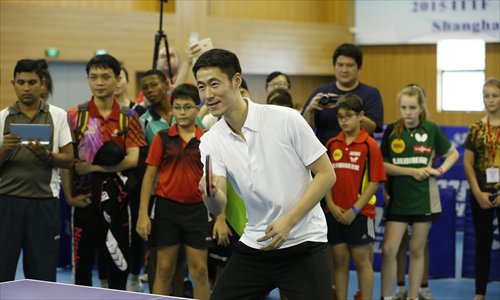
Ping-pong star Wang Liqin demonstrates playing techniques to foreign children.
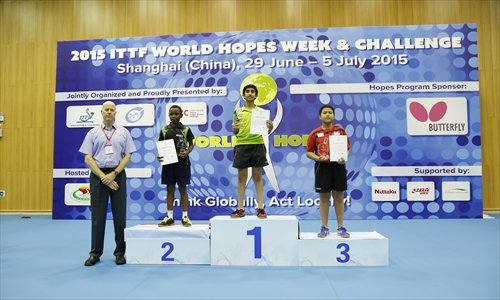
Awards are presented to the most outstanding children after the seven-day training camp.
Photos: Courtesy of Yu Xinpeng
Posted in: Metro Shanghai