HOME >> BUSINESS
Building bridges in Pakistan
By Chu Daye in Islamabad Source:Global Times Published: 2015-7-12 18:38:01
Experts suggest further JVs, exchanges could help China strengthen ties
Experts said that joint ventures and cultural exchanges with Pakistan could help China build up its image, safeguard its investments and ease doubts persisted with "Made in China" in the South Asian country.
Setting up local joint ventures (JVs) and engaging with the Pakistani public will help ensure that China's investment along the China-Pakistan Economic Corridor (CPEC) will reap long-term benefits, industry leaders and academics in Pakistan told the Global Times in mid-June.
The CPEC, which involves a reported $46 billion in investment, is a flagship project of China's "One Belt, One Road" (OBOR) initiative, which refers to the Silk Road Economic Belt and the 21st Century Maritime Silk Road - both were launched by President Xi Jinping in 2013.
Misconceptions about 'Made in China'
Ejaz Hussain, professor at Iqra University and a CPEC researcher, said there are concerns in Pakistan on the qualities of the products made in China but "at least within five years, the public only cares about buying cost-competitive goods."
There are a lot of Chinese-made products that are popular among the Pakistani public, from white goods to motorcycles and from smartphones to furniture, Hussain said.
However, Hussain suggested that the Chinese could engage more personally with Pakistanis to gradually reverse the negative perception about Chinese goods. A similar perception exists for Chinese technology standards, such as construction engineering.
"Pakistan previously had British standards and American standards. Pakistani engineers at first had doubts about Chinese standards," said Ye Chengyin, general manager of the Pakistan branch of China Road and Bridge Corp (CRBC).
CRBC is in charge of the reconstruction and extension of the Karakoram Highway, a 1,200 kilometer artery that connects Northwest China's Xinjiang Uyghur Autonomous Region to northern Pakistan.
Ye said CRBC gradually convinced their Pakistani counterparts to accept the Chinese standards through patient deliberation.
"We invited them to visit construction sites in China to give them a personal feel of what Chinese standards are like and explained to them our specifications. We signed the contract in 2006, but the project started only in 2008 as a whole year was devoted to making supplementary clauses to our specifications. It was a difficult process," Ye told the Global Times.
Ye said many foreigners do not even know that a Chinese standard (for road and bridge construction) exists, let alone taking it as an alternative to the US and European standards.
"If Chinese standard could go out with the implementation of the OBOR initiative, it will increase China's soft power," Ye said, noting that CRRC has taken a leading role in translating Chinese specifications to overcome language barriers.
Ye said the work has already yielded positive results as the Pakistani side has agreed to continue to apply Chinese standards to the second phase of the KKH project.
All the talk about the lack of quality of Chinese work is a misconception, said Khawaja Khawar Rashid, CEO of Lahore Esschem (Pvt) Ltd, a company that trades in chemicals used in cosmetics and materials used to produce whitening creams, shampoos and conditioners. It is based in Lahore, the country's second largest city.
"I visited the furniture city in Foshan, [South China's Guangdong Province], many times. Goods are graded into four different categories. So we should not blame China for the low-quality goods. It is the traders who imported lower-quality goods. Apple's smartphone is manufactured in China; it has no quality problem," he told the Global Times.
Hussain believes the Chinese government should plan to play a bigger role in addressing this perception issue.
"In order to make China more visible in Pakistan, to make China's image more friendly among Pakistanis in the long term, to make Chinese products more available in Pakistan, the Chinese government and companies need to interact with Pakistani people, NGOs, private institutions, and media groups," he said.
"There should be State policies for diplomatic and cultural institutions to interact with Pakistani elite and general masses to further open up to the Pakistanis so that Chinese investment could enjoy more sustainability at the public level," Hussain said.
Joint ventures
Investing in JVs is another effective way to ensure sustainable benefits for the Chinese, experts said.
Tanvir Hussain, CEO of Islamabad-based Limecom (Pvt) Ltd, an outsourcing firm of image and graphic design work, believes Chinese investors should work with local companies.
"The more they insist on being a foreign company, the lesser chances to get responses from the local market. In order to succeed, they have to make partnerships with local entrepreneurs and let the Pakistani partners lead from the front, as this will help project a good image and gain the long-term sustainability for the company," he told the Global Times.
Syed Mahmood Ghaznavi, vice president of the Lahore Chamber of Commerce & Industry, said he has seen an increase in both the scale and frequency of Chinese business delegations visiting his organization after President Xi's state visit to Pakistan in April.
"If you have a JV here, especially in sectors that have raw materials available such as leather and agriculture-based products, the cost of production will be low. And it is easier to export to the Middle East or Central Asian countries," he told the Global Times.
"We have very good dried fruits, but no packaging industry. If you set up a packing plant here, you can send them to Europe. Fruits, vegetables - we can add value to those products," he said.
While most of the current CPEC projects are focused on the infrastructure and energy, the Chinese and Pakistani companies could further cooperate in other sectors, experts said.
As the earlier phases of CPEC projects relieve the ongoing energy crisis of Pakistan, it will bring much needed energy and water [via electricity-powered pumps] to the Pakistan's agricultural sector, Iftikhar Ali Malik, chief executive of Guard Group of Companies (GG), told the Global Times.
GG is a conglomerate whose businesses include everything from cars to agricultural products. One GG subsidiary once cooperated with renowned Chinese scientist Yuan Longping on a strain of hybrid rice.
"Pakistan has very vast rural areas, a suitable climate and low-cost labor. Bilateral efforts could be taken to improve Pakistan's irrigation system, cultivate technologies and farm mechanization to produce fruit such as citrus, mangos and dates. Chinese companies could grow here, and buy back [to sell in their domestic market] and put them in their own network of warehouses. They can also sell the products from here to Southeast Asian countries," Malik said.
He urged the Chinese investors not just throw in their money, but also send in manpower to assist and train their Pakistani partners. Malik urged more youth exchange programs and language schools to bridge language barriers, along with skill development programs for the less-educated rural population.
To promote bilateral exchange, Pakistani Senator Mushahid Hussain Sayed founded the Pakistan-China Institute in 2009. In 2012, he launched youlinmagazine.com, the only website in Pakistan that is written in both English and Chinese.
"This is a very historic opportunity for Chinese companies. The corridor means opening of a new world of opportunities, out at the sea. In a very conducive and receptive environment, our Chinese friends will have a market of 200 million people, of which 65 percent are under the age of 35, with a leading skilled and trained manpower base among developing countries," Sayed said.
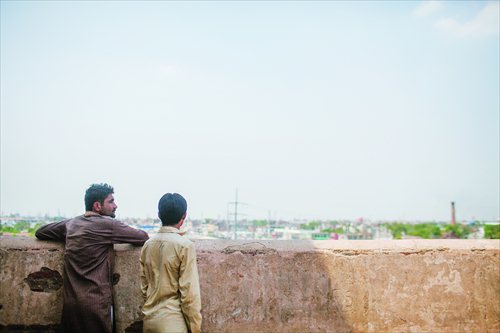
Tourists gaze out over the city from the walls of the Castle Museum in Lahore, Pakistan on June 21. Photo: Li Hao/GT
Setting up local joint ventures (JVs) and engaging with the Pakistani public will help ensure that China's investment along the China-Pakistan Economic Corridor (CPEC) will reap long-term benefits, industry leaders and academics in Pakistan told the Global Times in mid-June.
The CPEC, which involves a reported $46 billion in investment, is a flagship project of China's "One Belt, One Road" (OBOR) initiative, which refers to the Silk Road Economic Belt and the 21st Century Maritime Silk Road - both were launched by President Xi Jinping in 2013.
Misconceptions about 'Made in China'
Ejaz Hussain, professor at Iqra University and a CPEC researcher, said there are concerns in Pakistan on the qualities of the products made in China but "at least within five years, the public only cares about buying cost-competitive goods."
There are a lot of Chinese-made products that are popular among the Pakistani public, from white goods to motorcycles and from smartphones to furniture, Hussain said.
However, Hussain suggested that the Chinese could engage more personally with Pakistanis to gradually reverse the negative perception about Chinese goods. A similar perception exists for Chinese technology standards, such as construction engineering.
"Pakistan previously had British standards and American standards. Pakistani engineers at first had doubts about Chinese standards," said Ye Chengyin, general manager of the Pakistan branch of China Road and Bridge Corp (CRBC).
CRBC is in charge of the reconstruction and extension of the Karakoram Highway, a 1,200 kilometer artery that connects Northwest China's Xinjiang Uyghur Autonomous Region to northern Pakistan.
Ye said CRBC gradually convinced their Pakistani counterparts to accept the Chinese standards through patient deliberation.
"We invited them to visit construction sites in China to give them a personal feel of what Chinese standards are like and explained to them our specifications. We signed the contract in 2006, but the project started only in 2008 as a whole year was devoted to making supplementary clauses to our specifications. It was a difficult process," Ye told the Global Times.
Ye said many foreigners do not even know that a Chinese standard (for road and bridge construction) exists, let alone taking it as an alternative to the US and European standards.
"If Chinese standard could go out with the implementation of the OBOR initiative, it will increase China's soft power," Ye said, noting that CRRC has taken a leading role in translating Chinese specifications to overcome language barriers.
Ye said the work has already yielded positive results as the Pakistani side has agreed to continue to apply Chinese standards to the second phase of the KKH project.
All the talk about the lack of quality of Chinese work is a misconception, said Khawaja Khawar Rashid, CEO of Lahore Esschem (Pvt) Ltd, a company that trades in chemicals used in cosmetics and materials used to produce whitening creams, shampoos and conditioners. It is based in Lahore, the country's second largest city.
"I visited the furniture city in Foshan, [South China's Guangdong Province], many times. Goods are graded into four different categories. So we should not blame China for the low-quality goods. It is the traders who imported lower-quality goods. Apple's smartphone is manufactured in China; it has no quality problem," he told the Global Times.
Hussain believes the Chinese government should plan to play a bigger role in addressing this perception issue.
"In order to make China more visible in Pakistan, to make China's image more friendly among Pakistanis in the long term, to make Chinese products more available in Pakistan, the Chinese government and companies need to interact with Pakistani people, NGOs, private institutions, and media groups," he said.
"There should be State policies for diplomatic and cultural institutions to interact with Pakistani elite and general masses to further open up to the Pakistanis so that Chinese investment could enjoy more sustainability at the public level," Hussain said.
Joint ventures
Investing in JVs is another effective way to ensure sustainable benefits for the Chinese, experts said.
Tanvir Hussain, CEO of Islamabad-based Limecom (Pvt) Ltd, an outsourcing firm of image and graphic design work, believes Chinese investors should work with local companies.
"The more they insist on being a foreign company, the lesser chances to get responses from the local market. In order to succeed, they have to make partnerships with local entrepreneurs and let the Pakistani partners lead from the front, as this will help project a good image and gain the long-term sustainability for the company," he told the Global Times.
Syed Mahmood Ghaznavi, vice president of the Lahore Chamber of Commerce & Industry, said he has seen an increase in both the scale and frequency of Chinese business delegations visiting his organization after President Xi's state visit to Pakistan in April.
"If you have a JV here, especially in sectors that have raw materials available such as leather and agriculture-based products, the cost of production will be low. And it is easier to export to the Middle East or Central Asian countries," he told the Global Times.
"We have very good dried fruits, but no packaging industry. If you set up a packing plant here, you can send them to Europe. Fruits, vegetables - we can add value to those products," he said.
While most of the current CPEC projects are focused on the infrastructure and energy, the Chinese and Pakistani companies could further cooperate in other sectors, experts said.
As the earlier phases of CPEC projects relieve the ongoing energy crisis of Pakistan, it will bring much needed energy and water [via electricity-powered pumps] to the Pakistan's agricultural sector, Iftikhar Ali Malik, chief executive of Guard Group of Companies (GG), told the Global Times.
GG is a conglomerate whose businesses include everything from cars to agricultural products. One GG subsidiary once cooperated with renowned Chinese scientist Yuan Longping on a strain of hybrid rice.
"Pakistan has very vast rural areas, a suitable climate and low-cost labor. Bilateral efforts could be taken to improve Pakistan's irrigation system, cultivate technologies and farm mechanization to produce fruit such as citrus, mangos and dates. Chinese companies could grow here, and buy back [to sell in their domestic market] and put them in their own network of warehouses. They can also sell the products from here to Southeast Asian countries," Malik said.
He urged the Chinese investors not just throw in their money, but also send in manpower to assist and train their Pakistani partners. Malik urged more youth exchange programs and language schools to bridge language barriers, along with skill development programs for the less-educated rural population.
To promote bilateral exchange, Pakistani Senator Mushahid Hussain Sayed founded the Pakistan-China Institute in 2009. In 2012, he launched youlinmagazine.com, the only website in Pakistan that is written in both English and Chinese.
"This is a very historic opportunity for Chinese companies. The corridor means opening of a new world of opportunities, out at the sea. In a very conducive and receptive environment, our Chinese friends will have a market of 200 million people, of which 65 percent are under the age of 35, with a leading skilled and trained manpower base among developing countries," Sayed said.
Posted in: Insight