Inside look
Exhibition charts working process of one of the world’s most innovative design firms
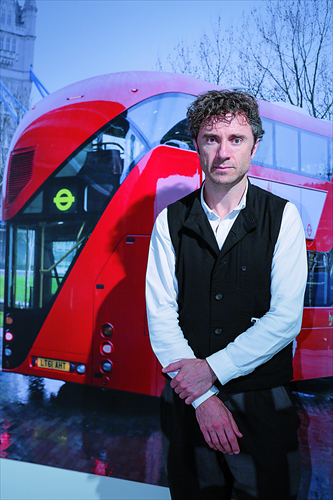
While Thomas Heatherwick (pictured below) may not be a household name, the architect's design studio has been responsible for some of the most recognizable, and talked-about, buildings of the past decade.
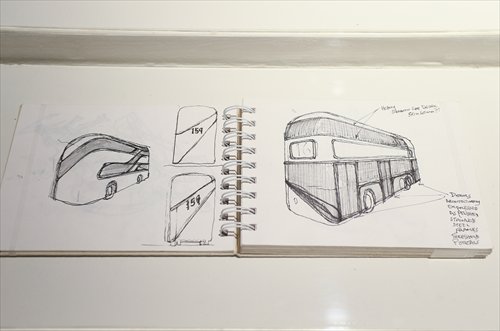
Some of the sketches from the exhibition The exhibition presents about 30 large and small key projects selected from a rich and expansive portfolio of works by Heatherwick Studio. Photos: Courtesy of British Consulate General Shanghai
Be it the giant fuzzy cube of the UK Pavilion at the World Expo 2010 in Shanghai, or the petal-like copper sculptures forming the Olympic Cauldron at the 2012 Summer Olympics in London, one thing is for sure: the creator has the pioneering, out-of-the-box talent to stun.
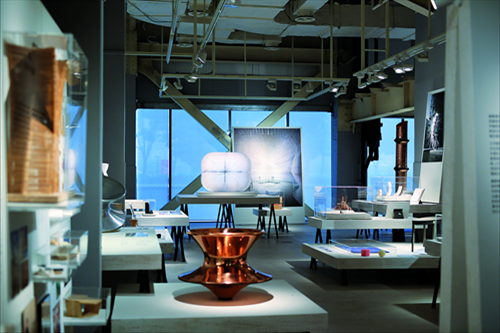
The New British Inventors: Inside Heatherwick Studio at the Power Station of Art until August 8 takes visitors behind the scenes of the studio and charts the rigorous process of critical thinking and questioning that goes into each of the designs.
The exhibition is split into three sections, "Thinking," "Making" and "Storytelling," presenting about 30 large and small key projects selected from a rich and expansive portfolio of works including architecture, urban infrastructure and furniture.
Commitment to innovation
Exhibition curator Kate Goodwin, Drue Heinz Curator at the Royal Academy of Arts, said it is rare for a design studio to break boundaries and cover such a diversity of areas.
"What is also interesting is that they approach these very different projects with a very similar way of thinking," Goodwin said, calling attention to the studio's profound commitment to finding innovative design solutions, and a dedication to artistic thinking and the latent potential of materials and craftsmanship.
Major architecture projects on display include the Learning Hub Singapore for Nanyang Technological University, which was completed this March. Twelve stacks of classrooms, interspersed with gardens, rise around a naturally ventilated central atrium.
"To create an environment to learn, the studio wants to break down hierarchies," Goodwin explained. "It is not teachers standing lecturing, but a round room that brings teachers and students together."
The exhibition includes full-scale models detailing parts of some of the projects - one of the Learning Hub's concrete sculptures stands tall and beautiful, allowing visitors to appreciate its quality up close.
In terms of urban design, there is a model of the Rolling Bridge that spans an inlet of the Grand Union Canal at Paddington Basin, London. With kinetic movements at the heart of the design, the bridge opens by transforming from a conventional, straight bridge into a circular sculpture sitting on the bank of the canal.
Evolving ideas
One of the most fascinating aspects of the exhibition is how it takes us from the inception of ideas through to their realization.
Sketchbooks complementing the models show how the projects were initially conceived - with sketch after sketch made in search of the ideal form, before arriving at the basic form of what we finally see.
Of the studio's efforts in furniture and product design, Spun Chair stands out. It started with the aim of making an unconventional chair, and the outcome succeeds in its aim - a startling yet functional chair of molded plastic in the shape of a sculptural vessel that can rock side to side or spin around.
"Thomas then developed it by trying different colors and materials, so that anyone can buy it," Goodwin said. "The idea is never static, it always goes to the next level."
The same goes for Expanding Rug, which can change form and size when pushed and pulled, and is conveniently portable. Heatherwick applied a similar idea and technique to dining ware. Examples of both designs can be handled at the exhibition.
Local interest
The exhibition also provides something of particular interest to local visitors - a model of the Bund Finance Center, which will be completed by the end of next year. The mixed-used destination has been conceived as a point of connection between the old town, the Bund, and the city's new financial centers.
The model of the flexible arts and cultural center that will be at the heart of the multifunctional scheme is eye-catching.
Clearly inspired by traditional Chinese theater stages, it combines exhibition and event halls with an open performance venue.
"In filling this last empty site on Shanghai's famous Bund, the concept is inspired by China's ambition not to duplicate what exists in the rest of the world but to look instead for new ways to connect with China's phenomenal architectural and landscape heritage," Heatherwick told the Architect, the journal of the American Institute of Architects.
Date: Until August 8, 11 am to 7 pm (closed Mondays)
Venue: Power Station of Art
Address: 200 Huayuangang Road
花园港路200号
Admission: Free
Call 3110-8550 for details