HOME >> LIFE, METRO BEIJING
‘Space out’ competition encourages slow living
Source:Global Times Published: 2015-7-13 22:18:01
International event draws daydreamer crowd
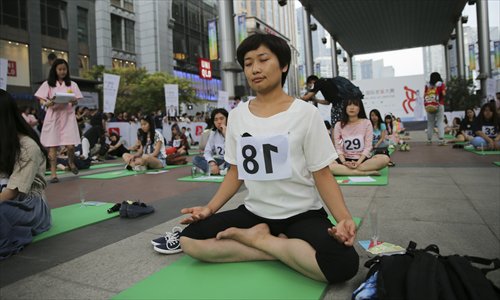
The space out competition is making people in China consider the importance of slowing down. Photo: CFP
Eighty people sat in The Place, a shopping street near China World Trade Center in downtown Beijing, 'spacing out' with zombie-like expressions and strange postures.Donning costumes like a cartoon kung fu bear, white collar outfits, and student uniforms, people from different walks of life gathered and immersed themselves in complete nothingness. There was no posting WeChat moments, no cell phone calls, no chatting, and no laughing or even listening to music.
This was the second International Space Out Competition held in Beijing on July 4. Judges looked for those who not only could zone out for the longest amount of time, but exhibited the best "mental state."
Professional nurses tested participants' heart rates. Those with a fast heart rate were out.
The more zombie-like one looked also counted towards the final vote, and this was decided by onlookers.
As distracted participants dropped out of the race one after another, the competition approached its ending with only less than half of the participants left.
Two hours later, Xin Shiyu, a recent college graduate, won the championship.
Xin told reporters the key to his success was that his normal pace of life is very slow, and he liked to get lost in his own world.
Woops Yang, a South Korean artist and the initiator of the International Space Out Competition, first proposed the event in Seoul last year with the intention of promoting stress-relief from fast-paced city life.
Yang told thepaper.cn, a news website, that "the stress of the artist lies in that when they have a job to do, they feel they are not making much progress, and when they don't have any jobs to do, they feel insecure. With this competition, people can build a legitimate reason [for their spacing out] without feeling insecure."
The competition is causing hot discussion on the Internet, but critics of the competition felt like it had little to do with "slowing down," but was simply an eye-catching show.
Feng Yongxi, the director of Shanghai Psychological Society, said the competition itself may seem a bit weird, but it definitely expressed the idea of the importance of a"slow-paced life" and raised people's awareness of letting go of pressures and reflecting on their own lives.
Carl Honoré, a Canadian journalist who wrote the internationally best-selling book In Praise of Slowness: How A Worldwide Movement Is Challenging the Cult of Speed, said in his book that slow-paced life does not equal laziness or constantly delaying your schedules. Slow is an attitude, a personal choice, and a mentality that reflects nature. Whether the "slow-paced life" will become the new trend, however, is not decided or influenced by personal willingness, but rather the general social atmosphere and job environment.
Xia Xueluan, a professor in the social studies department at Peking University shared Feng and Honoré's opinion and said that slow-paced life in China has new meaning.
"The space out competition is a new trial under the rapid economical development period of China when people are constantly under huge pressure," said Xia, adding that spacing out helps to relieve stress and get rid of the unhealthy depressors piled in people's minds. "From a social development angle, this new form of slow activity will make people's life more sensible and humane."
Yang said she plans to host a third competition and hopes that this time the location would be Hong Kong, another world-class metropolitan city where the pace of life is very fast.
"Some neurologists suggest that spacing out can develop creativity, just like doing brain stretching or light exercise," Yang said. "If it's possible, people can do it together to make it more interesting, so don't wait and start hanging out, spacing out ."
Posted in: Intel