HOME >> METRO SHANGHAI
The flaneur of Shanghai
By Qi Xijia Source:Global Times Published: 2015-7-20 18:53:01
What comes to mind when you think of the enchanting word "flaneur?" Perhaps a gentleman stroller of the streets, umbrella under arm, contemplatively admiring the architecture and life around him? Or an intrepid urban explorer, nose in the wind, letting imagination carry him away?
With these possibilities in mind, a local community service, Shanghai Flaneur, has taken the concept of flaneur, a French word translated as "stroller," to its most literal roots, "using walking as a methodology to transfer knowledge, stimulate creativity, create local awareness and encourage open-mindedness," the service says on its website.
Discussions with experts on local architecture, history and culture are an integral part of these tours. The service's most recent tour was a Bund Walk led by urban planning and sociology scholar Peter Hibbard.
Hibbard was the Visiting Scholar at the University of Hong Kong's Centre of Asian Studies in 1985/86, and lectured in tourism studies in Beijing before moving to Shanghai in 1991. The Englishman has devoted much of his life to researching the historical development of Shanghai and concerns himself with promoting awareness and understanding of Shanghai's unique historical inheritance.
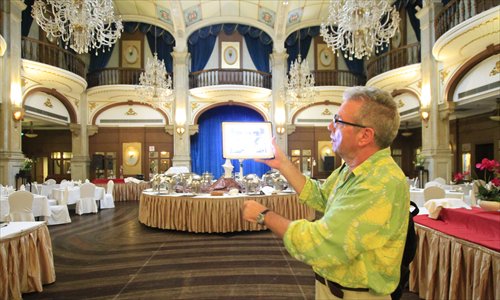
The first stop on Hibbard's 3-hour-long Flaneur tour, the Astor House Hotel, was also his first destination after arriving in the city in the 80s, the beginning of his 6-month trip across China. "At that time Astor House was just a backpackers' hotel - I stayed in one of the dormitory rooms with 17 other males - but it was once the finest hotel in Asia," said Hibbard.
"The first thing I did then was take a walk along the Bund. It was dark. It was gray. I was followed around by hundreds of locals. You couldn't get into many Chinese buildings, but you could get into the Peace Hotel. I walked in there and that changed my life. I've never seen a finer hotel. I needed to know more. That's the story of how it begins," said Hibbard.
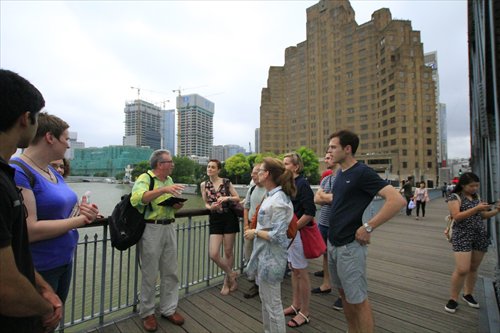
We then crossed the Garden Bridge, Shanghai's first all-steel bridge opened in 1908 and the only remaining camelback truss bridge in China, to Huqiu Road. What was called Museum Road in the 19th century, present-day Huqiu Road still offers some of Shanghai's most magnificent historical architecture, all concentrated in a single 5-minute saunter.
Hibbard explained to us the street's four heritage sites, including the Capitol Theatre, designed by C.H.Gonda, the Christian Literature Society Building built in 1933, the Youth Association Building built in 1919, and the North China Branch of the Royal Asiatic Society designed by Palmer & Turner.
The tour then arrived at the landmark Peace Hotel, the location of some of Shanghai's most iconic colonialists. The North Building was originally constructed as Sassoon House by Sir Victor Sassoon, a British Sephardic Jew of Iraqi origin. The famous Sassoon family dominated Shanghai business and real estate in the early 20th century. Hibbard led the tour to the ballroom where Sir Victor used to throw his legendary parties. The tales Hibbard told are the stuff of Hollywood and novels.
"I decided in 1983 that I wanted to become an expert of the China travel industry," Hibbard told the Global Times following his tour. "The link between Shanghai and China's travel industry is great; all the finest hotels have been here. That's how I became interested in the urban development of Shanghai."
"Peter has so many fantastic stories about this city," said Mia Urbano, a tour attendee who was visiting Shanghai on holiday. "The information behind these façades is very interesting."
Hibbard also shared with the Global Times his ideas and hopes as to how the Bund area may develop in the future. "Generally I am not pleased with how the buildings are preserved. I regard painting over the original bricks to make it look new as not the right practice. I don't think it is right to disguise the history of a building. The history should show through," said Hibbard.
The British flaneur is also the author of several locally published books about Shanghai, including a reprint of the classic 1930s guidebook All About Shanghai and Environs, published by Earnshaw Books, and The Bund Shanghai: China Faces West, which was published in 2007 by Odyssey Illustrated Guides. Hibbard said that he uses the Flaneur tours as an opportunity to gather materials such as photos for a forthcoming new edition of the Bund book.
Shanghai Flaneur is a locally registered service operated by consulting agency Constellations, a wholly foreign-owned enterprise from Shanghai co-owned by Katja Hellkoetter and Magali Menant. To join one of their public walks, which cost 300 yuan ($48.33) per person, contact the organizers through their website.
On August 28, Hibbard will be hosting a new Flaneur walkabout of Shanghai, this time focusing specifically on the city's most beloved diversions throughout its glamorous history: cars, high fashion and clubs.
With these possibilities in mind, a local community service, Shanghai Flaneur, has taken the concept of flaneur, a French word translated as "stroller," to its most literal roots, "using walking as a methodology to transfer knowledge, stimulate creativity, create local awareness and encourage open-mindedness," the service says on its website.
Discussions with experts on local architecture, history and culture are an integral part of these tours. The service's most recent tour was a Bund Walk led by urban planning and sociology scholar Peter Hibbard.
Hibbard was the Visiting Scholar at the University of Hong Kong's Centre of Asian Studies in 1985/86, and lectured in tourism studies in Beijing before moving to Shanghai in 1991. The Englishman has devoted much of his life to researching the historical development of Shanghai and concerns himself with promoting awareness and understanding of Shanghai's unique historical inheritance.
The first stop on Hibbard's 3-hour-long Flaneur tour, the Astor House Hotel, was also his first destination after arriving in the city in the 80s, the beginning of his 6-month trip across China. "At that time Astor House was just a backpackers' hotel - I stayed in one of the dormitory rooms with 17 other males - but it was once the finest hotel in Asia," said Hibbard.
"The first thing I did then was take a walk along the Bund. It was dark. It was gray. I was followed around by hundreds of locals. You couldn't get into many Chinese buildings, but you could get into the Peace Hotel. I walked in there and that changed my life. I've never seen a finer hotel. I needed to know more. That's the story of how it begins," said Hibbard.
We then crossed the Garden Bridge, Shanghai's first all-steel bridge opened in 1908 and the only remaining camelback truss bridge in China, to Huqiu Road. What was called Museum Road in the 19th century, present-day Huqiu Road still offers some of Shanghai's most magnificent historical architecture, all concentrated in a single 5-minute saunter.
Hibbard explained to us the street's four heritage sites, including the Capitol Theatre, designed by C.H.Gonda, the Christian Literature Society Building built in 1933, the Youth Association Building built in 1919, and the North China Branch of the Royal Asiatic Society designed by Palmer & Turner.
The tour then arrived at the landmark Peace Hotel, the location of some of Shanghai's most iconic colonialists. The North Building was originally constructed as Sassoon House by Sir Victor Sassoon, a British Sephardic Jew of Iraqi origin. The famous Sassoon family dominated Shanghai business and real estate in the early 20th century. Hibbard led the tour to the ballroom where Sir Victor used to throw his legendary parties. The tales Hibbard told are the stuff of Hollywood and novels.
"I decided in 1983 that I wanted to become an expert of the China travel industry," Hibbard told the Global Times following his tour. "The link between Shanghai and China's travel industry is great; all the finest hotels have been here. That's how I became interested in the urban development of Shanghai."
"Peter has so many fantastic stories about this city," said Mia Urbano, a tour attendee who was visiting Shanghai on holiday. "The information behind these façades is very interesting."
Hibbard also shared with the Global Times his ideas and hopes as to how the Bund area may develop in the future. "Generally I am not pleased with how the buildings are preserved. I regard painting over the original bricks to make it look new as not the right practice. I don't think it is right to disguise the history of a building. The history should show through," said Hibbard.
The British flaneur is also the author of several locally published books about Shanghai, including a reprint of the classic 1930s guidebook All About Shanghai and Environs, published by Earnshaw Books, and The Bund Shanghai: China Faces West, which was published in 2007 by Odyssey Illustrated Guides. Hibbard said that he uses the Flaneur tours as an opportunity to gather materials such as photos for a forthcoming new edition of the Bund book.
Shanghai Flaneur is a locally registered service operated by consulting agency Constellations, a wholly foreign-owned enterprise from Shanghai co-owned by Katja Hellkoetter and Magali Menant. To join one of their public walks, which cost 300 yuan ($48.33) per person, contact the organizers through their website.
On August 28, Hibbard will be hosting a new Flaneur walkabout of Shanghai, this time focusing specifically on the city's most beloved diversions throughout its glamorous history: cars, high fashion and clubs.
The Shanghai Flaneur group crosses the Garden Bridge on the Bund Sunday.
Peter Hibbard shows old photos at Astor House Hotel to participants of the walking tour.
Photos: Qi Xijia/GT
Posted in: Metro Shanghai