HOME >> METRO SHANGHAI
Shanghai summer
By Du Qiongfang Source:Global Times Published: 2015-7-22 19:18:01
For foreign students in Shanghai, a long vacation from school can be a great opportunity to further improve their Putonghua skills while learning more about Chinese society and its people.
This summer, Mandarin Garden, one of the largest Chinese training schools in Shanghai, organized a summer camp to introduce young foreigners to Chinese language and culture. The camp, which has been operating for over a decade, offers a variety of language learning courses and cultural activities, with over 1,300 children and teenagers from 50 countries attending in 10 years.
The little expats spend their summer in a purely Putonghua environment, which organizers say is more effective in exposing them to the many nuances of the language while also broadening their horizons to a variety of Chinese customs.
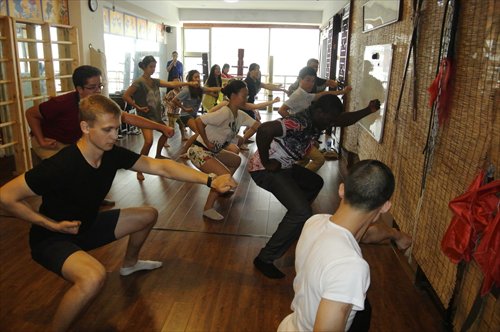
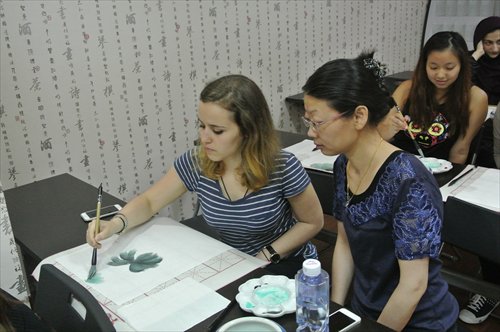
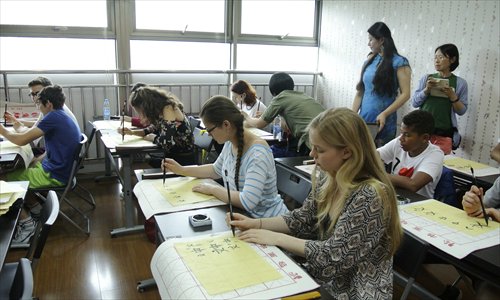
The courses, which began in June and will complete in late August, include reading and listening classes during the mornings, and cultural activities held at the center in the afternoons covering a range of themes and topics, such as poetry and songs, painting and calligraphy, and tea ceremony.
Students also visit local museums and parks, including field trips to Shanghai Museum, Shanghai Science and Technology Museum, Yuyuan Garden, the Bund, Shanghai Zoo and People's Park, to know more about the history and development of the city. These excursions also allow children the chance to put their newfound language skills to use during their many encounters with locals.
Zhang Yan, one of the camp's teachers, has five students aged between 8 and 17 from France, the US, Thailand and Singapore. She teaches them Chinese reading in the morning and arranges afternoon cultural activities with related content.
"Most of our teaching content is decided by the students and their parents. If the students want to improve their oral Chinese, for example, I will keep talking with them to help them practice," said Zhang. "Our conversations cover a large range of topics including daily life and social networking."
For native English-speaking students with poor Chinese abilities, Zhang also employs the use of English, but for students from non-English-speaking countries, the summer camp promotes "no media language teaching," requiring teachers to utilize situational teaching methods and role playing.
Among Zhang's students, two boys aged 11 and 13 from Singapore and one 8-year-old girl from the US all have basic Chinese language skills. Their parents hope the children will spend their days at camp practicing oral Putonghua and learning to write hanzi (Chinese characters). Zhang said she primarily uses pictures to illustrate a phrase then asks her students to draw pictures to illustrate what they have learned.
"When their vocabulary is large enough, I let one student draw a picture and ask another to guess the character or phrase," said Zhang, who thinks the key to mastering a foreign language is to actually use the language.
Since the students are all from different countries, there are many culture differences among them. "The most significant aspect of our camp is to teach the students how to get along well with people from other cultural backgrounds," said Zhang.
Nineteen-year-old Sali Dai comes from the US and has been in China for almost two months, including five weeks at the Mandarin Garden camp. Prior to arriving, she could only say "nihao" (hello), but over the course of camp she learned enough of the language that she can now venture out into the city on her own for shopping or day trips.
"I learned about Shanghai, the culture and ancient stuff like poems," said Dai, who mentioned that it was her father's idea to attend a Chinese summer camp. "It's helpful for when I have to get out and speak more Chinese."
Zhao Min has been teaching at Mandarin Garden since last year. Currently she is teaching two French brothers aged 13 and 17 and is impressed with their sense of independence.
"I don't make teaching plans for the afternoon outdoor activities. Foreign children tend to make those decisions by themselves, so I just follow their wills and guide them. It is more fun that way. I think becoming familiar with Chinese culture and society is just as important as learning the language," said Zhao.
During their field trips, Zhao urges the students to apply the language they have learned to practical use in daily life situations. She said she has the students count numbers in Chinese and identify Chinese bank notes when they purchase metro or public bus tickets to their destinations.
"It's a vivid experience for them," said Zhao.
This summer, Mandarin Garden, one of the largest Chinese training schools in Shanghai, organized a summer camp to introduce young foreigners to Chinese language and culture. The camp, which has been operating for over a decade, offers a variety of language learning courses and cultural activities, with over 1,300 children and teenagers from 50 countries attending in 10 years.
The little expats spend their summer in a purely Putonghua environment, which organizers say is more effective in exposing them to the many nuances of the language while also broadening their horizons to a variety of Chinese customs.
The courses, which began in June and will complete in late August, include reading and listening classes during the mornings, and cultural activities held at the center in the afternoons covering a range of themes and topics, such as poetry and songs, painting and calligraphy, and tea ceremony.
Students also visit local museums and parks, including field trips to Shanghai Museum, Shanghai Science and Technology Museum, Yuyuan Garden, the Bund, Shanghai Zoo and People's Park, to know more about the history and development of the city. These excursions also allow children the chance to put their newfound language skills to use during their many encounters with locals.
Zhang Yan, one of the camp's teachers, has five students aged between 8 and 17 from France, the US, Thailand and Singapore. She teaches them Chinese reading in the morning and arranges afternoon cultural activities with related content.
"Most of our teaching content is decided by the students and their parents. If the students want to improve their oral Chinese, for example, I will keep talking with them to help them practice," said Zhang. "Our conversations cover a large range of topics including daily life and social networking."
For native English-speaking students with poor Chinese abilities, Zhang also employs the use of English, but for students from non-English-speaking countries, the summer camp promotes "no media language teaching," requiring teachers to utilize situational teaching methods and role playing.
Among Zhang's students, two boys aged 11 and 13 from Singapore and one 8-year-old girl from the US all have basic Chinese language skills. Their parents hope the children will spend their days at camp practicing oral Putonghua and learning to write hanzi (Chinese characters). Zhang said she primarily uses pictures to illustrate a phrase then asks her students to draw pictures to illustrate what they have learned.
"When their vocabulary is large enough, I let one student draw a picture and ask another to guess the character or phrase," said Zhang, who thinks the key to mastering a foreign language is to actually use the language.
Since the students are all from different countries, there are many culture differences among them. "The most significant aspect of our camp is to teach the students how to get along well with people from other cultural backgrounds," said Zhang.
Nineteen-year-old Sali Dai comes from the US and has been in China for almost two months, including five weeks at the Mandarin Garden camp. Prior to arriving, she could only say "nihao" (hello), but over the course of camp she learned enough of the language that she can now venture out into the city on her own for shopping or day trips.
"I learned about Shanghai, the culture and ancient stuff like poems," said Dai, who mentioned that it was her father's idea to attend a Chinese summer camp. "It's helpful for when I have to get out and speak more Chinese."
Zhao Min has been teaching at Mandarin Garden since last year. Currently she is teaching two French brothers aged 13 and 17 and is impressed with their sense of independence.
"I don't make teaching plans for the afternoon outdoor activities. Foreign children tend to make those decisions by themselves, so I just follow their wills and guide them. It is more fun that way. I think becoming familiar with Chinese culture and society is just as important as learning the language," said Zhao.
During their field trips, Zhao urges the students to apply the language they have learned to practical use in daily life situations. She said she has the students count numbers in Chinese and identify Chinese bank notes when they purchase metro or public bus tickets to their destinations.
"It's a vivid experience for them," said Zhao.
Young expats learn calligraphy and other Chinese arts at a Chinese camp organized by Mandarin Garden. Photos: Courtesy of Mandarin Garden
Posted in: Metro Shanghai