HOME >> METRO SHANGHAI
Shanghai Tango
Source:Global Times Published: 2015-7-27 18:43:01
As Shanghai's notoriously intense summer heats up, so too does the city's multicultural festivities and dance competitions. As far as dancing, it doesn't get any hotter than the tango, as witnessed recently during the Fifth Shanghai International Tango Festival.
Originating in 1800's Argentina, over the centuries the tango has become one of the world's most beloved dance forms, culminating in its 2009 inclusion on the UNESCO List of Intangible Cultural Heritage.
Latin origins notwithstanding, the tango's popularity permeated China's borders as far back as the arrival of Shanghai's earliest Argentinean expats, eventually becoming a time-honored pastime among the city's multinational and local populous.
"In my opinion, the tango can be described as gaodashang (literally 'high-class')," said a Taiwanese dancer surnamed Lin in attendance at the festival at the Fairmont Peace Hotel. With the dual intention of acquiring musical expertise and keeping fit, Lin found his attitudes toward life have also developed along with his tango skills. "Hopefully I'll stick to this graceful sport until I'm too old to stand up."
Li, a middle-aged Shanghainese tango dancer, told the Global Times that the tango has become a "lingua franca" that bridges the world. "The influence of tango goes far beyond the dancing venue. My communication with Argentinean teachers enables me to learn something abstract - the thinking mode of Argentineans," he said.
According to dance scholars, the tango is said to have originated from the ceremonies of African slaves quartered in Argentina and Uruguay in the 19th century. In time, the dance was co-opted by South American high society before eventually migrating to 20th century Europe, where it was set to fashionable ethnic music.
Due to the close chest-to-chest proximity between tango dancers, it is considered a sexually charged dance, often raising eyebrows among conservative traditionalists. Nonetheless, the tango has transcended time and geography, spawning numerous location-based styles as well as its own universal idiom, "It takes two to tango."
The International Tango Festival in Shanghai coincides with the famous Tango Buenos Aires Festival in Argentina, which is considered the world's biggest tango extravaganza.
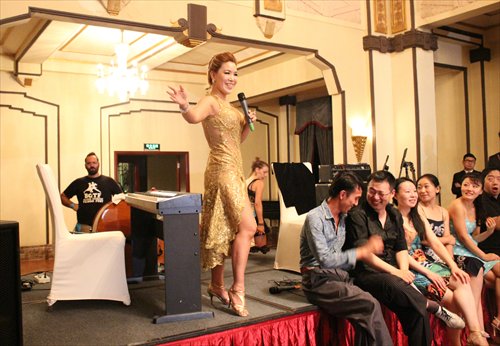
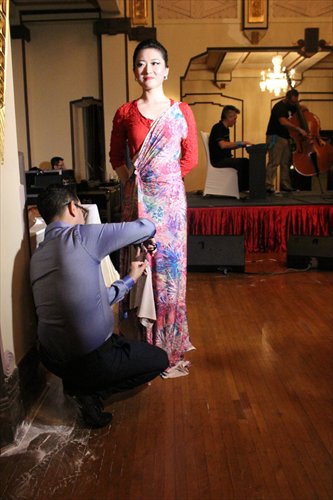
Following a speech by a consul of the Consulate General of the Argentine Republic in Shanghai, the festival's final performance was delivered by Vivian Yeh, a tango teacher from Taiwan and founder of the TangoBang dance school. The audience was also treated to the art of tango costume-designing by designer Walter Delgado.
"Learning and practice makes a good dancer. As time has elapsed, it suddenly dawned on me that tango is not for showing off. Instead, it is an internalized process," Li told the Global Times.
Global Times
Originating in 1800's Argentina, over the centuries the tango has become one of the world's most beloved dance forms, culminating in its 2009 inclusion on the UNESCO List of Intangible Cultural Heritage.
Latin origins notwithstanding, the tango's popularity permeated China's borders as far back as the arrival of Shanghai's earliest Argentinean expats, eventually becoming a time-honored pastime among the city's multinational and local populous.
"In my opinion, the tango can be described as gaodashang (literally 'high-class')," said a Taiwanese dancer surnamed Lin in attendance at the festival at the Fairmont Peace Hotel. With the dual intention of acquiring musical expertise and keeping fit, Lin found his attitudes toward life have also developed along with his tango skills. "Hopefully I'll stick to this graceful sport until I'm too old to stand up."
Li, a middle-aged Shanghainese tango dancer, told the Global Times that the tango has become a "lingua franca" that bridges the world. "The influence of tango goes far beyond the dancing venue. My communication with Argentinean teachers enables me to learn something abstract - the thinking mode of Argentineans," he said.
According to dance scholars, the tango is said to have originated from the ceremonies of African slaves quartered in Argentina and Uruguay in the 19th century. In time, the dance was co-opted by South American high society before eventually migrating to 20th century Europe, where it was set to fashionable ethnic music.
Due to the close chest-to-chest proximity between tango dancers, it is considered a sexually charged dance, often raising eyebrows among conservative traditionalists. Nonetheless, the tango has transcended time and geography, spawning numerous location-based styles as well as its own universal idiom, "It takes two to tango."
The International Tango Festival in Shanghai coincides with the famous Tango Buenos Aires Festival in Argentina, which is considered the world's biggest tango extravaganza.
Following a speech by a consul of the Consulate General of the Argentine Republic in Shanghai, the festival's final performance was delivered by Vivian Yeh, a tango teacher from Taiwan and founder of the TangoBang dance school. The audience was also treated to the art of tango costume-designing by designer Walter Delgado.
"Learning and practice makes a good dancer. As time has elapsed, it suddenly dawned on me that tango is not for showing off. Instead, it is an internalized process," Li told the Global Times.
Global Times
Vivian Yeh, founder of TangoBang dance school, welcomes participants to the Fifth Shanghai International Tango Festival.
Walter Delgado demonstrates tango costumes design.
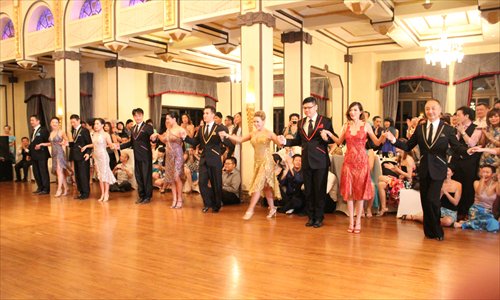
Tango dancers salute to participants.
Photos: Global Times
Posted in: Metro Shanghai