Duang but not forgotten
Group exhibition examines meaning of bad taste and media obsessions
Duang, the word invented by Hong Kong actor Jackie Chan that went viral in March thanks to a parody video, has been appropriated by Pata Gallery for the title of its new exhibition.
Part of the word's mass appeal lies in the lack of a clear definition - it was used by Chan in a commercial to describe the refreshing effect of the shampoo he was plugging.
While its meaning remains hard to pin down, its popularity iss the byproduct of poking fun at Chan's seemingly pathological willingness to put his face to any product promotion.
Similarly, the core spirit of the new exhibition is one of poking fun in a joyous manner.
Zoe Chang, the exhibition's curator, told the Global Times that the exhibition revisits the concept of e quwei ("bad taste"), which usually refers to parody and camp culture.
"People often connect the concept to vulgar images and the like, but I don't think it is a deliberate attempt to be lowbrow," Chang said. "Instead, it represents the fun-seeking lifestyle of those born in and after the 1980s. It is an attitude revolving around ridicule and irony, often targeting the personal state of the artist himself."
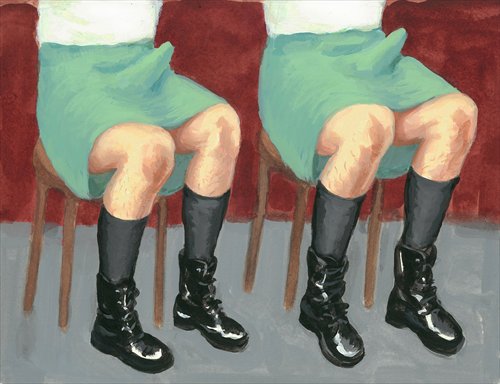
Animated sex
The exhibition begins with Nimue's motion graph pieces (pictured above) - hand-drawn, processed via computer, and displayed on several small LED screens on the wall on the left - that illustrate the sexual and the sensuous in a bold and refreshing way.
Among her cartoonish depictions are a close-up of a couple groping each other's private parts and a posterior made up of two faces sharing a kiss.
"Most Chinese people's idea of e quwei actually comes from Japan, where Nimue lived for many years," Chang said. "She is clearly influenced by the country's animation, and gives a pretty feminine take on eroticism."
Nimue said she wants to discuss human nature through sex because the latter encompasses both physicality and psychology - the connection of the two is of particular interest to her.
She believes discontent and doubt toward reality is at the core of her creations.
"In my works, I usually support the conventionally disadvantaged, out of compassion as well as empathy, and put them at an advantage, having pleasure," Nimue said. "It might encourage viewers to start thinking differently about what they take for granted."
A good example is Coquettishly, in which a girl in a tank top, with her arms behind the back of her head exposes her underarm hair, which grows wild and long at a lightning-fast speed.
Brazenly going against the social pressure for women to remove their underarm hair, the girl expresses an in-your-face confidence.
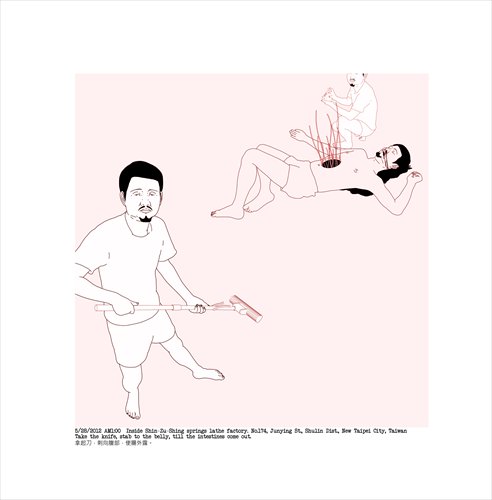
Dramatizing news
In the print onto a cotton canvas series The Black Dahlia (above), Hsu Cheyu depicts violent or bizarre incidents, mostly murders, that caused media sensations in Taiwan.
He based his drawings, most of which economically record the process of a murder, on the content of news reports. Beneath each piece he has written the date and place of the crime. Though in the pictures the victims' injuries are rendered in a surreal manner that renders them less upsetting than they otherwise could be, the pieces still hold a brutality capable of shocking.
Hsu's 2011 video Perfect Suspect also ties in with the news media by mimicking the Apple Daily and Next Media's animated news segments, that illustrate stories of the day with computer-animated characters.
"I attempt to create a mass media scene with real people, fictional figures and myself. This is not a reconstruction of an issue, but a dramatization," Hsu said. "It seems to be a real story in form, but the information cannot be verified. Thus my work is no longer concerning the issue - it focuses on the spectacle that is media."
Chang added that Taiwanese artists had traditionally shown interest in social topics but Hsu's generation (he was born in 1985) differs from those born in the 1950s and 1960s in that they tend not to apply grand narratives in their work.
"This is a trend identifiable in Taiwan as well as on the Chinese mainland and Hong Kong - the artists are not becoming apathetic, but come to develop a less radical and more humorous way of expressing their takes on news events," Hsu said.
"They transfer the social to the personal, and focus on their own thoughts and comments."
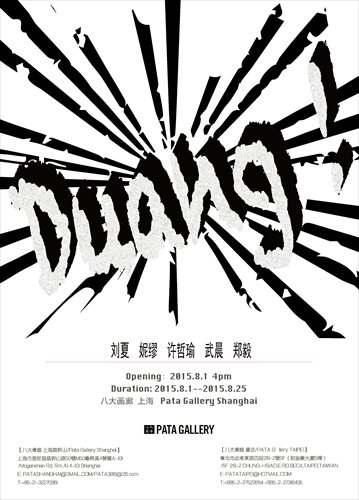
Duang is an exhibition that revisits the concept of bad taste and media obsessions. Photos: Courtesy of Pata Gallery
Scattered installations
Placed here and there between works from different artists without a traceable order or logic are a number of installations by Zheng Yi. Each is contained in a box, an approach Zheng started taking in 2010.
In Box - Breast, Zheng looks at infantilism by collecting 700 rubber nipples. By linking a black tube to the box's bottom, he believes he brings the inner space of the box and the public space together, building a bridge between himself and the viewers.
Box - Martyr is an interesting parody of the nation's classical art, as Zheng arranges the interior of the box according to the commonly seen image in Chinese traditional painting in which a bird rests on a tree branch.
"I put the Chinese traditional art pattern into this box and make a joke of it," Zheng said.
"Birds are the symbol of the painting and they die repeatedly in this pattern."
Date: Until August 25, 10 am to 6 pm (closed Mondays)
Venue: Pata Gallery
Address: Room A-101, Bldg 4, 50 Moganshan Road
莫干山路50号4号楼A-101室
Admission: Free
Call 3227-0361 for details