A journey into mystery
Exploring the culture of Northwest China’s Xinjiang Uyghur Autonomous Region
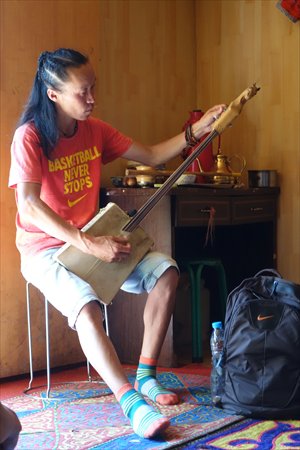
A local Tawa resident plays a traditional instrument. Photo: Hu Qingyun/GT

A tour group takes a boat ride on Kanas Lake. Photo: Hu Qingyun/GT
My journey to explore a mysterious nomad tribe started from a sip of chilled liquor on a hot summer day in Northwest China's Xinjiang Uyghur Autonomous Region.
While I was there, Xinjiang was experiencing its hottest summer in decades. The heat had even reached distant areas like Kanas, where the Mongolian Tuwa tribe lives.
While I sat in a 20-square-meter room in a wooden house in Kanas, a Tuwa woman served me a cup of fermented milk - a traditional way to welcome visitors.
The alcoholic drink was as clear as water and very cold, which was a blessing on such a scorching day.
"Fermented milk is tasty but don't drink too much. After seven or eight cups you won't be able to walk steadily," the woman told me as she smiled.
Even after her warning, I still had a hard time suppressing my desire to ask for more.
While the modern air conditioner wouldn't look out of place in any big city home, the animal furs and leather items hanging on the wall was a reminder that they were still very much living a nomadic lifestyle.
A nomad's tale
China now has some 2,000 Tuwas, who mainly inhabit three villages: Kanas, Hemu and Baihaba. All three are located along the banks of the Kanas Lake in a remote region of the Altai Mountains.
Followers of Tibetan Buddhism and still living a nomadic lifestyle, many village residents still reside in yurts roofed with straw. Their customs are similar to Kazaks and Mongolians. Their main staples are meat and dairy products, such as milk tea and fermented milk.
Although they register as Mongolian for census checks, they have their own dialect and customs. However, as the group has no written language, they lack written historical records, which added an air of mystery to the group.
How the tribe came to live in the area and where they came from remain unknown.
The Tuwas believe that they originated from wounded or old soldiers of Genghis Khan left behind during his expeditions westward. To show respect to Genghis Khan, Tuwas hang his portray on the wall of their houses.
"The history of skiing in China started with our ancestors," a woman from a Tuwa family in Kanas village said while showing me a nearly 2-meter-long pair of skis made of pine wood and covered in fur.
The voice of the Tuwa
Since the tribe passes its history down orally, songs are an important part of their culture.
"The Tuwa people learn to sing as they learn to speak. We are born musicians," Delik, a young man from a Tuwa family, told me proudly.
He then took out a unique musical instrument called suer and started to play a song about a veteran hunter. A suer is a flute-like instrument made from the stalk of a local plant. Since the instrument lacks a reed, a suer player must use his or her tongue as a reed.
"I learned to play the suer six years ago. It took me an entire year to learn how to make any sound," Delik said.
Tuwa musicians can also sing Humai, better known as throat singing, a technique that allows a singer to produce multiple pitches at the same time.
Delik is one of the few people who can play the instrument and throat sing. He told me that he has started to worry that with fewer young people interested in traditional music, the Humai skill and its songs might disappear.
"I've organized a band to perform Tuwa songs and uploaded videos online. I hope it can inspire more young people to join us."
Modern life
While some Tuwa people still make a living herding, some have chosen to settle down, including Delik's family. The six-member family lives in a newly built three-room wooden house and earn a living receiving visitors and introducing their culture.
"Thanks to the development of tourism in Kanas, many people want to visit Tuwa homes and explore Tuwa culture. Our quality of life is improving," a female member of the family told me.
They charge 80 yuan ($12) per person for a home visit. The price includes milk tea, fermented milk, traditional Tuwa snacks and performances by Tuwa musicians.
"We only operate our home visit business three months out of the year since the snow makes it difficult to reach our place. Last year, our family made some 500,000 yuan during those three months," she said.
There are six families in Kanas running this type of home-visit business.
"Together with the Tuwa community, we carefully evaluate these families' qualifications. They have to be knowledgeable about their culture and the desire to carry on their customs," a manager at the Kanas Natural Reserve told me.
Some may worry that tourism might over-commercialize this unique nomadic culture.
"We are a small group of people and used to living isolated lives. These circumstances take away from our ability to pass on our culture. Tourism helps us promote our culture to other parts of the country or even other countries," the female member of the family said.
Even though they run a business, the family has not given up their ancestral way of life. They still own dozens of livestock, which they herd during the off-season.
China's Nessie?
Leaving the Tuwa tribe, I continued my journey of mystery, which took me to Kanas Lake.
The lake, which covers 45 square kilometers and has an average depth of 120 meters, is located in one of the most remote border areas of China, Russia, Kazakhstan and Mongolia.
The color of the lake changes according to the seasons and the weather. In May, the melting snow from the surrounding mountains flows into the lake and the water becomes bluish-grey. As time goes by, the water turns aquamarine and then eventually become turquoise.
This is also the only area where species of Siberian animals and plants can be found in China.
Tuwa residents never let their herds feed by the lakeside, since local belief has it there is a monster living in the lake's blue depths.
According to a Tuwa tale, the huge monster lives in the deep water. Any horse or cattle that drinks at the lakeside will be dragged into the water and swallowed by the monster.
Taking a boat to explore the Kanas Lake, I recalled the excitement I felt during my previous cruise on Loch Ness and hoped I could spot the creature.
Like Nessie, the monster in Kanas has been spotted by some travelers and residents but no one really knows what it is.
The Kanas lake monster was first reported on by Chinese media in 1980. At the time, several local biologists witnessed a 10-meter-long creature floating in the lake which then quickly dived into the water. The scholars suspected that the creature might have been a type of giant fish.
In 2003, several tourists and local officials saw some large unidentified objects swimming quickly through the water and jumping as high as 20 meters above the surface.
One of the latest witness reports took place in June 2012. Some staff at the park witnessed and filmed three huge creatures swimming in the water. They were large enough to cause waves.
Local tour guides and residents say the creature often appears after unusual weather, such as month-long rainy weather.
Some theorize that the monster might actually be some type of rare fish, taimen, or Siberian salmon. The longest captured specimen of this fish was more than 10 meters long. However, all hunting efforts to find this fish in the lake have been in vain so far.
The Tuwas have never believed the fish theory as they think the monster is something else which acts as the area's guardian.
I wasn't lucky enough to see the creature, but maybe you'll have a chance to say hi to the monster if you decide to make the trip.
Rules of thumb
Getting there
The fastest and easiest way to reach Kanas is to take a flight from Urumqi, Xinjiang. The Kanas airport is 50 kilometers away from the park and visitors can take buses to reach the scenic area.
What to do
The best time to visit Kanas is June, July and September when the weather is pleasant and suitable for hiking and boating. Photography and hiking fans can also visit two other scenic areas near Kanas. One is Hemu, which is famous for its forest and the Tuwas' small wooden houses. The other is Baihaba, which is suitable for three- to seven-day hiking tours. If you prefer winter sports, you can also visit Kanas in the winter. Visitors can skate on Kanas Lake, ski down the local mountain paths and wrestle in the snow.
Where to stay
In Kanas, you have many choices for accommodation. For those who want to experience local culture, you can choose a guesthouse run by Tuwa residents, but these guesthouses are limited.