The emperor’s island
Escape to where the Great Wall meets the sea at Qinhuangdao
Located in northeastern Hebei Province, Qinhuangdao is a popular summer tourist destination thanks to its picturesque coastline and string of historical sites and natural scenery. Literally translating to "Qin Emperor Island," the city is named after Qin Shi Huang, China's first Qin Dynasty emperor (221 BC-206 BC).
Legend has it that Emperor Qin arrived at the island on an inspection tour to the East. He sent his followers out to the seashore to seek the gods of immortality and ask them to grant him the elixir of life. Qinhuangdao is the first-and-only city in China to be named after an ancient emperor.
Of course, it is not only the name that makes Qinhuangdao a sought-after summer escape. The city's true attraction lies in its breathtaking seashores featuring gorgeous views, soft golden sand, and a wide variety of water activities.
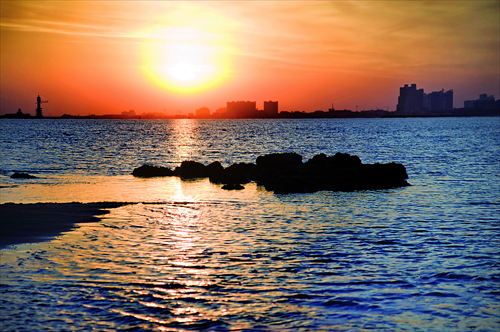
Qinhuangdao is a popular summer tourist destination thanks to its picturesque coastline and string of historical sites and natural scenery. Photos: Yang Zhenqi/GT and CFP
Natural beauty at Beidaihe
One of the best ways to explore the beauty of coastal Qinhuangdao is by visiting the Beidaihe summer resort. Nestled in the city's western region, the nationally renowned seaside resort is home to a winding coastline, pristine beaches, well-facilitated sanitariums and delicious seafood.
It's fun and relaxing to stroll on the soft, pebbled sand along the resort's long coastline and enjoy the sound of the water gently lapping at the seashore. The grand, open seascape will definitely elicit a sense of serenity. If you prefer more physical activities, you can take part in sunbathing, swimming, speedboating and beach volleyball.
There is a plethora of small restaurants and roadside eateries near the resort offering fresh seafood and other delectable grilled foods. Haggling is a must when ordering seafood at these small dining establishments. And don't be afraid to walk from one eatery to another to make comparisons in terms of quality, variety and price.
In addition to its waterfront diversions, Beidaihe offers plenty of other tourist attractions, of which Tiger Stone Park is one of the most popular.
Located at the heart of Beidaihe resort, the park covers an area of 33,000 square meters and is famously home to a vast collection of huge rocks that resemble a herd of tigers.
Apart from the park's lush greenery and the natural wonder of its gigantic rocks, it also has a public bathing place - one of the Beidaihe resort's central bathing areas. Other water activities on offer in the park include parasailing, windsurfing and surfboarding.
Another popular destination in the resort is Dove Nest Park. Situated at the eastern point of Beidaihe, the park is home to hundreds of domesticated pigeons and is particularly famous for the huge stone shaped like an eagle that stands on the seaside cliff. Accordingly, the park is also called Eagle Horn's Park. The stone offers a perfect view of the sunrise if one climbs it early in the morning.
History in Shanhaiguan
If Beidaihe resort is the best place for travelers to enjoy the raw natural beauty of Qinhuangdao, then Shanhaiguan scenic area is ideal for experiencing the city's profound history and rich culture.
Located in the northeast of Qinhuangdao, Shanhaiguan scenic area borders Bohai Sea to the southeast and Yanshan Mountain to the northwest. The name Shanhaiguan can be literally translated to "Mountain and Sea Pass."
Originally built in the Ming Dynasty (1368-1644), Shanhaiguan used to be a military fortress located at the eastern head of the Great Wall. It was widely recognized as the only entrance to Peking and Shengjing (today's Beijing and Shenyang Province). Given its strategic significance in ancient China, the area deserves the title of "the First Pass under Heaven."
Today, Shanhaiguan scenic area is mainly comprised of tourist attractions, including Laolongtou (Old Dragon's Head), the First Pass under Heaven, Jiaoshan Mountain, the Temple of Meng Jiang Nü, Changshou Mountain (the Mountain of Longevity), and Yansai Lake.
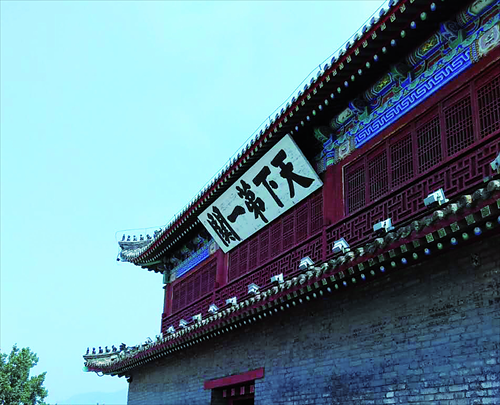
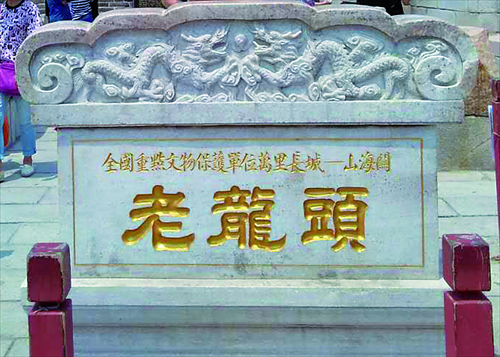
Among these destinations, the First Pass under Heaven (pictured above) and Laolongtou (below) should be at the top of a tourist's agenda. The First Pass under Heaven serves as the eastern gate of the original Shanhaiguan ancient town.
Also known as "Zhendong Tower," the tower is a two-story building that overlooks the Great Wall as it zigzags westward for thousands of miles. On the front of the tower sits a large plaque on which the five Chinese characters for "the First Pass under Heaven" are inscribed.
Laolongtou is nestled at the easternmost point of the Great Wall, which is the meeting place of the Great Wall and Bohai Sea. After ascending Laolongtou's Chenghai Tower, visitors can drink in the majestic view of the rolling sea.
If you are on a tight schedule, taking a stroll along Shanhaiguan scenic area's well-preserved city wall is a good option. Most of the area's stone walls have been carefully restored to their original condition, and they exude a sense of solemnity and grandeur.
Travelers' tips
- Qinhuangdao is about 1,300 kilometers away from Shanghai; it takes travelers approximately 6 hours on a high-speed train to get there. Direct flights between Qinhuangdao and Shanghai are irregular, but train tickets are readily available online seven days a week.
- The city's travel peak season ends in September. Make sure you've booked everything from accommodation to admission tickets before embarking on your journey. Some Chinese travel websites offer discounted ticket packages that cover most of the city's popular destinations.
- During the annual peak tourist season, it is not easy to hail a cab from any of the city's seaside resorts or tourist attractions. To make your trip easier and more enjoyable, booking a car is a good idea. You can rent a sedan from either local private car owners or car companies online for roughly 200 yuan ($31.26) to 400 yuan per day.