China’s sperm banks look to quench thirst online
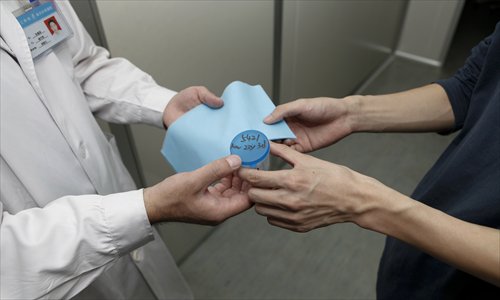
A man hands in his sperm sample at the Henan Human Sperm Bank in Zhengzhou, Henan Province, on September 25, 2013. Photo: CFP
Xiaojiu, a man in his 20s working in Beijing, posted a message on WeChat the other day saying that he just registered online to donate sperm.
"Sperm bank," a term that used to be veiled in mystery and seldom talked about in public (except maybe in jokes), became more intertwined with people's daily lives recently after one of China's largest online shopping platforms began promoting sperm-collecting efforts with an affable campaign.
Several weeks ago, Alibaba's Taobao Marketplace ignited discussion throughout the nation after it kicked off an online registration event for sperm donations with seven sperm banks across the country. In a short period of time, the campaign convinced a huge number of volunteers to register.
"It had an immediate impact," Yue Huanxun, director of the Sichuan Human Sperm Bank, told the Global Times.
"We hope there will be similar campaigns that will inform people and convince them to lend a hand."
DNA drought
During our interview I could see Yue was still not over his excitement about the sharp increase in the number of volunteers. After the online campaign, more than 2,000 netizens registered with Yue's sperm bank in just three days. A huge number compared with the 500 volunteers that had registered over the previous two years.
Besides Sichuan, the other six sperm banks that joined the campaign have experienced similar increases over the past several weeks. In Shanghai, within 72 hours following the online promotion, over 5,000 men registered to donate sperm to the Shanghai Human Sperm Bank through the platform.
"In the past, we mainly went to campuses to look for donors, but most students were too shy to ask for information. This time, in addition to promotions, there was also a guidance platform that provided clear steps. So anyone interested just needed to click their mouse and could avoid an awkward face-to-face inquiry," Yue explained.
This explosion in volunteer numbers will certainly go a long way toward meeting the urgent needs of sperm banks that are suffering from a drought across the nation.
China's first human sperm bank was built in 1981. Now there are 17 of these banks in total. However, it seems that these banks have never once managed to fill their stomachs - announcements that they are short on sperm are not infrequent.
Surfing online reveals advertisements looking for sperm donors are everywhere. Almost all of China's sperm banks have large advertisements on their official Sina Weibo accounts announcing that they are in urgent need of sperm and willing to pay donors.
"Don't waste your tissues anymore!" writes one advertisement.
Take the sperm bank in Sichuan and its low numbers during its trial operation from 2013 to 2014, of the 500 donors it received only 30 percent of collected sperm was viable.
"To make sure sperm can be effective, we have very high and strict standards when it comes to the viability of the sperm that is kept in the bank," Yue explained.
"We just can't keep up with demand currently. Meanwhile, the number of sterile families and demand for donated sperm continues to rise."
Due to the extremely long wait, some families end up turning to the illegal underground sperm trade, which has huge potential risks.
Ethical concerns
Xiaojiu told the Global Times that he had just received a reply from a local sperm bank telling him that he passed his identity check and could go on to examine the viability of his sperm. He had applied to the bank a month ago during the online campaign and was excited to have received the notice.
According to notice, he is supposed to head to the bank for a free checkup, and "to ensure the accuracy of results," he needs to "avoid sexual intercourse for three to seven days." The notice goes on to say this is something he needs to avoid every time he goes to the bank to make a donation.
This is probably the only issue that troubles the young man since he has a steady girlfriend.
"I didn't expect things to be so troublesome," he shared with the Global Times.
"But I don't regret it. If I'm qualified I'd like to donate. For me it's like donating blood. It's amazing that I might be able to help others this way. Just think, a stranger will share my blood."
The online registration provided all the convenience Xiaojiu needed. For many others, it allowed them to avoid embarrassment and made the entire process more acceptable.
However, sperm donation is still not an easy decision to make for many Chinese. According to media reports, most interviewed males have said no to donation, despite the money.
"For many, sperm donation remains something they are shy about or feel is improper," Yue said.
"Besides health concerns, they worry it might lead to problems like incestuous relationships or marriage between close relatives. Or, if the secret gets out, there may be disputes with the receiver's family."
In China, information about sperm donors and recipients are kept confidential. Recipients only know basic information about the donor such as his height, weight, educational background and blood type. This confidentiality is the main reason that many worry about possible ethical problems. What if a donor's daughter marries his son from a different family?
Yue explained that current regulations can help alleviate these worries. According to him, at present, a donor's sperm are distributed to different places (as far away as possible) and can only be used by five women at most. Additionally, one man can only donate to one sperm bank.
"In case they really think that there is the possibility of, say, marriage between a sister and brother, they can apply to have the sperm bank carry out an investigation," Yue said.
In some countries, relevant information is not confidential.
"There has long been discussion about which is more proper. Both have advantages and disadvantages," Yue noted.
"While this can avoid certain ethical problems, it means there may be potential disputes regarding the rights or obligations when it comes to raising a child. Each society chooses what it feels is the most suitable system."
With the glimmer of hope brought by the campaign, Yue said that the key to collecting more sperm lies in informing people.
"Once they understand things and realize there is no mystery, they may decide to take part," Yue noted.
Newspaper headline: Hungry for more