Sensors to help probe bee deaths
Source:AFP Published: 2015-8-25 23:48:01
Global push to understand factors behind mass decline
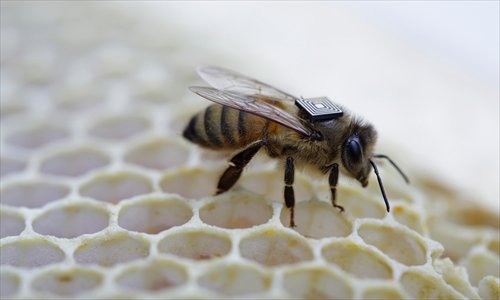
This picture released Tuesday by Australia's national science agency, the Commonwealth Scientific and Industrial Research Organisation, shows a micro-sensor glued onto the back of a honey bee to monitor its movements. Australian scientists revealed on Tuesday they are using micro-sensors attached to honey bees as part of a global push to understand the key factors driving a worldwide population decline of the pollinators. Photo: AFP
Australian scientists revealed Tuesday they are using micro-sensors attached to honey bees as part of a global push to understand the key factors driving a worldwide population decline of the pollinators.
There has been a sharp plunge in the population of honey bees, which pollinate about 70 percent of global crops, or one-third of food that humans eat including fruits and vegetables, raising fears over food security.
Researchers have said the falling hive numbers were caused by threats such as the sudden death of millions of adult insects in beehives -known as "colony collapse disorder" - a blood-sucking mite called Varroa, pesticides and climate change.
"The micro-sensors that we are using help us to ask different questions that we couldn't ask before because we've never really been able to quantify the behavior of bees both out in the environment and in their hives," Gary Fitt from Australia's national science agency CSIRO told AFP.
The sensors, 2.5 millimeters in width and breadth and weighing 5.4 milligrams - lighter than pollen that bees collect - are glued to the back of European honey bees. Sophisticated data collection receptors are also built into hives.
The CSIRO, working together with US technology firm Intel and Japanese conglomerate Hitachi, is now offering free access to the sensor technology and data analytics to identify global patterns.
"What we are gathering with the sensors is environmental information from where the bees have been," said Fitt, the science director of the CSIRO's health and biosecurity division.
"It tells us about their changes in behavior - how often and how long they're foraging, whether they're feeding, whether they're collecting pollen, what they're doing in hives.
"We can then see if we can interpret those changes to tell us how they are responding to different stresses."
About 10,000 bees and their hives in the southern island state of Tasmania have been tagged, with others set to be monitored in the cities of Sydney and Canberra. Around the same number of bees in Brazil were also being monitored, with interest expressed from scientists in Europe and North America, Fitt said.
In the US, beekeepers lost 42 percent of colonies over the 12 months to May this year, the second-worst year on record, the US Department of Agriculture has estimated.
Posted in: Biology, Cross-Borders