Calligraphy without characters
Exhibition seeks to trace line of abstraction through China’s historical art form
Although abstract art is a Western form that was first introduced into China during the period of the Republic of China (1912-49), and later saw a resurgence in the 1980s, affinities with the form can be found further back in the country's art history.
This can be seen in ornamental stones, the more abstract ink-wash paintings, the sparse sets of traditional operas, and perhaps most of all, in calligraphy, which began at the end of the Eastern Han (25-220) and blossomed in the period between the Han (206BC-AD220) and Tang (618-907) dynasties.
The current exhibition Calligraphic Time and Space: Abstract Art in China at the Power Station of Art explores the relationship between traditional calligraphic aesthetics and contemporary abstract art.
The exhibition does not focus on calligraphy itself, but rather on calligraphy's strong bonds with Chinese abstract art.
Setting aside calligraphy's function, the exhibition concentrates on the visual features and inner power of the calligraphic aesthetics that helped inform the direction of Chinese abstract art.
"The theme of this exhibition is not the calligraphic but the potential of Chinese abstract art. I think it's time that we liberate Chinese abstract art from the duplication and continuance of Western abstractionism. I think calligraphy provides a direction for doing this," the curator of the exhibition, Li Xu, told the Global Times.
The exhibition brings together 66 projects and a total of 174 works covering watercolor, oil painting, sculpture, installation, photography and video.
The most notable feature of the pieces is how they draw on traditional Chinese philosophies and art movements such as Taoism.
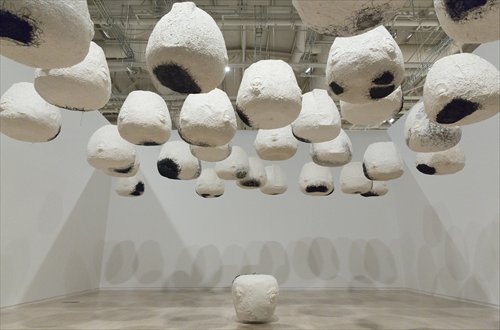
Suspending Foundation Stones (pictured above) by Shi Hui provides an excellent example of Chinese abstract art. At first sight, the seemingly heavy stones hanging on the ceiling seem as if they could fall at any time. However, they are in fact made from white rice paper pulp, meaning they sway in air currents.
This combination of heaviness and lightness reflects the Taoist notion of lifting heavy things in an easy manner.
Floating Memory (below) by Wang Lihua is a paper cut in which lines of calligraphy have been cut from paper, folded and stretched until the characters are unreadable, then hung from string. They are lit so as to cast calligraphy-like shadows on the wall, revealing the abstract, structural beauty of calligraphy.
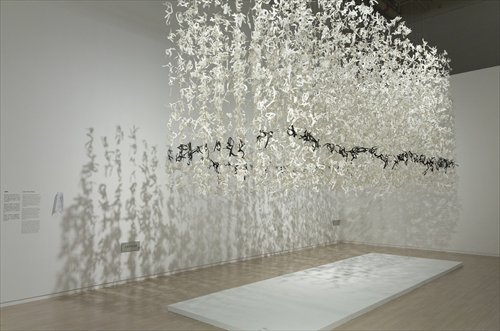
"The combination of line drawing and paper cutting induces a sense of movement and energy. The light and shadow transform the space in new depths," said Wang. "I want my work to be open-ended and to create connections between lines and space, light and shadow, to build a bridge between people's minds and my experience."
Born in 1982, Liu Yi is obsessed with kung fu, and his work draws parallels between calligraphy and the principles of martial arts. Its abstract white strokes on the green background bring to mind kung fu masters practicing their art.
"I think the point, horizontal, left-falling, right-falling and hook strokes in Chinese calligraphy have the same shape as ancient Chinese weapons such as the mace, sword, staff, saber, halberd and battle ax. To me there is a similarity between the moves of a sword and the strokes of a brush," Liu said, adding he thought he would have probably been a swordsman if he were born in that distant age of heroes.
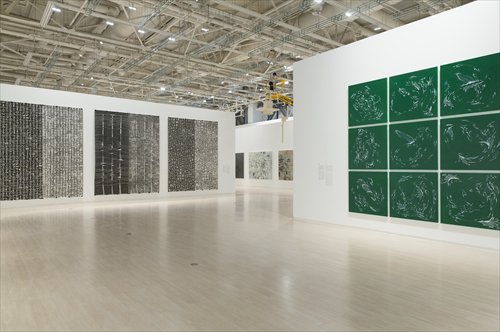
The current exhibition at the Power Station of Art explores the relationship between traditional calligraphic aesthetics and contemporary abstract art. Photos: Courtesy of the venue
In the video piece Inwalk 201503, Macao-born artist Wu Shaoying uses elements of flowing, abstract calligraphy ink to give her own commentary on the art form.
The video begins with dots of ink being dripped into a glass container filled with milk. The movement of the inky points is akin to lines of Chinese calligraphy. They present thousands of forms, stretching into dim fog, mountains and rivers.
"It took more than 20 attempts to make the 7-minute video clip. It has not been edited. The feeling and the effect of movement is closely related to the ink and milk I use," said Wu, who has been involved in video art for more than a decade.
Wu has experimented with liquids other than ink, such as vodka, soy sauce and milk.
Date: Until November 22, 11 am to 7 pm (closed on Mondays)
Venue: 7/F, Power Station of Art
Address: 200 Huayuangang Road
花园港路200号
Admission: Free
Call 3110-8550 for details