HOME >> METRO SHANGHAI
Sense of wonderment
By Liao Fangzhou Source:Global Times Published: 2015/9/13 17:58:01
"Fashionable" is the word critics and the art community choose to associate, often less than complimentarily, with the works of Beijing-based artist Mu Lei. And yes, there is a fair chance that it is also the first adjective to pop into mind upon visiting his new exhibition Wonderment in Shanghai.
The exhibition is made up of around a dozen oil paintings from 2012 to 2015, each constructed around a human character - predominantly seductive young women. The works appear highly polished and staged in the manner of a poster or advertisement.
Mu says the approach is aimed at representing our time, in which people confront their desires and states of mind under facades of fancy appearance.
Femme fatales
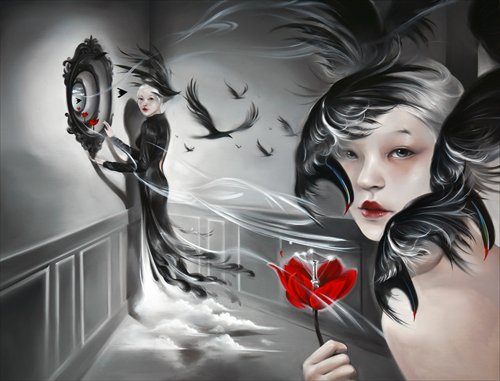
The "fancy appearances" have everything to do with Mu's depictions of porcelain-skinned, immaculately stylized female figures. He invites the viewers to look right into their sparkling eyes, which he fills with "illusion, void, or a desire to connect."
"Women in my paintings are the manifestations of women in the cosmopolitan city, who mask their fragility, sensitivity and self-doubt under layers and layers of delicate and extravagant high-end items," Mu said.
To Art+ Shanghai Gallery's curator Bonny Yau, these figures are comparable to the femme fatales and damsels that served as literary models to the Pre-Raphaelite painters of the 19th century.
"Recalling John Keats' titular 'La Belle Dame Sans Merci,' whose beauty bewitches and torments a knight, or Lord Tennyson's more sympathetic 'Lady of Shalott' cursed into isolation, Mu Lei's women are similarly strong in presence and dominant on the canvas, acting as protagonists even if their characters' particular roles are unclear," Yau said.
Into the virtual
Meanwhile, it is through these canvases of blacks, grays, hot reds, and deep blues that Mu comments on the relationship between the material and the virtual online worlds.
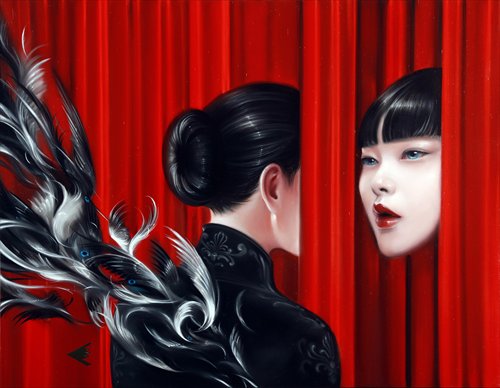
In Duality of Self (pictured above), we simultaneously see the back of a woman poking her head through red drapes and, impossibly, her face peering out of the drapes at the same time.
"We express our emotions in a parallel virtual world nowadays, and that other 'self' might become another back body of the original 'self.' This painting initiates a dialogue between the two selves that might actually be one," Mu told the Global Times.
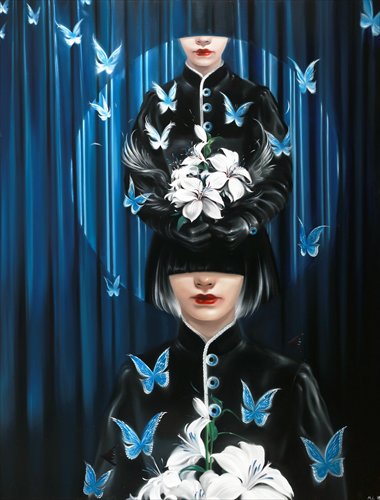
In Seeing without Looking (above), a bobbed woman in front of a blue curtain has long, even bangs that hide her eyes completely from sight. Atop her head is a replica of herself clutching flowers. With the piece, Mu wants to convey that people of today see far too many, but few provoke us to actually feel.
Zhang Linmiao, an independent curator from Beijing, is right in pointing out that Mu's images have an unnatural, industrially artificial light. It is Mu's deliberate replication of a world that is getting brighter and brighter.
"Everyone wants to be in a brighter environment, to be more in the spotlight, just as they crave attention in terms of 'likes,' reposts or condolence messages on the Internet," Mu said.
Diana Frenndl, curator at Vancouver Art Gallery, said the works show that Mu mediates his relationships with the online world through a sense of the real and the illusory.
"These open-ended portrayals echo the blurred lines between the fact, fiction and uncertainty that play out in Internet relationships," Frenndl noted.
Transforming identity
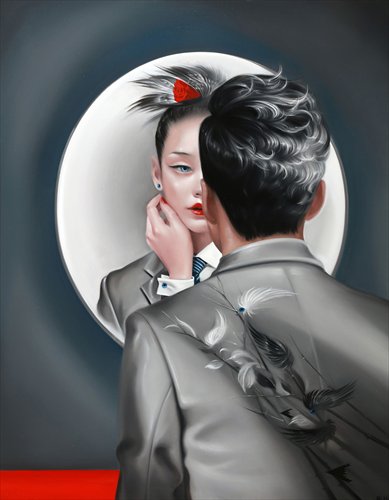
Mu also plays with the idea of identity. In Inner Self (above), gender becomes ambiguous - a shorthaired person in a grey suit faces a circular mirror, and a feminine, red-lipped image in the same outfit but wearing a rose on the head looks back.
"The person you see in the mirror every morning and the one other people see when you walk on the street is not necessarily the same. The painting captures the very moment that it is unclear if it is a woman or man living within your body, or perhaps, it is a different self instead of a reflection looking at you from the mirror," Mu explained.
Mu's human figures, and objects like mirrors, curtains and flowers, might be tangible and detailed, but at the same time he renders the scenes surreal and fantastical with a recurring motif of feathers transforming into birds, smoke forming beautiful shapes in the air, and translucent eyes that shine in brooches, rings and cuff links.
The feathers in particular embody human desire.
"Feathers appeared in paintings in the Song Dynasty (960-1279) to signify becoming a fairy or a god, a common wish among ancient people. Therefore, feathers would mean the desire to become a more beautiful, more powerful, and more perfect self. That desire might be as ethereal as the feathers, but it does exist," Mu said.
He also employs the feathers to balance what he calls the heaviness of oil paintings and create a flow of air and a sense of dynamism.
"Through heterotopic scenes of hushed breathlessness and multiplicity, there is a longing for understanding and acceptance, bridging reality and the illusory, mingling surrealism and hyper-realism, to straddle the thresholds of wonderment," said Yau.
The exhibition is made up of around a dozen oil paintings from 2012 to 2015, each constructed around a human character - predominantly seductive young women. The works appear highly polished and staged in the manner of a poster or advertisement.
Mu says the approach is aimed at representing our time, in which people confront their desires and states of mind under facades of fancy appearance.
A selection of works from Mu Lei's ongoing exhibition Wonderment at Art+ Shanghai Gallery Photos: Courtesy of the gallery
Femme fatales
The "fancy appearances" have everything to do with Mu's depictions of porcelain-skinned, immaculately stylized female figures. He invites the viewers to look right into their sparkling eyes, which he fills with "illusion, void, or a desire to connect."
"Women in my paintings are the manifestations of women in the cosmopolitan city, who mask their fragility, sensitivity and self-doubt under layers and layers of delicate and extravagant high-end items," Mu said.
To Art+ Shanghai Gallery's curator Bonny Yau, these figures are comparable to the femme fatales and damsels that served as literary models to the Pre-Raphaelite painters of the 19th century.
"Recalling John Keats' titular 'La Belle Dame Sans Merci,' whose beauty bewitches and torments a knight, or Lord Tennyson's more sympathetic 'Lady of Shalott' cursed into isolation, Mu Lei's women are similarly strong in presence and dominant on the canvas, acting as protagonists even if their characters' particular roles are unclear," Yau said.
Into the virtual
Meanwhile, it is through these canvases of blacks, grays, hot reds, and deep blues that Mu comments on the relationship between the material and the virtual online worlds.
In Duality of Self (pictured above), we simultaneously see the back of a woman poking her head through red drapes and, impossibly, her face peering out of the drapes at the same time.
"We express our emotions in a parallel virtual world nowadays, and that other 'self' might become another back body of the original 'self.' This painting initiates a dialogue between the two selves that might actually be one," Mu told the Global Times.
In Seeing without Looking (above), a bobbed woman in front of a blue curtain has long, even bangs that hide her eyes completely from sight. Atop her head is a replica of herself clutching flowers. With the piece, Mu wants to convey that people of today see far too many, but few provoke us to actually feel.
Zhang Linmiao, an independent curator from Beijing, is right in pointing out that Mu's images have an unnatural, industrially artificial light. It is Mu's deliberate replication of a world that is getting brighter and brighter.
"Everyone wants to be in a brighter environment, to be more in the spotlight, just as they crave attention in terms of 'likes,' reposts or condolence messages on the Internet," Mu said.
Diana Frenndl, curator at Vancouver Art Gallery, said the works show that Mu mediates his relationships with the online world through a sense of the real and the illusory.
"These open-ended portrayals echo the blurred lines between the fact, fiction and uncertainty that play out in Internet relationships," Frenndl noted.
Transforming identity
Mu also plays with the idea of identity. In Inner Self (above), gender becomes ambiguous - a shorthaired person in a grey suit faces a circular mirror, and a feminine, red-lipped image in the same outfit but wearing a rose on the head looks back.
"The person you see in the mirror every morning and the one other people see when you walk on the street is not necessarily the same. The painting captures the very moment that it is unclear if it is a woman or man living within your body, or perhaps, it is a different self instead of a reflection looking at you from the mirror," Mu explained.
Mu's human figures, and objects like mirrors, curtains and flowers, might be tangible and detailed, but at the same time he renders the scenes surreal and fantastical with a recurring motif of feathers transforming into birds, smoke forming beautiful shapes in the air, and translucent eyes that shine in brooches, rings and cuff links.
The feathers in particular embody human desire.
"Feathers appeared in paintings in the Song Dynasty (960-1279) to signify becoming a fairy or a god, a common wish among ancient people. Therefore, feathers would mean the desire to become a more beautiful, more powerful, and more perfect self. That desire might be as ethereal as the feathers, but it does exist," Mu said.
He also employs the feathers to balance what he calls the heaviness of oil paintings and create a flow of air and a sense of dynamism.
"Through heterotopic scenes of hushed breathlessness and multiplicity, there is a longing for understanding and acceptance, bridging reality and the illusory, mingling surrealism and hyper-realism, to straddle the thresholds of wonderment," said Yau.
Date: Until October 18, 10 am to 7 pm (closed Mondays)
Venue: Art+ Shanghai Gallery
Address: 191 Nansuzhou Road
南苏州路191号
Admission: Free
Call 6333-7223 for details
Posted in: Metro Shanghai, About Town