Popular appeal
New festival aims to spread the word about oft-overlooked Chinese instrument
"I believe that one day the zhongruan will be regarded respectfully as a very significant instrument in an orchestra," said Chinese musician Liu Xing, whose name has become synonymous with the plucked string instrument based on the ancient Chinese ruan, whose history can be dated back to the Han Dynasty (206BC-AD220).
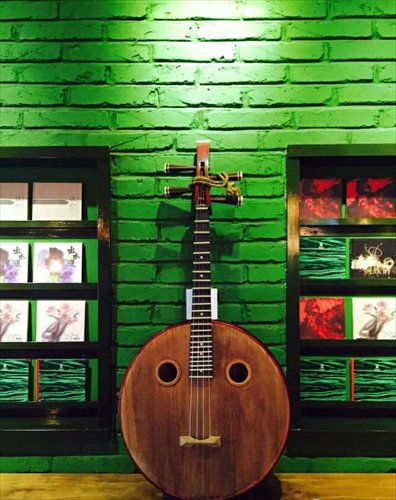
Created in the 1950s, the zhongruan is a straight-necked instrument with four strings and 24 frets with 12 semi-tones on each string. It is not as famous or popular as the guzheng (a bridged zither with 18 or more strings) or the guqin (a seven-stringed zither with no moveable bridges) among audiences, but it has been gradually gaining attention from Chinese musicians around the world in the last few decades.
Over the years, Liu has released several acclaimed compositions. Among them are his innovative concerto Memory of Yunnan, which features his virtuoso zhongruan soloing skills and is accompanied by other traditional Chinese plucked string instruments; Guanglingsan is his adaptation of the namesake masterpiece of the guqin; and his adaptations of Bach's suites for unaccompanied cello.
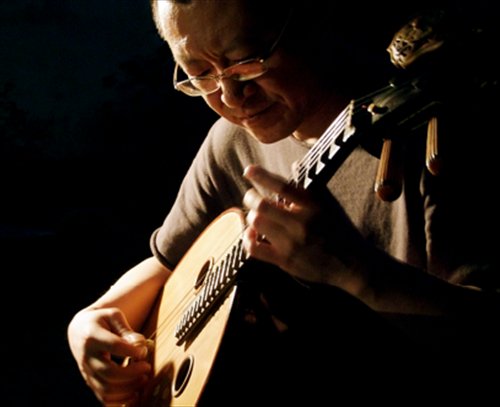
Liu Xing (above), master of the zhongruan musical instrument Photos: Courtesy of Bandu Music Festival
Standout sounds
Liu's compositions stand out for their innovative spirit. His experience playing other instruments such as the yueqin (another plucked string instrument derived from the ruan), guitar and piano, his experiments in New Age music, and his composition work for films and TV all nourish his creations.
Zhongruan players - mostly from Singapore, Hong Kong and Taiwan - have contacted Liu to ask for the sheet music to his works, as none has yet been officially published, although he does sell copies that he has printed out himself.
It has been 31 years since Liu started playing and composing for the zhongruan, and over the decades he has been calm about the slow development of the zhongruan's popularity.
In 2003, Liu, together with singer and music producer Lin Xiaocao, set up Bandu Music in Shanghai, which regularly holds small-scale traditional Chinese folk music events that also feature the music of minority groups at Bandu Cabin (1/F, Bldg 11, 50 Moganshan Road, 6276-8267).
Liu feels the time is now right to promote the zhongruan to more audiences. He has gathered a group of zhongruan musicians from China and abroad and, from this Friday to Sunday, the city will see its first Bandu Music Festival.
There will be events in the contemporary art zone at 50 Moganshan Road, and three concerts at Qianshuiwan Culture Center (179 Yichang Road, 6266-1110).
Opening number
Liu will raise the curtain on the festival at the first concert at Qianshuiwan Culture Center with his students on Friday night, performing his own compositions as well as "traditional-style" tunes for the zhongruan.
On Saturday night, FS, a chamber music band made up of four musicians from the China National Orchestra in Beijing, will present quartet as well as concerto compositions by Chinese contemporary musician Wang Shu, whose music draws influence from a wide range of styles including jazz and rock.
On Sunday night, some 30 musicians from the Central Conservatory of Music and Shanghai Conservatory of Music will explore the polyphonic charisma of the zhongruan.
During the daytime, Sangeren, a three-piece Taiwanese band featuring the zhongruan, the guzheng and flute will present live shows (4:40 pm to 5:40 pm on Saturday, 1 pm to 2 pm on Sunday) at the alfresco area beside Bandu Cabin, while zhongruan musicians will give free lectures at Bandu Cabin, sharing knowledge of the instrument and stories of their innovative compositions.
Chronus Art Center (Bldg 18, 50 Moganshan Road, 5271-5789) will host an exhibition during the weekend at which people can listen to and experience zhongruan music through art installations as well as multimedia displays. Sangeren will also present a one-hour performance here at 4 pm on Sunday.
Moreover, tea ceremonies and the ethnic costumes of minority groups in China will be showcased around Bandu Cabin.
All of the events on Moganshan Road are free to the public, while tickets to the indoor concerts at Qianshuiwan Culture Center are priced below 280 yuan ($43.94).
Sound of the future
"I want to let people know about the vast possibilities of making music with the zhongruan through the festival," Liu told the Global Times.
He believes that, with its privileged tone and compositions, the zhongruan will become as important in Chinese music as the piano and violin are in the Western orchestra.
Liu says the zhongruan is not as popular as the guzheng or guqin because it is relatively new, with just 50 years of history. Also, it did not have popular masterpieces composed for it in the early period of the People's Republic of China, when some traditional Chinese instruments got greatly publicized through anthems and ancient compositions.
After the country's opening-up, people were more interested in Western music, and some good pieces for the zhongruan created in the 1980s and after were overlooked.
Liu doesn't expect the festival will make him much money, and he regards himself as a volunteer in the development of Chinese music.
"I believe that as the material wealth of Chinese people reaches and maintains a stable state, people will be more and more interested in art and culture, rather than merely caring about making money, and gradually they'll pay attention to the zhongruan," Liu said.