Playing by numbers
Japanese band How to Count One to Ten on touring, the creative process and their forthcoming album
It is rare to find a post-rock band that composes primarily in major keys, but that is the norm for Japanese five piece How to Count One to Ten. For the most part eschewing vocals and discernible lead lines, the band plays lighthearted, cheerful tunes that it compares to going for a ride on a sunny day.
The band consists of Yuta Okuhara (guitar, keyboard), Yosuke Minamizuka (drums), Taichi Yaguchi (guitar), Mayuko Wada (bass), and Shunsuke Hayashi (guitar).
Following their big-selling debut Blue Building Blocks (2012), they released Method of Slow Motion late last year, experimenting with odd time signatures and pop chord progressions.
This month, the band went on its first Chinese mainland tour and performed in cities including Guangzhou, Wuhan and Xi'an. The gigs were well reviewed on social media, with many saying the performances were exuberant.
"Their music seems to say 'that is all right, love this world in spite of whatever happens,'" one Chinese fan wrote on Weibo after the tour's final stop in Shanghai.
The Global Times spoke to the band right before the gig at Yuyintang Livehouse.
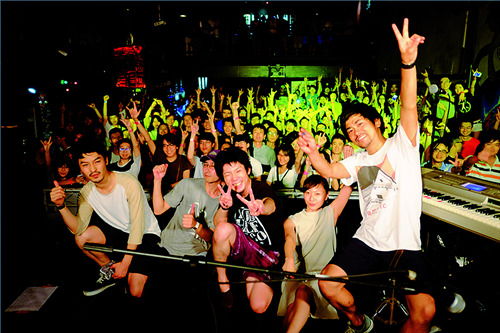
Members of the Japanese post-rock band How to Count One to Ten pose with fans.
GT: Many bands tend to come up with new compositions during tours - do you?
HTCOTT: Not really, we generally look for inspiration from other dimensions. But this tour allows us to engage with the Chinese audience up close - this is a chance we rarely have back in Japan. Japanese audiences tend to hold back during live shows, but people here are more willing to come to the front to really join us. The more lively responses bring out a quite different experience that we are very happy about. Also, we discover that China has so many young people who truly love music, and are very touched by it.
GT: There are three guitarists in the band - how do you bring a piece together?
HTCOTT: Our songs are variations, which would have been really difficult and time-consuming to arrive at if all the guitarists worked on their own tracks. Therefore, Okuhara writes all the songs independently to secure a sense of harmony, and then hands the scores to everyone.
GT: Your works are mostly instrumental, but there are exceptions. Under what circumstances do you feel the need to throw in vocals?
HTCOTT: We aim for music in its purest state and hardly rely on effects, so often when we need to add some sounds we find vocals are appropriate. It is all very spontaneous.
GT: You have said you tend to name songs after they are completed. Was any naming process particularly interesting?
HTCOTT: Take "Parallel" for example - the song starts with three guitarists in unison and then splits into three different tracks before reconverging, so that is where its name comes from. It is also fun that we came up with "An Association Game +2" before "An Association Game +1."
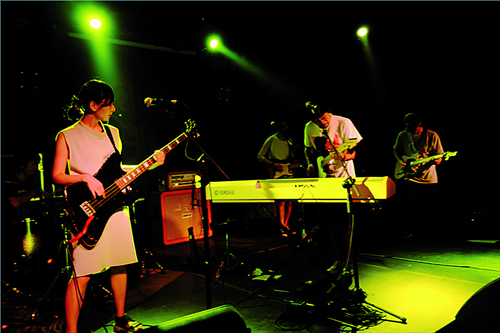
The band performs onstage. Photos: Courtesy of Live Wild
GT: Japan has a pretty big market for CDs compared to China. Are you trying other distribution channels?
HTCOTT: We sell our music, track by track, on the online music store bandcamp.com. We find it an important channel because all revenues go almost completely to us - CDs, in comparison, bring half the revenues. Overall, 80 percent of our gains come from CDs, 18 percent from bandcamp.com, and the rest comes from iTunes and the like.
GT: What can we expect from your next album?
HTCOTT: In the latest album Method of Slow Motion, we made fusions of rakugo (a form of Japanese cross talk) and radio drama. We would like to go further in the next album by turning it into a soundtrack that is not based upon a particular film, but hopefully one would feel a cinematic experience listening to the album. It will be an accessible and touching love story. The album will highlight the narrative, and dialogue will be heard over instrumental pieces. At the moment, we have completed around 2 percent of the album - we are at the scriptwriting phase. The works will be available online for free at first, and then appear on CD.
GT: Are there any Chinese musicians that you admire and want to work with?
HTCOTT: Frankly, we have little knowledge of either Japanese or Chinese bands. However, we got to listen to local guest performers during the tour and found many of them impressive, in particular Chinese Football, a band who opened for us in Wuhan. They have a great musicality, the lead is very talented, and the members share a shy disposition that fits the genre of post-rock very well. We would love to perform with them if they come to Japan. Choked Zone, the band that performed at our Shenzhen gig, is also cool.