The enigma of romantic roses
Experimental production adds music to Eileen Chang classic
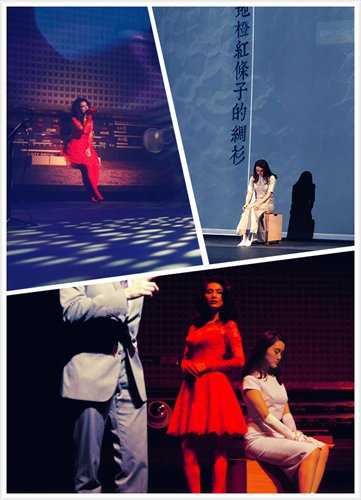
"Marry a red rose and eventually she'll be a mosquito-blood streak smeared on the wall, while the white one is 'moonlight in front of my bed.' Marry a white rose, and before long she'll be a grain of sticky rice stuck to your clothes; the red one, by then, is a scarlet beauty mark just over your heart." Scenes from the multimedia play Red Rose, White Rose Photos: Courtesy of Shanghai Culture Square
This was how Eileen Chang opened her 1944 novella Red Rose, White Rose - a summary of a romantic enigma that has continued, through the years, to convince generations of readers that this dilemma is unsolvable.
Adaptations, including an acclaimed Stanley Kwan film in 1994 and several theatrical adaptations, have continued to persuade that this particular enigma is ageless.
Now the story has come into the hands of Hong Kong director and art critic Mathias Woo who has added music to the enigma.
The latest experimental production by the nonprofit troupe Zuni Icosahedron, is a multimedia play that uses hit songs to illustrate and emphasize the emotions of the two female characters and original compositions as a background to the plot.
For example, there is Jiaorui (the Red Rose, played by Shanghai Dramatic Arts Centre actress You Mei) singing "Taste," a Winnie Hsin ballad, to express her attachment to her lover and protagonist Zhenbao (Shanghai Dramatic Arts Centre actor He Bin), and Yanli (the White Rose, played by actress Gao Ruoshan) singing "I Will Marry You Tomorrow" before tying the knot with Zhenbao.
The 100-minute show's music director Yu Yat-yiu has tailored the theme song "Other" - "Some die-hard, some halfhearted, but none can help themselves … No matter who is by your side, there is another that makes you sigh." The song itself is a taut recapitulation of the central themes.
Even if some of the songs first appeared in the 1980s, they go well with an adaptation that vaporizes the period and sets its characters in modern outfits.
"The story is about the politics between men and women, and this simply transcends time," Woo explained.
Diluted differences
Previous productions highlighted the contrast between the "red" and the "white" from appearance to disposition, but in this rendition the two women do not display stark differences.
Woo deliberately refrains from stereotyping the two characters. "Many women tend to think they are half White Rose and half Red Rose, so why should we confine Red Rose to a sexy image?"
Yu said that in the past audiences tended to focus on the two female characters but the spotlight should really be on Zhenbao.
"For he represents a middle-aged Chinese man living in a major city, someone who succumbs to fatigue just by trying to maintain his façade and his identity," Yu said.
The play completely removes the minor characters of the original and, unusually, breaks the connections between the three leads.
Zhenbao's interplays with either Red Rose or White Rose are out of sight - instead, in front of a minimalist set, three soliloquys are delivered, addressing the audience directly.
Though some critics have questioned Woo's approach to theater, as in when he made a heavy sometimes verbatim reference to Chang's text in his last adaptation, Eighteen Springs, the characters here speak the original lines.
"My adaptation principle is that, the one thing that cannot be adjusted is Chang's language, which is the important part of her work," Woo said. "Revising Chang's lines would be like revising Shakespeare, which would render the work soulless."
He said Chang combined classical and modern Chinese language perfectly and, as well, was uncompromising.
"Her opinions might be called 'the opinions of Shanghai' or the opinions of independent women of that age, which continue to make sense and resonate today," Woo said.
Date: October 9 and 10, 7:15 pm
Venue: Shanghai Culture Square
Address: 597 Fuxing Road Middle
复兴中路597号
Tickets: 80 yuan ($12.62) to 580 yuan
Call 6472-9000 for details