Laughing in Lhasa
My encounter with China’s happiest city
"You fellows from 'inland' are always too sensitive and alert," said a middle-aged Tibetan taxi driver, who rounded up three more tourists a few minutes after persuading me to be his first passenger on my way out of Lhasa Railway Station.
I was all too excited to embrace the brightness and freshness of the "city of sunlight" after a 23-hour train ride originating from Lanzhou in Gansu Province when some red-faced men walked up to me and spoke in Putonghua: "Miss, take my car, it's a legal taxi!"
Although my travel guide, whom I'd meet later at a hotel in downtown Lhasa, had told me that it only cost 20 yuan ($3.15) for a taxi to the hotel, I agreed to pay 30 yuan, which was already bargained down from what the driver initially asked.
I distrustingly refused the driver's help to carry my suitcase when he led me to his car at the back of a long queue of blue-and-white taxis. During the drive toward the downtown area, I began to feel a bit ashamed of myself for my excessive caution toward these kind strangers.
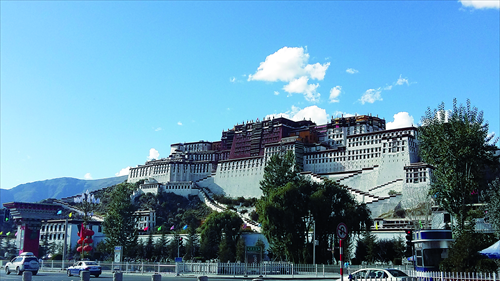
The famous Potala Palace
City of three honors
"Lhasa has the best social security in China, don't you know?" said the driver, who lit up a cigarette for himself after two male passengers in the car refused his friendly invitation.
Colorful flags were seen almost everywhere, adding a festive atmosphere to the area, which was celebrating its 50th anniversary of becoming an autonomous region of People's Republic of China.
Portraits of President Xi Jinping appeared at major transportation spots along with slogans reading "the governance of a country shall emphasize on the administration of its frontier, and to stabilize Tibet is a priority for administration of Chinese frontier."
I became convinced of these words during my 10 days in Tibet. Firstly, all Tibetans are Buddhists, who believe that they should do good things to have a better afterlife. Secondly, major scenic spots in Lhasa are all under police surveillance. Thirdly, the bus that drove my 15-people tourist group to nearby cities was embedded with a policeman throughout the entire journey.
The confident Tibetan taxi driver said that his vehicle was given to him by the government for free, and after a certain number of years the car would become his property.
Each day he pays 160 yuan to the taxi company, and usually he earns more than 1,000 yuan per day, which may explain why Lhasa ranks among the top Chinese happy cities.
Lhasa also leads in sanitary conditions, said the driver. The streets here are mostly clean and dustbins are easily to find. I almost couldn't wait to walk around the immaculate city after my check-in at the hotel, which was located between Beijing Road and Jiangsu Road, both named after the regions that have donated major funds for construction projects in Lhasa.
Modernity mixed with tradition
Lhasa is an amazing city, a place where modernity mixes with tradition and ethnic cultures. Two- or three-story Tibetan-style buildings line the streets, nor can you miss all the local people dressed in loose Tibetan garments juxtaposed against stores selling fashionable branded clothes as well as stalls for Tibetan yogurt and yak meat.
Although Lhasa is located in the westernmost region of China, and has generally lagged behind the east coast in terms of economy, the price levels in Lhasa are roughly the same as first-tier cities such as Beijing, Shanghai and Guangzhou. A bowl of beef noodles costs 14 yuan in Lhasa, more than double of the price in Lanzhou.
The nightlife in Lhasa also rivals that of any first-tier city, with numerous pubs and clubs open till dawn. A glass of sweet, fragrant barley beer is a nice choice for thirsty travelers, but don't drink too much alcohol if you are prone to altitude sickness.
Makye Ame is a famous restaurant and bar that offers modern Tibetan folk songs. Nearby Po Ba Tsang restaurant entertains diners with traditional Tibetan song and dance.
The city offers distinctive sceneries during the daytime and at night. I prefer the night, when temples are decorated with yellow lamps on their walls and roofs, and small zigzagging lanes distinguish themselves from major streets with silence and darkness.
The famous Potala Palace is illuminated at night with bright white lights, accentuating its sacredness by both local dwellers and travelers.
A walk around Great Brightness Temple at daybreak offers an intimate experience of Tibetan Buddhism as you may encounter hundreds of faithful, old and young, murmuring their prayers and fingering a rosary while walking clockwise around the temple.
You may also see some pilgrims prostrating in prayer one after the other in front of the temple's gate, fulfilling their target of 100,000 kowtows for a lifetime. After their morning koras, it's a custom for locals to have a nice warm cup of yak milk tea in stalls near the temple.
Except for the Potala Palace, which requires tourist to buy their tickets one day in advance during the busy season (May 1 to October 31), other sites sell tickets at the door. Many Tibetan Buddhist temples feature ancient, time-honored murals, some of which are hard to discern under the dim light of melted butter candles. In general, photography inside these halls is not allowed, though some temples charge an extra fee for cameras.
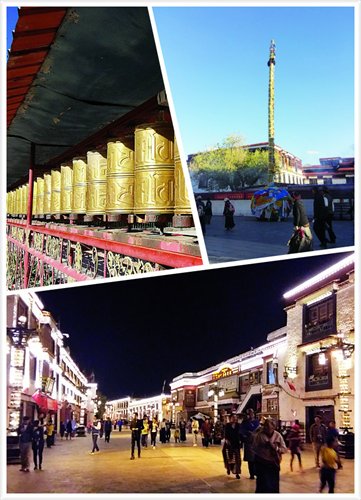
(Clockwise from above left) The prayer wheels inside a Tibetan temple; A pole wrapped in sutra streamers outside Great Brightness Temple; Lhasa at night Photos: Sun Shuangjie/GT
Travel tips
While adjusting to the high altitude, avoid intense exercise.
Don't eat too much at meals if you feel altitude sickness.
Though there are many Sichuan-style restaurants in Lhasa, avoid spicy meals in dry climates.
Remember to only walk around a temple clockwise, and spin your prayer wheel clockwise as well.
Be aware of sacred Buddhist spots, such as those adorned with sutra streamers, and never step onto them.