HOME >> CHINA
Lifted from a watery grave
Source:Xinhua-Global Times Published: 2015/10/8 19:58:01
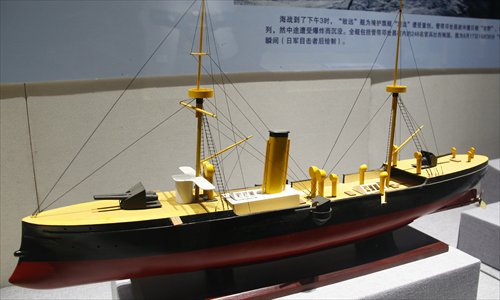
A model of the warship is displayed in Jiawu War Museum in Weihai, Shandong Province, on September 12. Photo: IC
A large number of items have been salvaged from the wreck of the warship Zhiyuan, sunk by the Japanese navy 121 years ago in waters off the port of Dandong in Northeast China.
During the past two months, archaeologists have brought up over 100 items, including an artillary shell found on Monday, said Zhou Chunshui, who leads the State Administration of Cultural Heritage mission.
The famed late Qing Dynasty (1644-1911) warship was discovered in the depths of the Yellow Sea in 2013, and exploration began in August.
Old rivals
The shipwreck that was code-named "Dandong No 1" has been tentatively identified as the Cruiser Zhiyuan of the Beiyang Fleet.
On September 17, 1894, the Zhiyuan came under attack from Japanese cruisers during Battle of Yalu River. This was the largest naval engagement of the First Sino-Japanese War, involving ships from the Imperial Japanese Navy and the Chinese Beiyang Fleet.
The Zhiyuan was hit in the bow by a Japanese shell but Captain Deng Shichang refused to abandon the ship.
Captain Deng ordered a full-speed charge at the enemy's flagship in order to protect the flagship of the Chinese fleet. But just one kilometer away from its target, the Zhiyuan exploded. Captain Deng later drowned along with his dog.
A total of 252 officers and soldiers were on board the Zhiyuan and only seven survived.
Guan Jie, a member of China's Society of Sino-Japanese Relations History, said the Beiyang Fleet invested almost all its forces in fighting the Japanese navy.
Guan said that during the five-hour battle, the Chinese fleet lost four warships, which were China's most sophisticated vessels at that time, bigger and carrying better weapons than the Japanese boats, but slower and short of ammunition.
The excavation of Zhiyuan represents the excavation of a period of history, said Guan.
Digging up the past
Song Jianzhong with the National Center of Underwater Cultural Heritage said that it is still too early to make a final conclusion on the ship and its history.
"The relics and information currently in hand indicates it's the wreck of the warship Zhiyuan, but more work needs to be done before publishing the final conclusions," said Song.
In the past month, over a 100 relics have been salvaged from the depths of the Yellow Sea, including canons, shells, and other artillery.
The most crucial piece of evidence for the ship's identity is a shattered porcelain plate that features the words "Zhiyuan" written in the middle of its back.
Also among the findings is a boiler cap found 30 meters away from the wreck at the bottom of the sea.
Sa Su, a Chinese scholar of Japanese studies, said that the artifact could reveal details of the final moments of the brave sailors who operated the ship during combat.
"It's said that the sailors sealed the boilers in the hope of enabling them to generate more power and make the ship run faster than usual. Only in this way could it catch up with Japanese warships that were more advanced. But as seawater poured in after Zhiyuan's hull was penetrated by shells, the boiler exploded, with the cap blown out," said Sa.
Song said that all of the recovered items will be studied further.
"Archaeology mainly focuses on the investigation, excavation, study and protection of cultural relics. Items found during the current underwater probe will be sent to labs where they will undergo procedures of de-watering, desalination and de-sulfating before being renovated and pieced together."
The State Administration of Cultural Heritage concluded a through check on the relics on Tuesday.
Since archaeologists said that it is impossible to refloat the whole warship at one time, it will be salvaged in pieces in 2016.
The State Administration of Cultural Heritage is negotiating with the port of Dandong to build a museum to commemorate Battle of Yalu River and restore the relics from the warship Zhiyuan, according to Song.
The museum will cover an area of 34,000 square meters near the battle area in the sea and will be free to the public, said Song.
Xinhua-Global Times
Posted in: Society