The Little Prince
Film’s narrative shortchanges the French tale though retains its beauty
Turning the thin volume of French writer and aviator Antoine de Saint-Exupéry's world-famous 1942 tale Le Petit Prince (The Little Prince) into a feature-length film is surely no easy job, but the weighty and often didactic framing story as seen in On Animation Studio's new adaptation was not the best approach.
This French production, reportedly one of the country's most expensive animated feature films with a budget of $80 million, was helmed by American director Mark Osborne (Kung Fu Panda), with a script from Irena Brignull (The Boxtrolls) and Bob Persichetti (Disney's Tarzan and Mulan).
Together, they develop what appears to be a spinoff of The Little Prince into just another empowerment story.
Two-sided tale
The film begins with a 9-year-old little girl (Mackenzie Foy) moving into a house, which has enabled her to enroll in an elite prep school. The dutiful child is to spend her summer vacation according to a horribly demanding schedule, or "life plan," mapped out by her well-meaning but pushy single mother (Rachel McAdams).
The girl is soon distracted by the eccentric neighbor, an elderly aviator, whose modern-day writings and illustrations of The Little Prince enchant the girl.
The film depicts the beginning of the friendship between the girl and the aviator with a dreamy breeziness. For one thing, they bond at the aviator's, a whimsical and disorganized building full of interesting gadgets and warm colors. This is in sharp contrast to the muted gray suburbia outside.
The 3D computer animation renders the "real world" characters with enormous, cartoonish eyes, and fills them with expressions and emotions that are more than just lifelike.
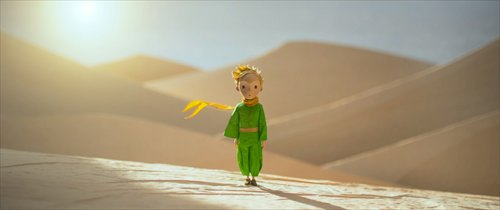
A scene of the film
Moments of enchantment
One of the most adorable moments comes as an enormous parachute, attached to the aviator's old airplane, falls slowly and gently onto the two protagonists in the lush backyard.
As the little girl looks up at the parachute, her eyes begin to reflect its various, vivid colors, and her mixture of astonishment and aspiration is heart-stopping.
Even better-looking are the scenes based on the original text, which are dispersed throughout the first half of the film and unfold as the little girl reads the tale.
Here, Emmy-winning director Jamie Caliri makes a clear-cut yet seemingly uncontrived distinction from the framing story as he marvelously employs 2D slow-motion animation and a rustling paper technique to revive the Little Prince (Riley Osborne, the director's son), the Rose (Marion Cotillard), and the Fox (James Franco) among many others.
The somewhat abstract imagery is perfect for the ageless, imaginative tale that has many themes. In a murky, fragile and poetic light, acquaintances and partings are made in an understated manner.
Nothing captures the growing intimacy between the Little Prince and the Fox more charmingly and economically than the few seconds during which they stand next to each other, the Little Prince's scarf and the Fox's tail waving by the wind in sync.
Princely bore
Unfortunately, such sections account for just a small proportion of screen time. The second half of the film sees the framing story rolling on by accentuating the idea that growing up is an awful bore, which is an awful bore itself.
To support that theory, the last 20 minutes or so of the film offers a sequel-like yarn that begins with a radical subversion of the common understanding of the source text and then develops it into a very conventional rescue story - neither is palatable.
Moreover, it is strange that the film, which seems to have little confidence in its audience's abilities and tends to over-elaborate from time to time, gives no explanation of any kind for this mini-film, which can be confusing and misleading.
A recommendation would be to skip the cinema and look for a video cut of all the 2D scenes.
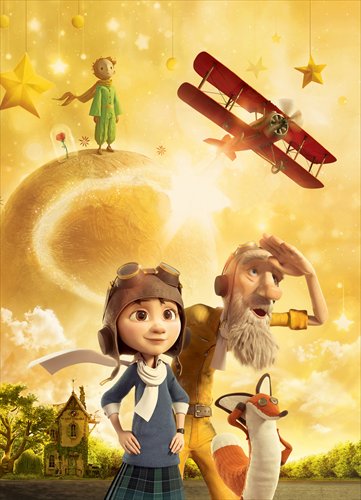
A poster for the film Photos: CFP
Everyone's a critic
GT: What was your best moment of the film?
Ginny, 23, public relations
"I liked every minute of the excerpts of the original story, in particular when the Little Prince chats with the aviator and when he laughs his famously lovable laugh. The more I hear the framing story's clichéd dialogue, the more I appreciate the simplicity and power of these lines. The voice-over is also great."
GT: Did you find the mini-film at the end to be a betrayal of the source material?
Huang Yan, 26, shop owner
"Yes, I think it goes a bit too far. I understand that nowadays films tend to work hard to add twists to classics to make them appealing and not end up being upsetting, but this part nevertheless feels more odd than imaginative."
GT: Which of its key messages do you think the film delivered best?
Mr Jia, 35, Japanese teacher
"The most repeated one, that what is essential is invisible to the eyes. The most beautiful things in life, for example, love, kindness and innocence, which the original text and the film promote, are just like that. But we can feel their existence with our hearts."