HOME >> BUSINESS, METRO BEIJING
Collector exhibits Hui architecture
By Wang Yitong Source:Global Times Published: 2015-10-22 17:58:01
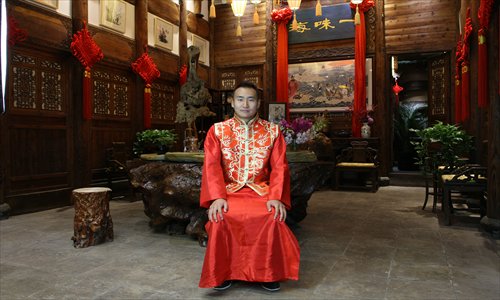
Liu Peng sits in Yiweihai Teahouse, constructed using Hui-style architecture. Photo: Courtesy of Liu Peng
Huizhou, or "Hui-style," architecture is one of the main schools of traditional Han architecture. Built mainly using wooden structures, it is popular in many provinces and regions in China, primarily Jiangxi and Zhejiang provinces. In Beijing, one can find Hui-style architecture at Songzhuang Art Zone at the Yiweihai Teahouse.Liu Peng, the owner of the teahouse, is a post-80s overseas returnee. On October 18, it was in this building that he completed an important step in his life: getting married. In concert with his teahouse building, he chose to have a Chinese wedding.
Liu graduated with a master's degree in Business Administration from the University of Sunderland, UK. Taking after his father, Liu became fond of collecting antiques when he was very young. His hobby began with an interest in wood and bracelets and soon he began to collect antique furniture.
The main building of the teahouse, which dates back to the reign of Emperor Qianlong in the Qing Dynasty (1644-1911) was moved to its current location from Wuyuan, Jiangxi Province. Its interior is furnished with gorgeous, but low-profile solid wood carvings. Guests at the teahouse not only will be able to try superior tea, but also feast their eyes on Liu's marvelous collectibles.
"Huizhou architecture is usually composed of wood mosaics with exquisite carvings," Liu said. "I have two buildings with a history of over 200 years that were moved from Wuyuan to Songzhuang Art Zone. In order to protect the ancient buildings and present them to everyone, I spent three years renovating them. I hope I can make a contribution to the heritage of ancient Chinese architecture."
Liu believes that the essence of ancient Chinese culture is embodied both in spirit and in entity. Spirit refers to Taoism, Buddhism and other ideological and cultural traditions, while "in entity" means it can reflect a country's strength and heritage.
"Whenever a foreigner comes to drink tea, they are wowed by this building," Liu said. "It makes me feel extremely happy and proud, but I think the protection of ancient Chinese architecture still needs further improvement and I still have much to do."
In regards to Liu's future plans, he said he firmly believes that he will continue to be involved in dealing with ancient Chinese culture, which may include collecting works of art and calligraphy.
Posted in: Press Release, Enterprise