HOME >> ARTS
Ping Pong Concerto
By Xiong Yuqing Source:Global Times Published: 2015-10-25 20:28:01
Novelty music brings athletes, soloists and orchestra together
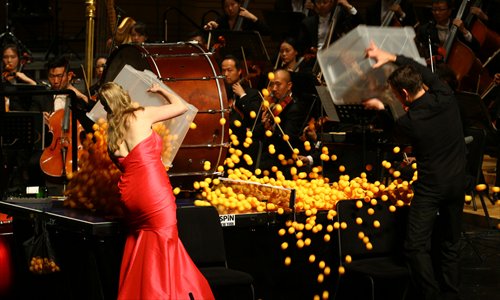
Violin soloist Elizabeth Zeltser and percussion soloist David Cossin pour two boxes of ping pong balls on the table at the end of Ping Pong Concerto on Thursday. Photo: Courtesy of BMF
Most Chinese have played ping pong or have at the very least watched ping pong games. China's having won all but two of the World Championships since 1971 makes it a popular sport, so the sound of the little ball bouncing off the paddle and the table is very familiar to us.But to use a ping pong to play music - and not a short piece of only a few minutes but a whole concerto, which means the sound of ping pong would have to cooperate with a whole orchestra - would certainly require a stretch of the imagination.
And that is exactly what the Ping Pong Match - Unique Melody did for Beijing Music Festival (BMF) at the Poly Theatre on Thursday night when it gathered two Olympic ping pong players on stage to create music, with soloists and an orchestra.
Aleatoric hits
Classical music is usually very precise. How do the players control the tempo to get a harmonious sound? Even for top players, it is hard to make every sound of the ball precisely the same, a ball is not a finely made musical instrument, and yet harmony and precision is a what one would expect at a symphony orchestra.
"At first, we thought we had to play in perfect rhythm, with everything going on in tempo. And what is really incredible is that Andy wrote the piece so that it didn't have to be in perfect rhythm all the time and it still works," said Michael Landers at a press conference on Wednesday in Beijing.
Landers started playing ping pong professionally at 13 and was on the US national team for three world championships. Having been trained in China, Landers can speak and understand Chinese well. His partner Ariel Hsing represented the US national team at the London Olympics.
Landers said that the most difficult thing at first was cooperating with the orchestra and "being able to memorize exactly where to start playing and more precisely where to cut off and catch the ball."
During the performance that night, the audience could see each of the athletes holding more than one ball in their hand in case they didn't hit the ball coming to them they still could return a ball.
"I think the worst thing that could possibly happen is that if the whole work cuts off, and you hit another ball and bounce it on the table, the audience completely knows it was a mistake," Landers said.
More than novelty
Incorporating innovative methods in music to gain a rise out of the audience seems to be losing its novelty nowadays. The technique dates back to Franz Joseph Haydn's 1791 work The Symphony in G major No.94, "Surprise," where the musician designed a sudden loud sound to shock the audience during a light melody. American modern composer John Cage did something similar in 1952 during his legendary performance 4'33'' with a record-setting long rest on the score, surprising and disappointing the crowd, some of whom left before the event was over.
In the East, Chinese musician, Tan Dun attempted a WeChat symphony Longligelong last year, asking users to download a piece of vocals on their mobile phone and then to play it like random echoes during the performance.
"For me, with this piece, I realized it was mixing very unique concepts together, and I didn't want to be about just novelty in that. I try to create musical pieces using athletes and musicians too," said Andy Akiho, the composer of the piece.
However, making sounds using a ping pong could not prop up the whole concerto. Akiho had to make it more creative by exploring the different bounces and sounds that could be had from different materials and with different types of force. The two players changed their tools to hit the ball all through the performance. Besides the normal paddles, they also used tambourines and even a tulip glass. Landers also created a series of syncopation by serving high ball for Hsing to smash. During the second movement, Hsing even smashed balls directly into the audience, making strong, quick sounds as they flew and effectively shocking the audience.
The two soloists were also very important to the music. Violin soloist Elizabeth Zeltser presented the theme melody, which was in an unconventional rhythm that made it easy to insert random sounds, while percussion soloist David Cossin seemed to be in a musical call and response with the ping pong sounds. He, too, used different materials including metal rods and thick wooden planks. For the second movement, Cossin moved a bass drum to stand on the table so that the players could let balls bounce on the drum and make surprising sounds.
Accompanied by the China Philharmonic Orchestra, the whole piece ended up with Cossin and Zeltser suddenly pouring about several hundreds ping pong balls on the table, the sound earning a round of applause from the delighted audience.
Sounds and performance
The concert was arranged into three works, each presenting contemporary music with both Eastern and Western influences. The other two pieces also incorporated different sounds into the music.
The night started with Chinese American composer Huang Ruo's Shattered Step. Huang used a piece of recorded original folk song from Southeast China at the beginning and the end to create an enigmatic phenomenon. Though including Chinese music elements, the whole piece is in a contemporary style, and in one of the sections the viola and cello players stopped playing and clapped their hands as part of the music.
Famous for his musicals such as Cats and The Phantom of Opera, Andrew Lloyd Webber also wrote Variations for the cello and orchestra based on Paganini's 24th Caprice in A minor. The conductor of the concert Zhang Yi chose this variation as the link between Shattered Step and Ping Pong Concerto.
Posted in: Music