HOME >> ARTS
New Eawtern Fantasy
By Wei Xi Source:Global Times Published: 2015-11-3 22:13:01
‘Chronicles of the Ghostly Tribe’ brings freshness, controversy
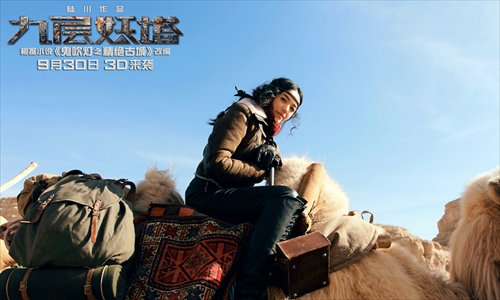
A still from Chronicles of the Ghostly Tribe Photo: CFP
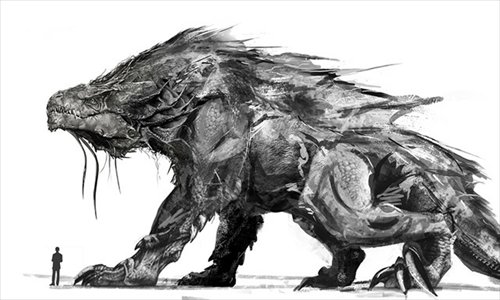
A still from Chronicles of the Ghostly Tribe Photo: CFP
Despite the heavy dissatisfactory voices from viewers of mainland director Lu Chuan's latest commercial film, Chronicles of the Ghostly Tribe, industry experts still gave the film a positive review. A forum analyzing Ghostly Tribe and the future of Chinese fantasy films was held at Peking University, in Beijing, on Sunday afternoon, after which Lu got a job as a consultant to the Institute of Film, Television and Theatre at Peking University.Lu is the second director to be hired by the institution after Chen Kaige, known for works like Farewell My Concubine (1993), and a representative of the fifth generation directors on the mainland.
Paving a new path
According to a recent entgroup.cn survey on the level of viewer satisfaction with National Day holiday films, while Ghostly Tribe was the least satisfactory among the six films on the list, it ranked first in the section regarding a "fresh feeling", with a grade of 81.4/100.
"The importance of Chronicles of the Ghostly Tribe to Chinese film is similar to what The Host is to South Korean films. And Lu Chuan to Chinese language films is similar to what Ridley Scott is to English films," said Wang Xudong, project manager for Lu's film, who was also at the forum.
While Wang's comment might be overstating it a bit, Ghostly Tribe indeed stands out from previous Chinese films. Labelled as a fantasy film, Ghostly Tribe's plot unfolds in contemporary times whereas earlier fantasy works such as Painted Skin, Mural and the various versions of Monkey King all placed their stories in ancient times.
There was a widely recognized unspoken rule among members of the Chinese film industry that cautioned against films depicting story lines after the founding of the People's Republic of China having monsters, demons, spirits or other kinds of supernatural beings because it would be difficult for them to pass the censors.
That is why all the mainland-produced ghost and horror films always ended up having either the lead character suffer from a psychological illness or a character disguising themselves as a ghost.
Ghostly Tribe departs from this into a "taboo" area with direct presentations of a monster on the big screen and the creation of a completely new race the "ghostly tribe," offspring of miscegenation between humans and aliens.
More importantly, while most previous Chinese fantasy films based their stories on traditional legends, Ghostly Tribe created an entirely new world with imposed rules, similar to what many sci-fi stories do.
This kind of purely imagined world is common in many novels. A similar world was also depicted in the recent popular TV drama Nirvana in Fire though it, too, is an ancient story. Hence, Ghostly Tribe stands as the first appearance of such work on the big screen.
More bricks needed
Admittedly Ghostly Tribe has shown the Chinese market that a Chinese-made film can reach the same high level of production on par with Hollywood industry blockbusters, said Yin Hong, an executive vice dean of the School of Journalism and Communication at Tsinghua University. Yin pointed out that the film's content focuses too much on social happenings and histories and lacks an analysis of human nature, the latter being what can appeal to general audiences.
Using The Hunger Games as a contrast to elucidate his point, Yin said, "Hunger Games analyzes humanity and discusses autocracy, freedom, and the autocracy after freedom."
Zhang Yiwu, a professor at Peking University's Chinese Language Department and a research fellow at the university's Institute of Film, Television, and Theatre, sees the market performance failure of Ghostly Tribe in a more practical way.
"[The film] lacks communication with the original novel's fans," he said, explaining that with such a huge following for the novel, mouths of good and bad can directly influence the film's image among other audiences who had not read the book and, therefore, are likely to be swayed by those fans.
An author and director, Lu's early works such as The Missing Gun (2002) and Kekexili depicted strong social commentary earning him praise among the masses. However, when he started producing bigger budget films for the market, many common audiences found it hard to accept. Lu's 2012 costume drama The Last Supper is one example of this; it was criticized for being too deep.
On catering to fans, novelist turned director Guo Jingming seems to be a contrasting example. There is a strong fanbase for all three of his Tiny Times films yet Guo was admonished for being too shallow and worshiping money.
Tailor movies for the market or shut the door and work within an all professional world? It's a hard question, not easily answered.
Posted in: Film