Climbing the ‘Golden Ladder’
By Xu Ming Source:Global Times Published: 2015-11-16 20:13:02
Yoko Ono steps further out from Lennon’s shadow with new exhibition
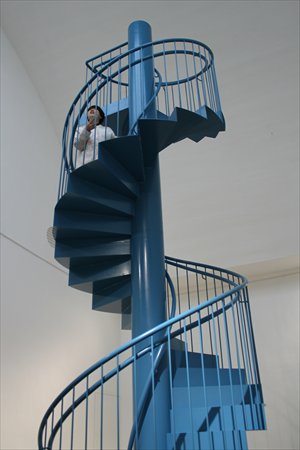
A visitor walks up Yoko Ono's To See The Sky on display at the Faurschou Foundation Beijing on Friday. Photo: Xu Ming/ GT
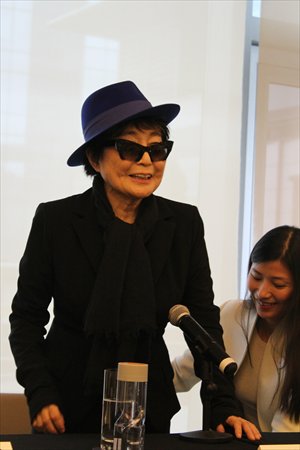
Yoko Ono Photo: Xu Ming/ GT
Not many in attendance were surprised when Yoko Ono suddenly stood up and shouted at the top of her lungs for over one minute after she was invited to say something at the press conference for her first exhibition Golden Ladder in Beijing on Saturday.The audience was actually kind of prepared for it, having heard so much about this globally known avant-garde artist's edgy art and often shocking behavior. However, sitting there I still felt the energy she brought with the vigorous howl she let loose despite her age. This is something I never could have felt without meeting her in person.
When she spoke her concern for peace and anti-war stance were as strong as they were 46 years ago when she and John Lennon held the Bed-Ins for Peace performance, reassurance for the audience that she's still the Ono that they are familiar with.
"It is really good for the Chinese and Japanese people to get together. Instead of using their intelligence to fight each other, it is better to get together. I don't think the world wants that. The world wants us always fighting, so that we are weakened. But we have to know that. They are trying to trick us," Ono said at the conference in response to a question from the Global Times about her feelings on China.
A conceptual journey
"Today, I came here, so that you can hear the voice of a woman," Ono said before her one-minute vocal performance. "My voice is real. My voice is true," she once wrote in song.
It seems that the goal of her appearance and the exhibition at the headquarters of the Faurschou Foundation Beijing is to reveal her true self to people after years of seeing her talent long overshadowed by her husband John Lennon. Since Ono is often referred to as John Lennon's widow, her achievements as a pioneering artist have been largely neglected over the years. Probably only a few people know that it was Ono's advanced ideas about art that attracted Lennon to her when they first met in 1966 and that before meeting Lennon she was already a very accomplished avant-garde artist.
Exhibiting important works from different stages of Ono's career, Golden Ladder allows visitors to truly see Ono as an artist. Together with other exhibitions held around the world in recent years, they constitute Ono's efforts to step out from under Lennon's shadow.
In the exhibition, Ono shows off her conceptual creations to visitors while stressing their participation. Walking into the exhibition hall, visitors will notice four coin-operated dispensers filled with capsules of air selling for 1 yuan a capsule. Sending the message that air is a valuable resource we all share, the work gained an added layer of meaning in Beijing since the exhibition opened on a particularly smoggy Sunday.
The name of the exhibition gives a hint at how important an element ladders have been in Ono's creations. For the exhibition, Ono specially created the work after which the exhibition is named, Golden Ladder. The exhibit is made up of seven ladders, three traditional Chinese ladders and the others more modern, that are covered in leaves of pure gold.
"The ladders symbolize our climb toward the sky in our lives, each in our own way on a precious ladder of existence," curator Jon Hendricks writes in the explanation for the exhibit.
The artist also invited visitors to bring their own golden ladders to add to the work and together expand its scale.
"Participate by contributing a gold colored ladder of your choice. Know that your preference of the ladder - its size and what material is used will determine your entrance in the exhibit in the future," Ono writes in the explanation.
Another work, To See The Sky, which Ono created this year and displayed at The Museum of Modern Art in New York is also part of the Beijing exhibition. An installation work consisting of a blue spiral ladder that entices visitors to climb to the top and look at the sky. However, as you get higher up the structure, as I tried, the stairs begin to shake leading the climber feeling increasingly insecure - a subtle way of allowing visitors to experience how the fear that comes with the climb to freedom.
Affected by Chinese culture
In addition to proving thought-provoking, several of her other works look especially familiar to Chinese visitors due to the amount of Chinese cultural elements presented in their design. In We Are All Water, an installation she created in 2006 and recreated in 2015 for Chinese audiences, 118 transparent bottles filled with water are seen lined up along a wall, labeled with names (in Chinese) of famous and infamous figures around the world. By placing these labeled bottles together, the artist seeks to point out that all people, both good and bad, are actually just water in different containers.
Led by the Chinese philosopher Laozi, the 118 names, which include Sun Yat-sen and Lenin, Martin Luther King and Hideki Tojo, are all represented with the same amount of water to stress their equality.
At the press conference Ono said that she shocked herself when she first created the work: "[I asked myself] Am I saying that Hitler is the same as Napoleon? But all is water. Once you know that, we can surrender to the situation... Surrender is more important than fighting. Surrender is the result of love and understanding," Ono added.
In another installation, Ex It, Ono touches upon the seriousness of death by placing dozens of wooden coffins throughout the display hall to memorialize those that have died in accidents or disasters. However, Ono also provides hope for the future by planting one of the Chinese "Three Friends of Winter" - bamboo, pine and plum trees, three plants that do not lose their leaves in winter - in each coffin. Accompanied by the sound of birds singing, these coffins represent death as well as the hope that the circle of life will go on.
First reading Chinese novels like Journey to the West and Romance of the Three Kingdoms at about 9 or 10, Ono admitted that she has been greatly affected by Chinese culture.
"Japan is so near China, so we get everything from you," she pointed out.
"Many things of China are not known so much to the world, because they don't want to know. But the thing is, Saiyuki (Journey to the West) is full of a sense of humor. Chinese culture has a sense of humor. Japan certainly doesn't have that much of a sense of humor as old Chinese people. It is incredible stuff," remarked Ono.
To encourage understanding and world peace, Ono created a special Wish Trees For Beijing exhibit outside the exhibition hall where she again uses the "Three Friends of Winter." Here she invites the public to write their wishes on cards and hang them on the trees. When the exhibition ends on July 3, these wishes will all be sent to Ono's Imagine Peace Tower in Iceland, to join the millions of wishes collected through the Wish Trees exhibition's travels around the world.
"We feel together. And together, we can change the world. So everybody is very important," Ono said.

Scan to see video
Posted in: Celebrity, Art