Physical theater piece revives a classic ghostly character from Chinese opera
Before the launch ceremony of Li Huiniang took place at Shanghai Dramatic Arts Center (SDAC) Monday, the cast and crew of the physical theater piece had rehearsed for half a week. Unlike most plays, in which early rehearsals require just the actors and director, almost all the crew members of the show were involved.
"The lighting operator, sound engineer and stage supervisor accompanied our rehearsals, because they are so significant for this show," said Guo Hongbo, director of the play. "Even a minor lighting change will lead to an alteration in the performance's pace and atmosphere."
Guo embraces improvisation during rehearsals, as they help him find the best way of bringing alive his characters.
In this case, the protagonist is Li Huiniang, one of the favorite characters from traditional Chinese opera. Originally created by a Ming Dynasty (1368-1644) writer, the character of Li was a poor concubine of Jia Sidao, a merciless prime minister in Southern Song Dynasty (1127-1279). After discovering Li's fondness for another man named Pei Shunqing, Jia killed Li and held Pei in captivity. Li later returned as an angry ghost who hoped to someday rescue Pei.
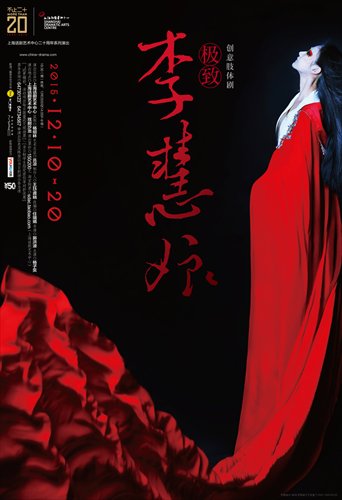
A poster for contemporary physical theater Li Huiniang
Over the intervening centuries, Li's story has been adapted and used in different Chinese opera styles such as Peking Opera, Qin Opera of Northwest China, and Yueju Opera of South China.
This new performance is the first time the story has been told through contemporary physical theater.
Inside the traditional shell
This is the seventh piece of physical theater directed by 35-year-old Guo, who finds traditional Chinese opera a treasure trove of inspiration for contemporary theater practice.
"The minimalist stage and the importance of rich body movements in traditional Chinese opera resemble that of Western physical theater, so why don't we learn from them and turn waning art forms into something lively for modern audiences?" said Guo.
He added that, like many young people, he was once resistant to traditional Chinese opera until he went to see and appreciate it for himself.
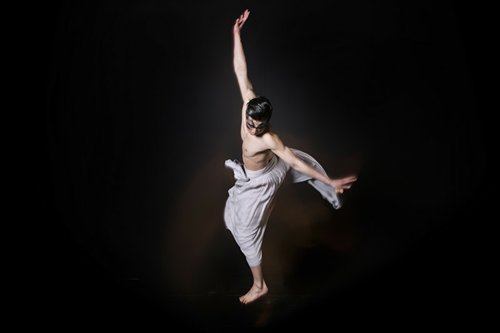
The physical movements in Li Huiniang are a combination of traditional Chinese opera, classical dance and contemporary dance.
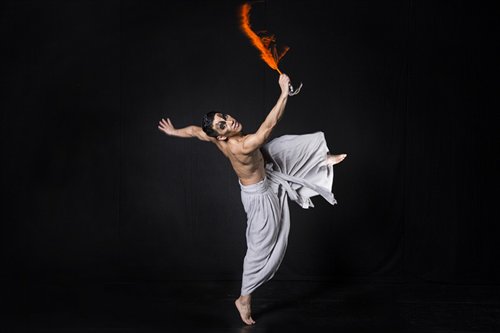
Li Huiniang combines movements from traditional Chinese opera, classical dance and contemporary dance.
A number of professionals from Shanghai Theatre Academy have given guidance to cast and crew on Chinese opera performing. Among them is Xiao Ying, an assistant professor in the acting department, who served as action director for the well-received ancient costume play Jiangjun Xing. Li Huiniang combines movements from traditional Chinese opera, classical dance and contemporary dance. Photos: Courtesy of Qin Zhizhi
Yang Ziyi, an SDAC actress with a background in classical dance, takes the title role. In the past week, she has been doing a lot of physical training and practice, like a student in a Chinese opera school, to accomplish the ancient elegant yet powerful movements.
"I've also tried sitting in mediation to achieve the inner peace that may help me to reach the calm mind of ancient people, because nowadays young people like me are often too impulsive and restless in this hustle and bustle society," Yang told the Global Times. She also read Buddhist and Taoist books to absorb traditional Chinese mentality to feel the role of Li Huiniang.
"Playing the role of Li is very different from my previous theater experience," said Yang. Months ago, she played the role of Una, a victim of pedophilia, in the Chinese version of award-winning play Black Bird.
For Yang, Una cares more about herself and her own feelings and thus would do things impulsively regardless of consequences. In contrast, Li is a symbol of traditional morality in China, who is reserved and willing to "sacrifice" everything for her love.
"I think what I'm trying to do in the show is to go back to the charm of Li Huiniang, go back to some valuable virtue of Chinese women in the past," Yang told the Global Times. "These women who choose to serve full-heartedly for their love and their family are also very charming."
Guo explained that the play is not saying that women should only serve men and make sacrifices for them, but that when a woman chooses to do so, it should be regarded as a virtue rather than a degradation.
The 75-minute show will continue Guo's minimalist style, with very few props and a simple stage design. With these elements, the play will create poetic scenes such as snow-covered mountains with flying birds and furious scenes of burning flames, evoking the time and passion of the story for the audience.
Date: December 10 to 20, 7:30 pm
Venue: Shanghai Dramatic Arts Center
上海话剧艺术中心
Address: 288 Anfu Road
安福路288号
Tickets: 150 yuan ($23.5) to 200 yuan
Call 6473-0123 for details
Newspaper headline: Angry lover