HOME >> ARTS
Banjo renaissance
By Chris Hawke Source:Global Times Published: 2015-11-19 22:38:01
Pioneering musician introduces hot jazz to China
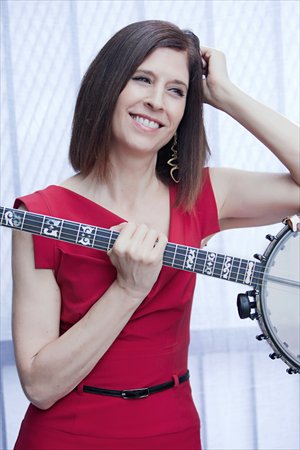
Cynthia Sayer Photo: Courtesy of Cynthia Sayer
When Cynthia Sayer was 13, she never dreamed that one day she would be the front woman of a jazz quintet, on a stage in Beijing, answering questions about playing the banjo.Mostly because at that age she wanted to play the drums.
"I told my parents I wanted a drum set. They said no way. I lobbied hard for a couple of weeks, but they wouldn't budge," she recalls.
Sayer grew up in Scotch Plains, New Jersey, hardly a center for the hot jazz of the 1920s, the banjo, or music of any kind. In those pre-Internet days, she had no access to the music that would eventually become the backbone of her career. She was familiar with seminal jazzman Louis Armstrong through her parents' recording of the Hello Dolly soundtrack.
One day she came home, and there was a banjo on her bed. "I saw that and I knew I would never get my drums," she said.
Her parents had noticed an ad in the newspaper from a banjo instructor, Patty Fisher, who had just moved into town. "They figured anything had to be better than drums and arranged some lessons," she told the Global Times.
First lesson
The banjo is experiencing a renaissance in the US right now. The New York Times ran a front page story on the winner of Steve Martin's annual banjo award. Young musicians are incorporating it into popular music. But when Sayer was a teenager, the banjo was beyond not cool. It was weird.
Sayer took her new instrument and met her new teacher. "I was dazzled by her," Sayer recalls. She had never met an adult in the arts before, let alone a professional woman in the arts.
"Banjo, that's okay. But that's how I got to hang out with Patty Fisher."
At the time, the banjo's heyday had long faded. It was once a staple of popular music, and played a key role in early jazz, folk and country music. But by the time Sayer was a teenager, the banjo was mostly known as a bluegrass instrument.
Sayer's glamorous new teacher explained all the different types of banjos and banjo styles. There was the 5-string banjo used in bluegrass and old time music. There were also the tenor and plectrum banjos used in traditional jazz and sing-along music. The impressionable young girl decided to emulate her new hero, and chose to play plectrum banjo, the lesser-known 4-string cousin of the 5-string banjo.
Lesser-known cousin
The 5-string bluegrass banjo style made famous by Earl Scruggs featured exciting rapid fire fingerpicking in unusual patterns over a steady rhythm. Bluegrass music bubbled into the mainstream as the soundtrack to movies like Bonnie and Clyde and Deliverance, and on television shows like Hee Haw.
On the other hand, the last plectrum banjo player to become a household name was Eddie Peabody who rose to fame in the 1920s and was as big as any famous music star today. The instrument is most noted for its use in early jazz music, and also as an accompaniment with piano for sing-alongs, featuring old popular music like "You Are My Sunshine."
These sing-alongs were still popular when Sayer was a teen, and she found professional gigs on the banjo almost immediately.
When Sayer started playing, she was overwhelmed by how kind and generous the older, almost exclusively male musicians were with their advice and help. In retrospect, she realizes that they were stuck playing with her because there was a shortage of 4-string banjo players at the time, so it was in their interests for her to improve as quickly as possible, which she did.
Women in jazz
Being a female instrumentalist in the jazz world was very rare at the time. She was frequently assumed to be the singer, or a girlfriend of a band member.
That started changing gradually as she became well established and renowned in the traditional jazz world. Quality women instrumentalists were so rare that she toured for 15 years before finally sharing the stage with another woman player. Happily, in the last five years or so, a new crop of young women who are top quality players have begun playing traditional jazz professionally.
Sayer is not sure what triggered the increasing number of female players, but she is grateful for it. She founded an all-female traditional jazz band that tours Europe called The Women of the World Jazz Band (or WOW). Pointing out that there is still a long way to go, she notes, "When one of the women can't make a gig, it's really hard to find someone to replace them," due to the continuing scarcity of top women players in the field.
Trip to China
Sayer, inspired by a Chinese friend who came to New York as a teenager to study at Juilliard, decided she would like to tour through China.
On this tour, Sayer and her band Joyride have already toured through Xian, Hangzhou, Guangzhou, Hong Kong and Xiamen. She will be playing at the upscale lounge Xiu in the Park Hyatt Beijing on Saturday evening.
"I would say for the most part this music is new to them. Many have said so," says Sayer. "The energy has been so warm and inviting. Audiences have been enthusiastic and receptive in the most wonderful way."
During a Q&A after a performance at the Beijing Foreign Studies University on Wednesday, students in the audience gushed about how much they enjoyed her show, a combination of original material and early jazz standards, and asked her very basic questions about performing this kind of music. Perhaps most memorably for Sayer, a young boy in the audience, perhaps 13 years old, stood up and asked in broken English, "Where can I learn to play the banjo?"
Posted in: Music