HOME >> BUSINESS
Record smog drives demand for ventilation systems
By Zhang Ye Source:Global Times Published: 2015-12-1 21:13:01
Individuals show fresh interest as pollution persists in northern China
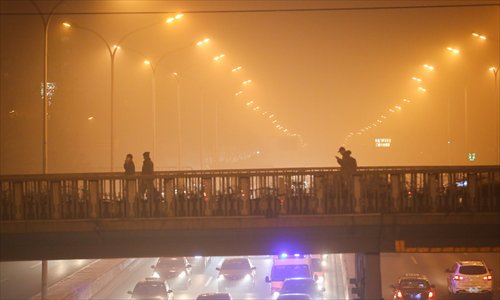
A smoggy Beijing street Photo: CFP
Fresh air ventilation systems are gaining popularity among high-end consumers as thick smog has settled over northern China for days.
"Domestic demand for fresh air ventilation systems has grown dramatically this year. We've seen orders for such systems increase twice so far in comparison with the same period of 2014," Yang Xiaofeng, head of a Beijing-based air purification solutions company, told the Global Times Tuesday.
Fresh air ventilation systems, which can be installed inside an apartment, are generally designed to pump out stale indoor air and eliminate harmful pollutants. Compared with commonly used air purifiers, the fresh air ventilation system is a more professional and safer air purification method, which will not create ozone - an emission that may harm human health - while working as the former did, said experts.
These new systems were unfamiliar to Chinese individuals in the past, but they have generated quite a lot of consumer interest these days, said Yang, who has been selling fresh air ventilation systems from big-name brands such as Japan's Panasonic Corp over the past four years.
Data from a domestic fresh air ventilation system information provider, xinfengxitong.net, showed that the number of customers and merchants who showed an interest in such systems has surged up to five times in the third quarter from the second quarter.
The figures come against the backdrop of the severe air pollution occurring in northern China since Friday.
Beijing, for instance, has been choking on thick brown smog for five days. It experienced record-breaking air pollution on Monday when the concentrations of airborne particles smaller than 2.5 microns in diameter (PM2.5) peaked at 900 micrograms per cubic meter in southern Beijing, more than 30 times the World Health Organization's safe level.
Zhang Dawei, head of Beijing's environmental monitoring center, was quoted as saying by the Xinhua News Agency on Tuesday that tests found coal burning was to blame for the latest pollution surge.
China has been intensifying efforts to solve its air pollution issue, with total investment expected to reach 17 trillion yuan ($2.66 trillion) in energy conservation and environmental protection during the 13th Five-Year Plan period (2016-20), according to a statement posted by the Ministry of Commerce on Tuesday.
A Beijing resident, surnamed Shi, attributed her decision to buy an air ventilation system mainly to the latest thick smog. She already had an air purifier but said that "one air purifier can hardly supply fresh air for the whole house"and the fresh air ventilation system will generate better effects.
"In addition, a high-quality air purifier can be priced at 10,000 yuan. I'd rather install a fresh air ventilation system, which, I've learned, usually costs about 10,000 yuan for 100 square meters," Shi told the Global Times Tuesday.
Some consumers like Guo Xin, another Beijing resident who has two air purifiers, consider convenience as a major reason for using fresh air ventilators.
"Two air purifiers, one in the bedroom and the other in the living room, are effective. But I will still try a fresh air ventilation system, because the system can be installed on the ceiling without taking up any space on the floor," Guo told the Global Times Tuesday.
Air pollution can be a catalyst, but the long-term sound development of the fresh air ventilation system relies on whether there are many middle-class consumers like Guo paying great attention to healthcare and indoor living conditions, Liu Haiyang, founder of xinfengxitong.net, told the Global Times Tuesday.
Both Liu and Yang said that the industry is a niche market that faces many hurdles.
For example, property management companies usually do not allow households to install fresh air ventilation systems. That requires boring holes in the ceiling, which management companies claim will damage the whole building, Yang said.
Also, the market is full of counterfeits and low-quality products, dampening the prospects of the sector, he noted.
Posted in: Companies