Through yonder window breaks
A visit to Verona – Home of Romeo and Juliet
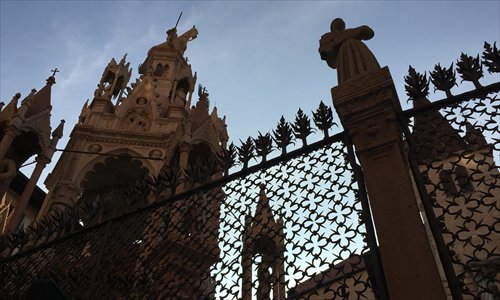
Verona's Arche Scaligere Photo: Chu Daye/GT
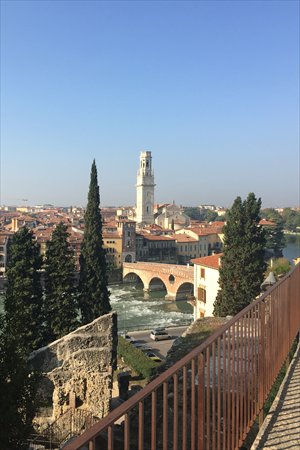
View of a cathedral across the Ponte Pietra Photo: Chu Daye/GT
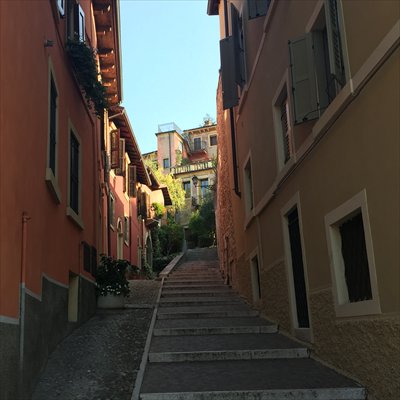
An alleyway in Verona Photo: Chu Daye/GT
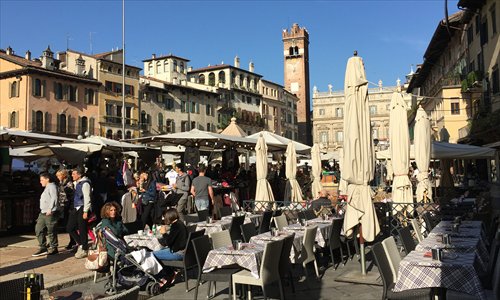
View of the Piazza Erbe Photo: Chu Daye/GT
The city of Verona in northern Italy is most famous as being the setting where William Shakespeare's Romeo and Juliet, one of the world's most famous love stories, takes place.
This fall, I had the chance to visit the city for a second time and revel in the romance, beauty and the historical atmosphere of this ancient city that can trace its origins back to Roman times in the 1st century BC.
Missed opportunity
The final scene of my first visit to Verona was quite dramatic. It consisted of me sitting in a van crossing the city's bridge, as the sight of several elegant bridges crossing the Adige River moved past a hazy canopy composed by winter drizzle, tears came to my eyes - I had spent too much time shopping and squandered my one-hour stay in the city. At the time I was part of a tour group and we never even reached the banks of the Adige because we were hooked by the boutique stores on the shopping avenue. I only really discovered the city's beauty as we were driving away from it.
The beauty of Verona is multifold, but the major attractions that you should see include the city walls, the ancient amphitheater built by the Romans known as the Verona Arena, the Piazza Erbe and of course the House of Juliet, the belle whose name lives forever on the lips of men.
The Verona Arena is one of the best preserved Roman colosseums today. During the course of its 2,000 years of existence it has withstood several major earthquakes. In fact, even today it still functions as a venue for events like concerts and theatrical plays in the summer time. For two millennia, it has been the heart of the city.
Verona's city wall looked rather tall and thin compared with their Chinese counterparts, such as the walls of Xi'an, capital of Northwest China's Shaanxi Province. Large pebble stones can be seen as making up the main elements of the wall and large parts of the wall have been dug out to allow modern day traffic.
My first morning excursion after arriving in the city a second time consisted of a nice walk around the city. It was still dark at the time and in the dim light of early morning the view of a shiny red city bus with glaring headlights passing through wall's gate with its stylish battlements was quite captivating. It felt like I was trapped at a point where the past and present had merged into one.
I had reached the Bra Gates, the city's main gate during the 13th century, and it was just a few hundred meters away from the Arena.
As I walked through the gate, I was hooked by a marble inscription. It read, "There is no world without Verona walls. But purgatory, torture, hell itself."
Back home, I checked this out, and it turned out to be one of those famous verses by William Shakespeare, specifically from his play Romeo and Juliet. In the play, the Bra Gates are the gates Romeo took when he left Verona:
I was later confronted by a similar connection between Verona's historic relics and Shakespeare's works in the tomb of Juliet:
"A grave? O no! a lantern, slaughter'd youth, For here lies Juliet, and her beauty makes, This vault a feasting presence full of light."
I saw this line written on the entrance to the crypt of Juliet's tomb. Inside the vault of the tomb, I saw even more writing - what seemed like millions of signatures and messages left by lovers from all over the world.
The city has played an extremely important role in European history as it served as an important stop on the trade routes between major Italian cities south of the Alps, such as Milan in the West and Venice along the Adriatic coast. The city's mark in history, from Roman times all the way to the Renaissance, is so deep that three of Shakespeare's plays are set in Verona: Romeo and Juliet, The Two Gentlemen of Verona and The Taming of the Shrew.
Beautiful buildings
As the location of Italian cities seldom change and new buildings often rise from the ruins of previous ones, as you tour around the city you may discover yourself walking over a glass section of the street. Underneath the glass, you can see the original floors and delicate frescos of a Roman building that does not exist anymore.
This way of protecting and displaying ancient ruins and heritage sites can be found on Verona's main street near the Eastern Gate and the Piazza dei Signori. I was stunned by every ruin and was amazed at how they came together to create a tunnel that merged the past and present.
This delicate and intricate square holds an important place in the history of the world's architecture. In his book Essays on Italian Architecture, Chinese architect Chen Zhihua specifically mentions the connected social space that is formed by the Piazza Erbe and the Piazza dei Signori. The city squares are linked by alleyways and are not far from each other, forming a unique layout not commonly seen elsewhere.
There is a saying: Only when you are in Italy, you know how to love.
I don't know when we lost this inherit capacity, but I will have to admit that our Italian friends are miles ahead of many people in the world when it comes to their pursuit of the love of life.
At the Ponte Pietra, I noticed there was a hotel immediately close to the bridge's gate tower. Its balconies were covered by vines and was located in such a way that you wouldn't have thought to give it a second look.
Yet a closer examination showed that there were three floors of balconies hanging over the steep bank of the Adige River.
It was cutely laid out with tables - not too many, just a handful - hidden under the ivy. Looking at such a small restaurant, it was clear that the owner's goal was not raking in the cash, but adhering to a certain way of living. One that allowed customers to admire the beauty of the bridge by candle light as they enjoy a glass of wine. What he had created was a life attitude.
Rules of Thumb
1. The essential parts of the city can be visited in about half a day. However if you have more time, try to stay for a night to give yourself more time to enjoy the city. With the euro depreciating against the yuan by large amount in recent years, accommodations are becoming increasingly affordable. We stayed in a hotel a few meters away from the Arena, and it only cost about 1,000 yuan ($156) per night, almost the same price you'd find in some Chinese cities. We were able to enjoy the benefits of staying in the center of the city, going everywhere on foot and returning a little bit late at night without having to worry about traffic at all.
2. Try to walk some distance along the Adige River. For me this provided some of the best scenic views of the city, with the beautiful Ponte Pietra, the Greek theater, and at the little hill of Castel San Pietro, you get to see the silhouette of Verona's historical center. A massive expansion of red roofs, yellow walls, the white marble tower of a church and blackened time-seasoned granite bridges dotted by greenery and spire-like Italian cypresses. We even saw someone kayaking in the torrents of the Adige!
3. Climb the Lamberti Tower and reach for the skies! When we were there, we were actually short of time, so my friends took the elevator. However, I decided to take the hard way. Hurrying up the stairs, my lungs felt like they were about to explode. The commanding height of the tower was definitely worth the climb though. When you look at the city from the top of the tower for yourself, you'll understand.
4. Try to see more of the sights before you indulge yourself in the city's dazzling boutique stores that display the various temptations of the sophisticated material world.