HOME >> ARTS
Exhibition 'Cross Line' merges modern and traditional Chinese art
By Lu Qianwen in Shenzhen Source:Global Times Published: 2015-12-8 18:08:01
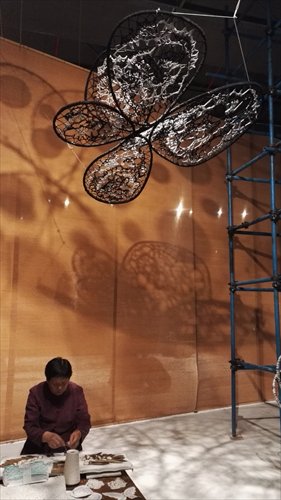
A woman from Shandong Province demonstrates traditional drawn thread work at the Cross Line exhibition in Shenzhen on Saturday.
While the Internet age has seen people become used to living and working online, the recently opened exhibition Cross Line is trying to remind people of a forgotten art whose beauty can only be realized via lines of thread stitched in the real world. Unveiled at the OCT-LOFT in Shenzhen, Cross Line gathered eight artists of modern art and seven handicraftsman of traditional Chinese art together to create works that inspire viewers to look at modern art in a new way, while also reminding them of the role that disappearing traditional arts can play in today's society.
A long-time fan of traditional handicrafts such as embroidery, Chen Yuecheng, the organizer behind Cross Line, initially just wanted to hold an exhibition on embroidery that would try to raise people's awareness of traditional handicrafts. However, with the help of well-known curators Zhang Zikang and Yan Weixin, the exhibition became something larger - an exhibition that combines traditional handicraft with modern art that helps viewers see the untapped potential of both.
A break from tradition
Anyone who has seen Suxiu (Suzhou embroidery), whose origins can be traced back about 2,000 years, is usually deeply impressed by the lively and brightly-colored patterns on silk that are typical of the art form. However, in artist Shao Yinong's work Ages at the exhibition a traditional Suxiu work is turned into a gloomy and dark-colored five yuan paper note dating from the The Republic of China (1912-49) period. This somber exhibit stands in sharp contrast to traditional Suxiu works.
The sight of the hard currency sought after by people around the world woven onto soft silk is very impactful, reminding viewers of the many heroic figures throughout history that were ruined by the pursuit of wealth and the invisible but strong influence money has on society.
"Shao's work is a product of the comprise and coordination between traditional and modern art," said Wang Luxiang, the academic chair for the exhibition. Although there are still quite a few embroiderers in Suzhou today, Shao had a hard time finding one who was willing to create such a work for him, despite the fact that he was constantly offering more money to each embroidery master he asked. With traditional concepts about Suxiu deeply rooted in their minds, Shao's idea of using more somber colors must have seen like an affront to their tradition. As such Shao had to spend a lot of time persuading embroiderers to accept his idea.
"It took the embroiderers a whole year to complete the work," Wang introduced.
"It was a creative challenge for them since they had never dealt with such a situation and so had to figure out how to match these dark colors."

Wang Luxiang introduces Shao Yinong's work Ages. Photos: Lu Qianwen/ GT
Creative protection
The creative challenges that the artists encountered while integrating traditional and modern art can be pervasively seen in other works at the exhibition.
In artist Qiu Zhijie's works Cell and The World View, traditional bamboo plaiting techniques were used to plait copies of the human bones found at famous archaeological sites. It comes across as quite shocking to see this ancient art which had long been applied in an elegant and tasteful way used to such a macabre end.
While this combination of past and present may change the very nature of these traditional arts, it is also a way to keep them alive in modern times.
Zhang has long focused on finding ways to protect and preserve China's intangible cultural heritage. He told the Global Times that in his opinion protecting traditional culture by merely copying the art is nowhere near as effective as using creativity to help these traditional arts survive in today's world. He calls this concept "creative protection."
This type of creative protection is exactly what Cross Line is trying to explore. Presented in the form of modern art, time-honored handicraft arts acquire new life, while also adding an extra layer of meaning to these works that would otherwise be missing if they were made from modern metal and plastic.
Independent art
This merging also provides other benefits to modern Chinese art, which is constantly criticized for following too closely in the steps of Western art - it helps make it more independent and distinct. Shao's Five-yuan wouldn't be quite so shocking to visitors if it were made using modern techniques or materials, and Qiu's works wouldn't seem so weird and chilling if bamboo had been used instead.
While traditional art emphasizes the immaterial artistic spirit, contemporary art tends to be more about the actual materials themselves. Finding a balance between the two is an exploration carried out by many artists around the world.
"When you come down to it, contemporary art lies in its independence and creativity," said Wang. "Turning to our traditional arts gives it a unique distinctiveness."
Newspaper headline: Stitched threads
Posted in: Art