Larger than life
South Korean hyper-realistic painter’s journey into humanity and history
Frameless Heads, a new exhibition of work by South Korean artist Kang Hyung-koo (pictured below) at MoCA Shanghai, fittingly takes its name from a lyric in the Don McLean song "Vincent."
On the third floor of the venue, the song accompanies a video about Kang, who sold one of his portraits of Vincent van Gogh for $350,000 in 2004.
Meanwhile, the first and second floors are filled with dozens of larger-than-life human portraits, each hung on a white wall, most featuring large heads with eyes that gaze outward.
Born in 1955, Kang is famous for his hyper-realistic portraits of famed figures, including political leaders such as Abraham Lincoln and cultural icons such as Samuel Beckett, Marilyn Monroe and Audrey Hepburn. He also paints a large number of self-portraits.
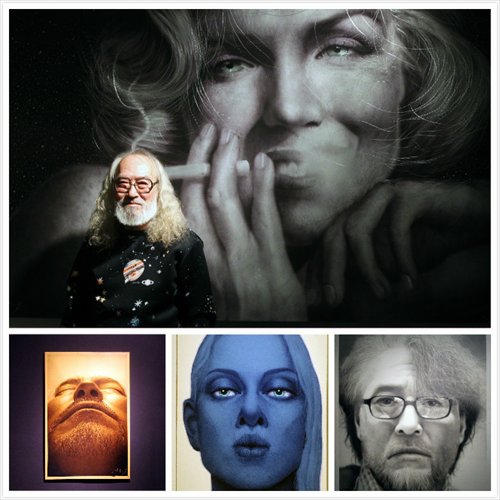
(Above) Some of the hyper-realistic portraits by South Korean artist Kang Hyung-koo Photos: Yang Hui/GT
Extreme details
Kang paints on canvas, aluminum and acrylic panels with tools that include airbrush, nails, electric drills, cotton buds, toothpicks and erasers to present vivid and sensational portraits featuring extreme detailing in wrinkles and hair.
"Van Gogh and Rembrandt also painted a lot of self-portraits, but I have more self-portraits and the size is bigger than theirs," said Kang, who started his artistic career in the late 1980s.
After graduating from art school, Kang was a clerk at an agricultural import company for 10 years before he decided to go back to the art scene. Self-portraits made up one-third of his early works.
"Many people recognized me as a sincere artist because of my self-portraits, as they were not very commercial," said Kang, who also made self-portraits based on what he may look like in old age and even death.
"My self-portraits seem very serious, but I'm a very funny person actually. I'm a man who never made a woman cry, but always made her laugh," said the artist.
"The reason my self-portraits look a little depressing and sad is the actuality that there are not that many happy events in this world," he said.
"I'm not painting myself per se, but I'm trying to express many facts I have to live with in this life, so I choose different emotions and different appearances."
Although Kang paints famous people, his focus is the history, humanity and stories behind them.
"For example, if you look at Gandhi, you are immediately reminded of the colonization of India by the British Empire," said Kang.
"I sometimes have to paint some not-so-nice people, because they are important in history and they have influenced the world."
Unlike some hyper-realistic artists who use technology to help in their painting, Kang sticks to the most basic techniques.
To begin with, he first finds a source image. He then draws a grid over it and the canvas to help in his painting. He leaves the grid on the canvas once the work is complete.
"I'm fascinated by the size (of my work) and I always focus on the subject's eyes," said Kang.
"When the subject's eyes look back at me, it gives me a lot of excitement, and when I have felt that fascination and excitement, I know that the work is finally done."
He also uses colors to express emotions in his paintings. Red is for passion, blue for calm, while black and white are used to express more complicated emotions.
Break time
Kang paints fewer than 30 portraits per year, and he often has 10 or more paintings underway at one time. He finds switching between paintings keeps him inspired and gives him the energy to create.
"I also need to find the right time to take a break," said the artist. "The most important time to take a break is when you have a very good flow and you just can't stop painting. That's very difficult, like when you're in a bathroom and taking a pee and you have to stop in mid flow."
The reason for taking a break at such a point, according to Kang, is that when the process is going very well, you feel like you'll achieve something successful, and you feel like the work will welcome you back.
But when you feel frustrated and take a break, you may be unable to overcome your frustration, and find yourself never returning to the piece.
"The way to paint a very good work is never to lose the rhythm or the good working process," said Kang.
Having been in Shanghai for a couple of days, Kang is creating a piece of work inspired by the city.
The rivers and waterways of Shanghai have impressed him a lot and he has decided to use blue as the background for this portrait.
The subject, after a painstaking search through the city's icons, will be Lu Xun, the prestigious writer and revolutionist who spent most of his time in Shanghai.
Date: Until January 16, 10 am to 6 pm
Venue: MoCA Shanghai
Address: 231 Nanjing Road West
南京西路231号
Admission: 50 yuan ($7.78)
Call 6327-9900 for details