HOME >> METRO SHANGHAI
Dialogue of civilizations
By Yang Lan Source:Global Times Published: 2015-12-17 19:03:01
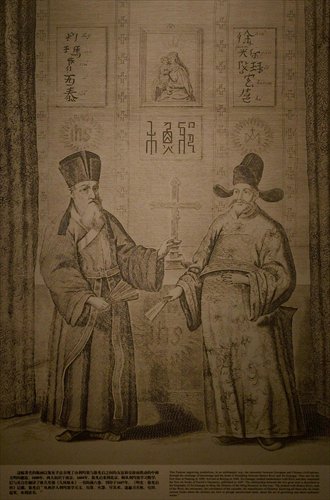
In the 13th century, a group of Italian missionaries led by Giovanni da Pian del Carpine arrived in China to visit the territory of the Great Khan in the Mongol Empire. But the earliest China-Italian exchange in philosophy and science took place in the 16th century, between Chinese scholar-bureaucrat Xu Guangqi in Ming Dynasty (1368-1644) and Italian Jesuit priest Matteo Ricci.
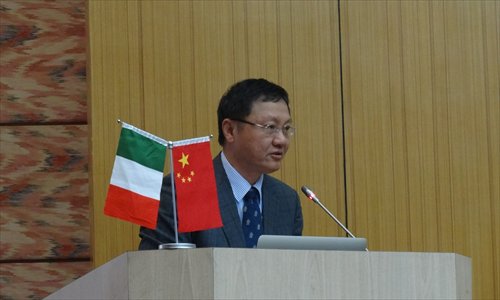
"The earliest use of geometry in China, which today all Chinese students learn in school, was introduced by Xu and Ricci. They worked together and translated part of Euclid's Elements, a geometric treatise, into Chinese. Matteo Ricci also translated Chinese classic books into European languages with the help of scholars like Xu Guangqi," said Li Tiangang, Director of Xu-Ricci Dialogue Institute.
With the first translation of Euclidean concepts into Chinese, Xu and Ricci opened the dialogue between Confucianism and the Christianity, resulting in millennia of scientific collaboration between the two countries.
Increased collaboration
Data provided by Plinio Innocenzi, the science and technology counselor of the Embassy of Italy to China, shows that the number of Chinese scientific publications grew by 234 percent between 2008 to 2014, reaching 500,000.
Although the number of scientific publications in Italy has only grown 32 percent in that same period, publications coauthored between Italian and Chinese scholars increased by 414 percent to over 1,800.
In Europe, the UK ranks first in terms of the number of scientific publications coauthored with Chinese researchers, followed by Germany and France. Italy ranks the fourth, but is also the fastest-growing.
The most common topics that Chinese and Italian scholars collaborate on are physics and astronomy (37 percent), medicine (23.8 percent) and engineering (17 percent), with coauthored publications accounting for 78 percent.
Ongoing exchange
Following increased cooperation in academic research, the two countries have also seen many educational collaborations and student exchanges.
The Xu-Ricci Dialogue Institute of the School of Philosophy at Fudan University was established in 2010. It was named after Xu Guangqi and Matteo Ricci and aims to contribute to the ongoing dialogue between cultures and religious traditions in China and Western countries.
Next year marks the 10th anniversary of the cooperation between Fudan University and two major Italian universities, according to Stefano Beltrame, Consul General of Italy in Shanghai.
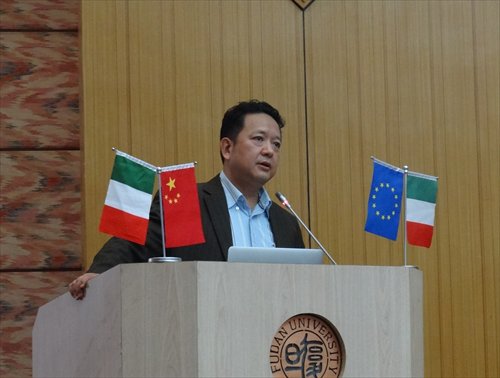
"The number of Chinese students studying abroad is reaching half a million per year. At the same time, about 400,000 foreign students come to study in China every year," said Shen Jian, chair of the Department of Physics at Fudan University.
However, he added, most Chinese students prefer to study in US, Canada, Australia or other Asian countries. Only a small percentage goes to Italy. Likewise, Italian students account for just a fraction of the number of foreign students visiting China. Shen believes that there is still room for growth in the exchange between Chinese and Italian students.
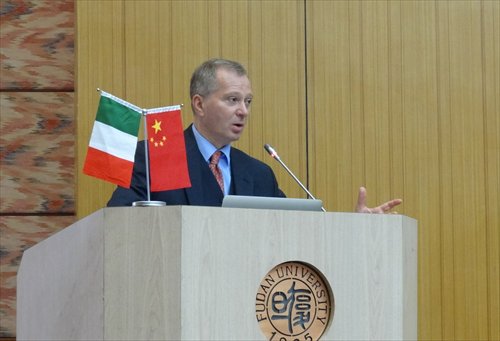
"Xu Guangqi and Matteo Ricci are quite famous in China. They had great personal relations. However, while everyone knows Matteo Ricci in Italy, very few Italians know about Xu Guangqi. It is our duty here to try to fill the gaps," said Beltrame.

"The earliest use of geometry in China, which today all Chinese students learn in school, was introduced by Xu and Ricci. They worked together and translated part of Euclid's Elements, a geometric treatise, into Chinese. Matteo Ricci also translated Chinese classic books into European languages with the help of scholars like Xu Guangqi," said Li Tiangang, Director of Xu-Ricci Dialogue Institute.
With the first translation of Euclidean concepts into Chinese, Xu and Ricci opened the dialogue between Confucianism and the Christianity, resulting in millennia of scientific collaboration between the two countries.
Increased collaboration
Data provided by Plinio Innocenzi, the science and technology counselor of the Embassy of Italy to China, shows that the number of Chinese scientific publications grew by 234 percent between 2008 to 2014, reaching 500,000.
Although the number of scientific publications in Italy has only grown 32 percent in that same period, publications coauthored between Italian and Chinese scholars increased by 414 percent to over 1,800.
In Europe, the UK ranks first in terms of the number of scientific publications coauthored with Chinese researchers, followed by Germany and France. Italy ranks the fourth, but is also the fastest-growing.
The most common topics that Chinese and Italian scholars collaborate on are physics and astronomy (37 percent), medicine (23.8 percent) and engineering (17 percent), with coauthored publications accounting for 78 percent.
Ongoing exchange
Following increased cooperation in academic research, the two countries have also seen many educational collaborations and student exchanges.
The Xu-Ricci Dialogue Institute of the School of Philosophy at Fudan University was established in 2010. It was named after Xu Guangqi and Matteo Ricci and aims to contribute to the ongoing dialogue between cultures and religious traditions in China and Western countries.
Next year marks the 10th anniversary of the cooperation between Fudan University and two major Italian universities, according to Stefano Beltrame, Consul General of Italy in Shanghai.
"The number of Chinese students studying abroad is reaching half a million per year. At the same time, about 400,000 foreign students come to study in China every year," said Shen Jian, chair of the Department of Physics at Fudan University.
However, he added, most Chinese students prefer to study in US, Canada, Australia or other Asian countries. Only a small percentage goes to Italy. Likewise, Italian students account for just a fraction of the number of foreign students visiting China. Shen believes that there is still room for growth in the exchange between Chinese and Italian students.
"Xu Guangqi and Matteo Ricci are quite famous in China. They had great personal relations. However, while everyone knows Matteo Ricci in Italy, very few Italians know about Xu Guangqi. It is our duty here to try to fill the gaps," said Beltrame.
An etching of Matteo Ricci and Xu Guangqi from an exhibition in Shanghai Library in 2010
The bronze statues of Matteo Ricci and Xu Guangqi at Guangqi Park in Shanghai
(From above) Shen Jian, Li Tiangang and Stefano Beltrame speak at a recent forum on cooperation between China and Italy in Shanghai.
Photos: CFP, IC and Yang Lan/GT
Posted in: Metro Shanghai