Joining EBRD a big step in yuan’s Europeanization
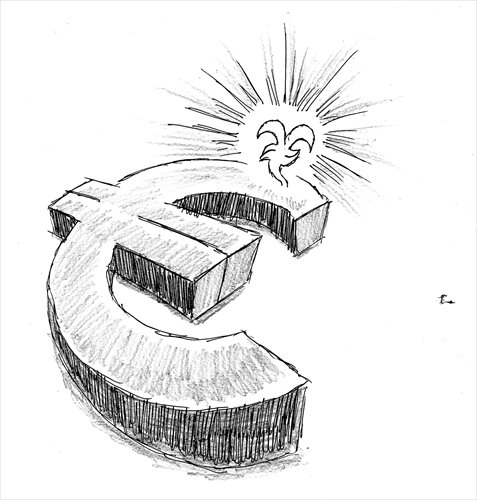
Illustration: Peter C. Espina/GT
The European Bank for Reconstruction and Development (EBRD) announced last week that it had accepted China as a new member, handing the world's second-biggest economy investment routes into Europe, Africa and the Middle East. The news did not gain a huge amount of attention in the Chinese media, but this may be due to the fact that China will have a shareholding of only 0.01 percent in the EBRD.
However, this minuscule amount is a significant step for China. The EBRD was founded in 1991 to help Central and East European states make the transition toward becoming market economies, and some of the countries where the EBRD operates are on the route of China's "One Belt, One Road" initiative. The geographical, political and economic connections between these countries and China will help contribute to the work of the EBRD.
Joining the EBRD will also contribute to the yuan's Europeanization. The IMF recently confirmed its decision to include the yuan in its Special Drawing Rights (SDR) basket from October 1, 2016.
This is crucial for the Chinese currency's internationalization as it will not just be the fifth currency in the basket.
Given its weighting in the basket - 10.92 percent, which is higher than that of the British pound sterling and Japanese Yen - the yuan will soon be the third international currency after the US dollar and the euro.
I believe the yuan's internationalization should be divided into three phases: its Asianization, Europeanization and finally its internationalization.
Numerous currency swap agreements have been signed between China and other countries, and more and more institutions and enterprises have started to use the yuan in their transaction settlement and bookkeeping. So the yuan is increasingly present and accepted in more and more regions. Today we can say without exaggeration that the Chinese currency has almost completed the first phase (Asianization) and is starting on the second phase (Europeanization).
Obviously, the yuan's inclusion in the SDR basket will accelerate its Europeanization and internationalization because it will be used by more and more international institutions and multinational enterprises such as Fortune 500 companies in their business transaction settlement and capital movement.
Joining the EBRD will reinforce the trend of the yuan's Europeanization, and the overlapping of Central and East European states and "Belt and Road" countries has justified China's participation in the EBRD when it operates in these economies.
Therefore, China's move to join the EBRD will lead to greater presence for the yuan in these regions because of their huge demand for capital to finance the construction of infrastructure projects.
As we know, the Asian Infrastructure Investment Bank (AIIB) has been conceived as a multilateral development bank to provide financial support for infrastructure projects.
If the AIIB was just an infrastructure bank, why would the Americans be so nervous about it? The real reason in my opinion is that the AIIB will reinforce the yuan's Asianization, then strengthen its Europeanization and finally contribute to the yuan's internationalization. The Americans are nervous because the AIIB will help the yuan to mount a challenge to the US dollar and eventually perhaps challenge its hegemony.
Thanks to the yuan's inclusion in the SDR basket, China joining the EBRD can be a forerunner for the AIIB in the process of the yuan's Europeanization and internationalization.
So joining the EBRD is a significant step for China and especially for the yuan. Just as China's "One Belt, One Road" initiative has strategically prepared for the yuan's Europeanization, the AIIB has financially prepared for it and inclusion in the SDR basket has laid the international basis for the yuan's Europeanization.
The author is a Paris-based economist and vice-president of the China-France Association of Lawyers and Economists. bizopinion@globaltimes.com.cn