Buddha mountain high
Lingyin’s ancient temple and mystical statues offer a reflective retreat
Located to the northwest of Hangzhou's West lake, Lingyin is a major holy site for Buddhism in Southeast China. It is also well worth a visit for non-Buddhists looking for a peaceful respite, with its pretty hills, clear springs and streams and ancient trees.
Lingyin is at its most beautiful in late autumn as the maple trees planted on both sides of the road to the site turn red and yellow, filling one with expectation for the trip ahead.
The major attractions in Lingyin are Lingyin Temple - the oldest temple in Hangzhou, and Feilai Peak. The history and legends surrounding the two are tightly interwoven.
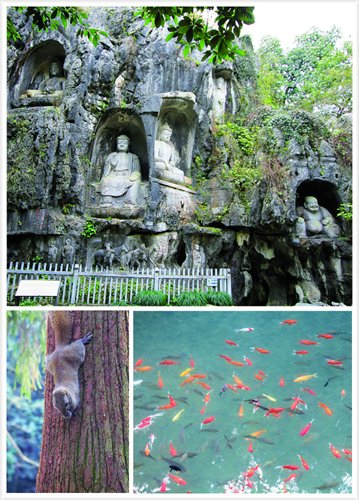
Lingyin is a major holy site for Buddhism in Southeast China. Photos: Qi Xijia/GT
Lingyin Temple
Lingyin Temple has stood amid old trees and bamboo groves for thousands of years. It was first built in AD326 by the eminent Indian monk Hui Li.
The temple has been ruined and rebuilt many times. It experienced its zenith during the Five Dynasties period (907-960).
Currently, the temple boasts nine buildings, 18 towers and 72 halls with 1,300 rooms. It houses more than 3,000 monks.
The statue of Sakyamuni in the center hall, which is 24.8 meters in height, is China's largest sitting statue of Buddha.
With its imposing and magnificent architectural structures, the temple is one of the 10 largest Zen Buddhist temples in China and attracts a great number of tourists and worshippers from home and abroad.
The local government of Hangzhou does a great job promoting a civilized way of worship. Every visitor is given incense for free as a means of deterring hawkers and protecting the environment.
Thanks to these efforts, the environment of the scenic area is well protected. Now and then you will encounter squirrels (pictured above left) who live among the ancient trees.
Though the squirrels are not as naughty as the infamous monkeys of Emei Mountain, who will attack you for food, still they are gluttons.
They will climb down from the trees quickly when they spot a piece of bread in your hand, take a bite and escape back upward to enjoy the feast.
Feilai Peak
Stepping out of Lingyin Temple and crossing a brook, you will find Feilai Peak. Feilai means "fly from afar." The way that the peak got this name is also related to Hui Li.
When the Indian monk came to the valley 1,600 years ago, he was surprised to see a peak that differed from the others in the valley, but that was similar to those from his home.
He thought this mountain must have flown to China from India and thus named it Feilai Peak.
In 1682, Emperor Kangxi of the Qing Dynasty (1644-1911) had the peak's name inscribed on the stone cliff.
Also dotted on the cliffs are 345 well-preserved ancient stone carvings of Buddhas. They are mainly scattered on the 500-meter cliff along the brook and in the natural caves in the mountain.
There is a path on the mountain that leads to the statues. Appreciating the statues at close quarters, you will find they appear in a variety of poses ranging from standing, sitting, sleeping and looking at you benevolently.
Perhaps the most famous one is the Maitreya Buddha with a Sack sitting on the cliff along the stream.
It is a classic work from the Southern Song Dynasty (1127-1279). Thanks to its exposed breast and belly, it is also nicknamed the "Big Belly Buddha."
If you wonder why he has such a big belly, the answer is that his belly is where the Buddha contains all the troubles in the world.
The carvers also did a superb job with his expression. Unlike the solemn Buddha statues in the temples, this one appears to be joyful and carefree.
He is laughing with his mouth open widely, which also got him the nickname the "Laughing Buddha."
Here is a couplet describing the Laughing Buddha: "His belly is big enough to contain all the intolerable things in the world; his mouth is ever ready to laugh at all snobbish people on the Earth."
His big smile attracts many tourists to take a photo with him and allows them to forget their own troubles for a while.
The Feilai Peak is also the birthplace of many local legends, such as the legend of the Three Life Stone.
It is said lovers will be in love for three lives, the previous life, this life and next life, if they make their vows in front of this stone.
The romance between Jia Baoyu and Lin Daiyu in the classic Chinese novel Dream of the Red Chamber also originates from this stone.
The legend adds to the mystical feel of this legendary peak and Lingyin.