The year in music: China
A look back at the major music industry trends for 2015

Han Geng (right) performs in Beijing on November 6.Photo: CFP
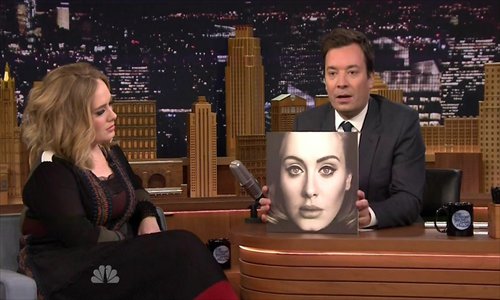
Adele (left) and Jimmy Fallon show off Adele's new album 25 on The Tonight Show Starring Jimmy Fallon on November 24. Photo: CFP
While we may have a hard time pointing to a song that went viral this year like "Little Apple" did in 2014, this was still a big year for the music industry in China.
Serene and gentle seems to be the trend this year when it comes to Chinese pop music. In March, singer Li Jian won second place in singing reality show I Am a Singer, but later saw a huge leap in popularity.
While poetic singing started out the year, it seems that folk music is closing it out. Several indie folk singers and bands have made headlines recently, such as Haomeimei's successful crowdfunded push to hold a concert at Workers' Stadium, one of the largest venues in China.
In boy band news, another Chinese member of EXO, Huang Zitao, announced that he would be returning to China this year. This is bound to be good for Huang's career, as two previous members, Wu Yifan and Lu Han, have already released EPs and started movie careers, with both showing amazing high appeal at the box office. Considering these success of even the teenaged TFBoys, it looks like the music market has formally become the domain of China's Post-1990 generation of idols.
Copyright rules
The biggest news for the year was the National Copyright Administration's announcement on July 9 of new regulations that would require all online music services to stop offering unauthorized music by October 31.
From November, most online music services including Xiami and QQ Music announced that they had renewed their licenses for copyrighted songs and were operating in strict compliance with new regulations. With massive capital required to obtain or renew copyright licenses, some smaller music services chose to form alliances, such as Kugou and 163's decision to ally together and purchase copyrighted music from QQ Music.
Copyright regulation has also caused music lovers to change their listening habits. With different services licensing different exclusive music, fans may have to use QQ Music to listen to Jay Chou and then open a Xiami app for Jonathan Lee. Some in the media have labeled the current situation as "the age of double apps."
Paywalls are also something Chinese netizens are getting used to. While in the past people could easily listen to an entire new album through various apps and sites in China, now some music is only accessible to Xiami or Tencent VIP members.
This has been a trying time of change for both consumers and companies. On November 4, well-known musician and Alibaba Music Group President Gao Xiaosong and CEO Song Ke released a joint statement asking listeners to have patience as the industry suffers through these "labor pains."
Goodbye physical media
With music now needing to be licensed Chinese have started getting used to paying for digital music. British singer Adele's latest digital album began selling last weekend for just 15 yuan ($2.30). Data from QQ Music shows that the album had sold more than 35,600 digital copies by Thursday through QQ Music.
This year only a few pop musicians in China released new music in retail stores. Earlier this month, singer Han Geng announced that his latest album San'geng would be his last physical album. This didn't mean he was leaving music behind forever, but that all future releases of his music would be digital.
Most pop singers seem to be thinking along the same lines, as many of them have chosen to release singles and EPs exclusively online.
Looking at the popular hits this year, most of the them were tied to movies or TV series. Na Ying's theme song for the film You Are My Sunshine and the ending credits song to the highly popular TV series The Journey of Flowers sung by the show's leading actor and actress became hugely popular.
In July, when fans used footage from hit animated film Monkey King: Hero Is Back to make a music video for singer Dai Quan's song about the legendary monkey king, the singer and his song became more popular than when he was trying to promote his song on talent show Sing My Song in January.
Looking at this trend, it seems that pop music is more likely to succeed as a marketing tool than just pure entertainment.
No more distance
Another trend this year has been streaming live concerts.
After realizing the commercial power of online live platforms last year, more stars have begun working with these streaming sites. Not only have Chinese idols like Cyndi Wang held small concerts live online, some South Korean companies have also begun showing strong interest in the online concert market in China.
In August, Tencent TV's Live Music signed a cooperative contract with South Korea's Cantara to hold online concerts for South Korean groups that are also popular in China, like f(x), T-ara and Wonder Girls. These online concerts are not just a chance for fans to interact online with their favorite groups, but also a great opportunity for foreign bands to increase their profile in China. After a live concert on March 29, searches for South Korean group SISTAR on Chinese search engines increased by 56 percent, according to a report on yule.com.cn.
Ignoring the barriers of distance and enabling fans to easily send virtual gifts to their idols (for a small fee), online concerts seem to be a new ambitious way for the music industry to earn some quick money.