Generation gap takes center stage in Beijing gangster film ‘Mr Six’
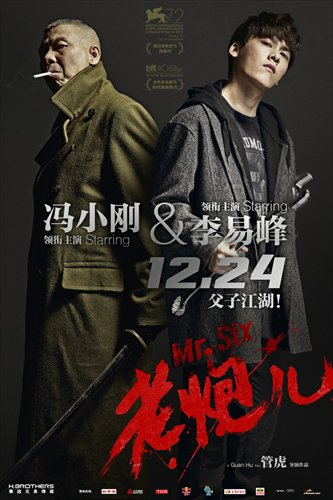
A poster for Mr. Six featuring Feng Xiaogang (Left) and Li Yifeng Photo: CFP
Before the premiere of Mr Six (Chinese title: Laopao'r) on Thursday, some film critics were saying that while the film was good, it may not necessarily perform well at the box office. Looking at the cast for the film, I had no idea why they were worried. Even if no one ended up liking the film, with two of China's hottest idols, Li Yifeng and Wu Yifan, in supporting roles, the film would probably do well with just one of them, let alone both.
While fans may be interested in young idols, what interested me the most about the film was leading actor Feng Xiaogang. Usually known as one of the top directors in China, Feng won a Best Actor Award at the Golden Horse Awards last month - the biggest black horse of the night. While most of his acting roles in previous films consisted of ridiculous or funny cameos, this time Feng was stepping into the lead. Full of curiosity I went to the theater to see how Guan Hu, a director far younger than Feng, had turned this stubborn master director into an award-winning actor.
Beaten by reality
The first half of the movie comes across like the Beijing-version of Taken. When Zhang Xiaobo (Li) is kidnapped by Xiaofei (Wu), a wealthy leader of a local gang, his father, retired gangster Mr Six (Feng), must return to the gangster world to save him. However, unlike Taken, when father and son finally meet again, there are no warm hugs involved: Mr Six, with his outdated gangster's code, is not a hero in his son's eyes.
This tense relationship between father and son is the main theme running throughout the movie. The son doesn't care about his father's past glories at all. Even after his father's friend and lover tells him the story about how his father fought a dozen men with only a sword, all the young man can remember is his absence while growing up after his mother's death.
When telling a story about a hero of a bygone era, a Hollywood film would see him beating all the bad guys and reuniting with his family in a big happy ending; a South Korean film might feature a romantic or taboo relationship between the father and a woman; a Japanese movie would most likely focus on the darkness of the society; while in this Chinese film the hero is finally defeated by reality. Living in alone and running a dark old store, this grizzled man is now just another nameless nobody trying to get by in Beijing's maze-like alleyways. He names his pet bird after his son though he claims he doesn't care about his son at all - a symbol of his empty nest syndrome.
At the end of the film, Mr Six is just an average person. So when Mr Six is seen stepping onto a frozen lake wearing his old coat and holding his old sword as part of a traditional gang fight against the bad guys, the scene is both moving and yet also a bit pathetic. The cracks on the frozen lake look just like the wrinkles on this old gangsters head. It's the last battle of a hero from a time long past.
Although he won a major award for the character, Feng has stated this was never his motivation for taking on the character.
"I'm a director and my job is filming others. I'm an amateur actor. It's just that rare character's like Mr Six just suit me," he said in an interview with the Beijing News.
Strong local flavor
Since the film is full of characters speaking in the local Beijing dialect, it's probably easier for both foreigners and Chinese from outside Beijing to rely on subtitles to understand what is being said. Director Guan kept a lot of local curse words in the script to reflect the personality of the characters and the city they live in.
While large scale gang fights are something that people today have a hard time imagining happening in Beijing, they weren't that rare during the 1980s. In 2011, Xu Haofeng, the scriptwriter for the film The Grandmaster, published a book detailing the history of gang fights during that time in Beijing. According to the recollections of martial arts fighter Wang Jianzhong detailed in the book, gangs would come together to fight over women or territory. Those that arranged these fights were called zhucha.
"There was a zhucha for every few alleys or several buildings. They didn't enjoy giving way to each other and would easily start a large-scale gang fight. Sometimes bringing 100 or 200 gang members together," Wang said.
In an interview with the Beijing News, Feng concluded that the laopao'r in the Chinese title of the film refers to people who are hot-blooded with a strong sense of brotherhood and principles. People who are a bit outdated by today's standards, yet who are also a permanent part of society.
"People like this will never disappear. As time goes on, there will always be people who are not willing to change and insist on their own rules. Young 18- or 19-year-old people look down on people who are our age, but when this generation enters their 50s or 60s, they will end up having their own conflicts and barriers to communication with the young people of that time," he said.
Newspaper headline: A hero for yesterday