Online sarcasm – funny or hurtful?
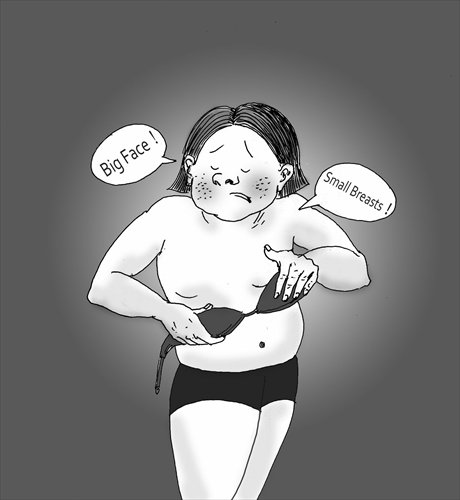
Illustration: Luo Xuan/GT
"My boyfriend hasn't touched me in two weeks. What should I do?" When my friend Amy asked for relationship advice in a WeChat group chat recently, she got responses that she didn't expect.
"Your breasts are small, but your face is big," one commented. "No need to lose weight. Your ugliness has nothing to do with your weight," another responded. "When is the last time you had a shower?" someone else asked. Of course, they were all joking; but as the victim of their sarcasm, Amy couldn't tell if they were being serious or not.
Sarcasm has recently become increasingly popular among young Chinese people, with Chinese Net users sharing jokes with "negative energy" that often involve making fun of others. For example, if someone says he/she wants to work harder, someone else might respond, "Don't bother. Those who are smarter than you are also working harder." This kind of online sarcasm is being called "arsenic for soul," the opposite of "chicken soup for soul."
The popularity of online sarcasm makes sense. For one thing, sarcastic comments are often funny, or at least they are packaged as jokes, which means they're more likely to attract Net users' curiosity and attention. Second, sarcasm is a way of venting stress, especially among young people who are struggling to establish themselves economically and socially in today's competitive environment.
The Qiushi Journal, a bimonthly political theory magazine, once criticized the growing "negative energy" on the Chinese Internet, which it said was having a bad influence on society. But that hasn't stopped some of these negative posts from going viral. That may be, in part, because so-called negative thinking can have a positive influence on some people's mental states. According to Psychology Today, the demand for positive thinking has become so deeply rooted in our culture that it can cause unnecessary stress.
Earlier this month, Qiushibaike.com, a humor site, did vox pop interviews in Beijing, asking people to share their favorite sarcastic jokes. Some of them made me laugh so hard that I almost died. For example, one young man said, "Don't worry that you don't have any money at the moment - you may never have it."
Though comments like these are only intended as "jokes," they can be hurtful to those on the receiving end. Take my friend Amy for example - after reading the relationship advice dispensed in her WeChat group, she said she felt hurt. "I felt like they were bullying me, not helping me," she said.
There is a fine line between jokes and sarcasm. While some kinds of humor can easily translate across languages and cultures, sarcasm is more likely to be misinterpreted.
Here is another example. Recently, I sent my congratulations to one of my American friends who got a promotion at work through LinkedIn. He replied, "Where where," a Chinglish version of the traditional Chinese response of "Nali nail," meaning, "It is nothing."
Then I replied sarcastically, "No need to be humble, you aren't that great." The minute I sent the message, I could feel our friendship ending.
This article was published on the Global Times Metropolitan section Two Cents page, a space for reader submissions, including opinion, humor and satire. The ideas expressed are those of the author alone, and do not represent the position of the Global Times.