HOME >> BUSINESS
Drones not ready for takeoff in mainstream market
By Hu Weijia Source:Global Times Published: 2016-1-3 23:53:01
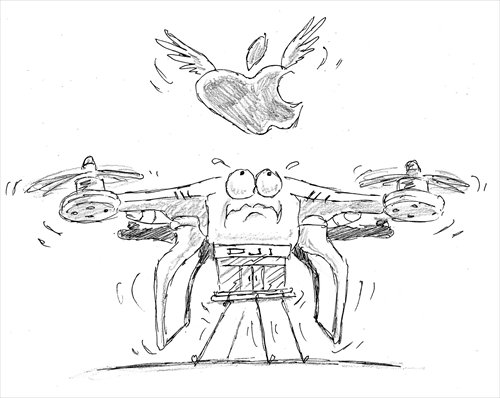
Illustration: Peter C. Espina/GT
Chinese drone maker DJI is hoping to boost its success by drawing on Apple's strategy of opening flagship stores to increase its presence in the market and sell directly to consumers. The question is whether drone manufacturers can copy that model to achieve similar success.
DJI's first flagship store has attracted a lot of attention over the last few weeks, in the run up to the Christmas and New Year period. The 800-square-meter store, which opened in Shenzhen, South China's Guangdong Province on December 20 ahead of the year-end shopping rush, features a flight area, lounge area and repair counter. It also displays a full range of DJI's products like the Phantom 3 series, the Inspire 1 and Spreading Wings series. This works to some extent like an Apple store, in that it is directly operated by the manufacturer instead of a separate retailer, and offers special free services such as hands-on experience and technical support.
DJI reportedly accounts for around 70 percent of global civilian drone production. It seems that the company is now striving to improve its brand awareness among the public and to build closer ties with consumers via the flagship store.
The move could be conducive for boosting the growth of its business in the long term, but the drone maker may also face more challenges than Apple did in making a profit from its physical store experience.
Apple's stores help reduce costs by cutting out "middleman" retailers and selling directly to consumers, but it may be difficult for drone makers to replicate this sales model in China.
Even though China's market for drones has seen rapid growth in recent years, civilian drones are mainly used in areas like aerial photography, filmmaking, remote sensing, and search and rescue. This suggests that enterprises with certain business purposes are probably the major customers for DJI drones, and the flagship store might not be the best way to reach these buyers. Using distributors and online stores as sales channels might be a more efficient way for the company to get in touch with its target customers in certain industries.
DJI's flagship store is designed to be a place that serves customers directly and where customers are taught how to operate the drones. There is no doubt that the store will help develop new customers among the public, but the company might encounter difficulties in expanding the physical store model to other areas of the country, especially second- and third-tier cities, given the weaker demand for drones there.
China's demand for drones is still in the early stages of its development. The Phantom 3 Standard, which is designed for beginners and first-time pilots, is likely to be the most popular product in the physical store. But one disadvantage the products have is their relatively high prices. The Phantom 3 Standard costs about 5,000 yuan ($771), and most of the other drone products sold in the DJI store are even more expensive. It will be difficult to make a profit from the physical store if the sales volume can not reach a certain level, because the earnings may not be enough to offset the cost of offering free services like hands-on experience.
The drone maker is expected to encounter less challenges in this regard when it opens stores in developed countries, given the higher consumption capacity in those regions. DJI has made great progress in expanding its business overseas in the past few years, and the overseas market is already a major source of its profits. However, management of drones is being strengthened around the world due to security concerns, so there is a risk that DJI might face a more complex investment review in some Western countries if the company wants to open new physical stores to replace its current sales channels, such as local retailers.
The US Federal Aviation Administration recently issued new rules requiring all unmanned aircraft systems to be registered if they weigh more than half a pound and less than 55 pounds. The new regulations came after one of DJI's drones crashed on the White House lawn in early 2015, triggering concerns that local authorities may further strengthen management of the drone market.
Now is perhaps not the right time to expand DJI stores around the world, and there may still be a long way to go for drone makers in developing innovative sales models.
The author is a reporter with the Global Times. bizopinion@globaltimes.com.cn
Posted in: It's Your Business