HOME >> LIFE
Biggest-ever restructuring of PLA art troupes spells huge changes
Source:Global Times Published: 2016-1-12 19:28:01
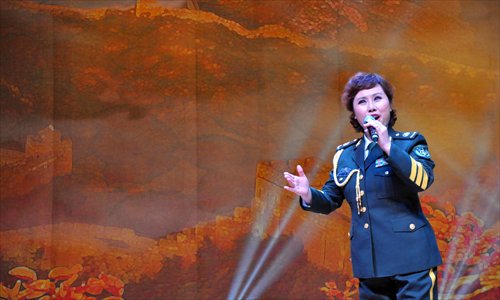
A military performer from the Nanjing Military Area Command Art Troupe sings at a performance in Suichuan county, Jiangxi Province, on April 20, 2015. Photo: CFP
Since China is one of the few countries that still has dedicated art troupes as part of its military structure, whenever the country goes about implementing reforms aimed at these troupes it tends to attract quite a bit of media attention. Just last week, nearly all the major media outlets in China were astir over rumors that another bout of art troupe reform was underway.
According to these reports, insiders have revealed that restructuring will move three art troupes under the PLA General Political Department - the Song and Dance Troupe, the Opera Troupe and the Modern Drama Troupe - out from under the purview of the General Political Department and into a newly established political department under the PLA.
A move that points directly to the streamlining of these art troupes, many suspect that this may be the biggest-ever reform of PLA art troupes since President Xi Jinping, who is also the Chairman of the Central Military Commission of the CPC, announced restructuring plans to reduce personnel by 300,000 during a military parade on September 3.
Another round
According to a press release from China's Ministry of National Defense, the restructuring will mainly focus on the reduction of outdated combat troops and streamlining non-combat institutions. The restructuring is expected to be completed by the end of 2017. As major non-combat institutions, PLA art troupes are expected to be at the center of this round of reform.
There are currently approximately 2,000 military personnel working in PLA art troupes, according to Tang Dong, the former director of the Artistic Creation Department of the Song and Dance Ensemble under the Guangzhou Military Area Command.
This is not the first time that the PLA has carried out restructuring. Back in October of 2003, the PLA announced plans to reduce personal by 200,000. The following year, all PLA art troupes were reorganized, leaving each military area command only one art troupe each, while the PLA General Political Department held on to its three art troupes. Prior to this reform, military commands across the country possessed various art troupes including sing and dance troupes, drama troupes and orchestra and symphony troupes.
In 2013, two new regulations from the PLA General Political Department and the Central Committee narrowed the functions of these art troupes, while also laying the groundwork for future reform.
This was interpreted by many as a sign that large-scale reform was not far off. However, it wasn't until President Xi announced restructuring plans last year that plans for reform seemed to finally be underway. Compared to previous rounds of reform, this round is expected to be the most profound, as many of these art troupes have been experiencing difficulties over the past few years.
The call of money
Before news of the restructuring hit last week, the biggest news concerning military art troupe reform involved well-known singer Han Hong, a former deputy head of an art troupe under the PLA Air Force Political Department.
On December 7, Han announced on Sina Weibo that she had officially resigned from the PLA Air Force. More than a week later on December 16, Han held an impressive press conference attended by dozens of celebrities where she officially announced her new role as the CEO of entertainment company Hualu Baina Entertainment.
Han's transformation ignited speculation about the future of military performers, especially those who already hold great market appeal.
Popular military performers can raise the reputation of their art troupes, but tightening regulations concerning their participation in commercial activities means that these performers more often than not have to decline attractive offers to perform, which limits their exposure and decreases their market appeal.
Choosing between military service and career freedom is dilemma facing many other popular military singers and actors. Actor Zhang Yi once stated that back when he was in the military he was given few chances to be a real stage actor or seize commercial opportunities. Another famous singing group, Phoenix Legend, also choose to resign from military service after just two years due to the difficulties their military position created when it came to coordinating commercial performances.
As military personnel, military performers are paid by the government. However, when troupes are called upon to perform frequently this remittance begins to look insufficient. Some troupes have considered earning more income through commercial performances, but are limited by military regulations.
Well-known singer Chen Sisi, deputy head of the PLA Second Artillery Corps Song and Dance Troupe, once told media that she hoped to lead her troupe on the path to marketization by mobilizing her social resources and influence, but that increasing regulations posed challenges.
Not only are military performers' ability to perform restricted, there are also challenges when it comes to artistic creativity.
"Our art troupes are stuck creating works just for galas or the official events this leads to fewer quality artistic performances," said Fu Lin, former deputy head of the PLA Naval Song and Dance Troupe.
Profound changes
Most of these art troupes were established in the 1940s-50s, and even earlier during the 1920s, as such they face a number of issues in today's world. Besides issues like the loss of talented performers, decreasing artistic quality, or even corruption scandals, other issues such as an unfair promotion system have been broiling for a long time.
All these issues underscore the urgent need for major reform for military art troupes in China. Reduction of personnel is not the ultimate goal, how to better define the role these art troupes should play in today's society and how to allow them to more efficiently boost morale are the crux of the problem when it comes to reform.
Newspaper headline: Dramatic reform
Posted in: Miscellany