US painter Gary Bukovnik talks about staying true to his artistic roots
Renowned American watercolor painter Gary Bukovnik has just finished his exhibition at Shanghai Hongqiao Contemporary Art Museum, which ran from December 18 to January 9.
It was the second time Bukovnik had exhibited his works in Shanghai. This time round, he made a huge watercolor painting on a 2.5 meter by 10 meter canvas custom made in Italy. Bukovnik painted his signature flowers on the canvas, and hung 199 butterflies in front of it on red ribbons. The butterflies were multicolored on one side, and gold and silver on the other. As they turned, they illuminated the walls and cast shadows on the painting.
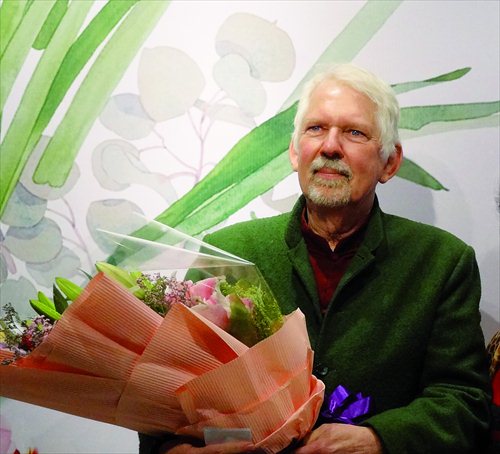
American watercolor painter Gary Bukovnik in Shanghai Photo: Yang Lan/GT
Deep China ties
Chinese singer Song Zuying is one of Bukovnik's favorite singers. He particularly likes her song "Butterflies' Love for Flowers." Deeply moved by the melody, he created the installation composed of butterflies and flowers. The butterflies came from a vase displayed in the Palace Museum in Beijing. Bukovnik owns a copy of the vase.
The red ribbons used to hang the butterflies also bears a special meaning.
"I never told anybody what this was about until recently. The ribbons come from a Chinese story of the man in the moon that I read about when I was a little child. The man in the moon ties a red string on the ankle of one person and he attaches it to the other person that is destined for him or her. The story stuck with me all these years and I love it a lot," said Bukovnik. There are red ribbons in most of Bukovnik's paintings.
Along with this special creation, a series of Gary Bukovnik's watercolors were exhibited at the center. Standing in front of the paintings, one could almost smell the scent of the flowers depicted and feel that moment when their beauty was recorded.
Painted from life
All Bukovnik's paintings are done from life. However, on the canvases there are not just flowers, but creative interpretations of the flowers. For example, in his Leaping Fish, it seems that fish have jumped out from the surface of the vase onto the fresh flowers. Under the seemingly simple structures lies Bukovnik's delicate craftsmanship.
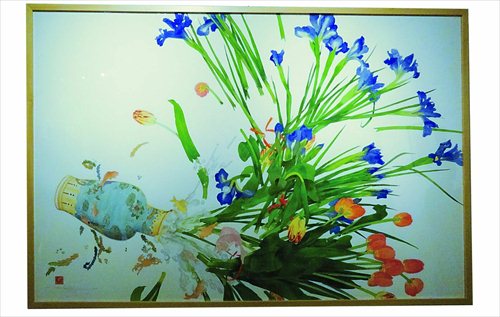
Leaping Fish by Gary Bukovnik Photo: Yang Lan/GT
For each creation, Bukovnik buys the plants from the San Francisco Flower Mart and takes them back to his studio. Without too much arranging, he begins sketching. Watercolors are not as forgiving as oils, since the colors can not cover each other. As a result, Bukovnik uses a sharp pencil and draws single lines.
"If you make one mistake, you will have to create on it and make a new element," said Bukovnik.
Then he puts the flowers away for a day or a week, until he can barely remember what he saw. It is then time to combine reality and his fantasy to finish the painting. He develops the sketch and colors it with his imagination, trying to keep things in proportion and portray the image in his mind accurately.
"Nature is perfect. If I sit in front of a subject and paint what I see, I am frustrated, because nature cannot be outdone. My job is showing people the impression of what I think," said Bukovnik. The work starts with only an idea in Bukovnik's mind, and it evolves to a whole picture.
Chosen by flowers
Many artists would choose the vehicle that expresses their thoughts. But in Bukovnik's case, flowers chose him, as did the medium of watercolors.
"It's like a hand that kept pushing me. As an adolescent, I wanted to act out and be bad. But the hand pushed me a different way," Bukovnik told the Global Times. After many detours and struggles, Bukovnik ended up doing what he loved.
Bukovnik was born in Cleveland, Ohio in 1947. His grandmother owned a general store in the countryside. All around the general store were nursery fields full of flowers, plants and trees. Bukovnik's mother used to let him paint on the dining room table.
"She let me paint with watercolors because it was not too messy. So I painted things around me, which were flowers," said Bukovnik. But his mother did not want him to spend his life painting flowers in watercolor.
Encouraged by his family, Bukovnik went to university to become a chemist. He lasted about three months there before realizing it was not the path for him.
Bukovnik then went to art school. But he was greatly discouraged there, as painting flowers was seen as conservative.
"People often told me that I shouldn't do this. After two years, I finally believed them. I dropped out of school," said Bukovnik. He got a job at a record store.
Two years later he saw the works of the people that he could have graduated with, and he told himself: "I could do that." He quit the record store and went back to painting. When he was 27, Bukovnik moved to San Francisco to become a professional painter.
Flowers were not a popular subject in contemporary art, so he planned to become a landscape painter. He did not paint flowers until the director of the gallery he worked with asked him to.
"It turned out that it was the correct thing, not necessarily because flowers are a subject with which a person can make a living, but because it was the truth and still is the truth about me," said Bukovnik.
Newspaper headline: Creative stem