HOME >> METRO SHANGHAI
Ikebana lovers in Shanghai celebrate Chinese New Year with floral art
By Yang Lan Source:Global Times Published: 2016-1-19 18:03:01
Members of the Shanghai Chapter of Ikebana International recently gathered at the residence of the Consul General of Japan in Shanghai to celebrate the coming Chinese New Year. There, ikebana masters demonstrated the art of Japanese floral arrangements while inviting guests to try their hand at the ancient art form.
Ikebana International was created by Ellen Gordon Allen in Japan in 1956. The American expat learned about ikebana while living there with her husband. Back then, ikebana was unknown outside of Japan. Traditional Japanese ikebana schools were very conservative and each school had their own strict rules and specific style.
Allen hoped to promote ikebana to people around the world and bridge the cultural divide between these schools and non-Japanese, which lead her to creating her own organization for foreign ikebana lovers around the world to exchange ideas and make new friends, hence her motto "Friendship through Flowers."
Lily Zhang, president of the Ikebana International Shanghai Chapter opened China's first chapter in 2014. She is a master of ikebana and a member of Japan Ikebana Association. The vice president, Tan Fangqi, is a member of the Ohara School, one of the three biggest ikebana schools in Japan. Prior to returning to Shanghai, she lived many years in Japan, where she developed a passion for ikebana.
Spring is coming
At the event, Tan demonstrated landscape Moribana, a classic style of the Ohara School, whose specialty is to place natural scenery into the arrangements. Several pin holders are mounted in a special water plate called suiban. Unlike Western floral arrangements, which primarily use vertical vases, suiban presents the arrangements horizontally, which is closer to the look of a natural setting.
Tan then inserts peony, gomphrena globosa and daisies on the pins, using the leaves of asparagus myrioeladus to cover parts of the water surface for a more natural-looking scene. "Japanese ikebana only arrange flowers that are in season or about to be in season, so I have used the flowers of spring. This arrangement signifies the coming of spring," explained Tan.
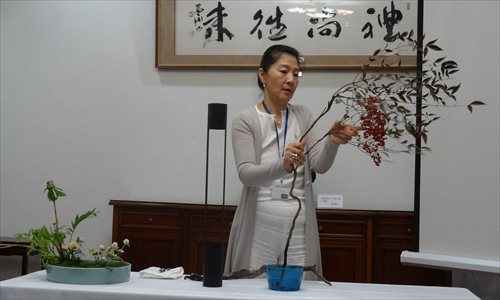
Zhang demonstrated two floral arrangements from the Ichiyo School, which prefers to achieve a free balance without the use of pin holders. Instead of suiban, the Ichiyo School uses hollow bamboo.
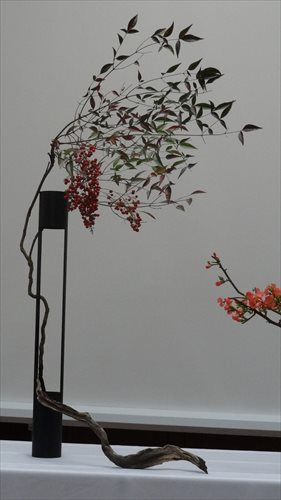
One of Zhang's arrangements incorporated pine, flowering quince and trumpet lily. "Flowering quince is a very flexible and strong plant. Although its branches are twisted and broken, as long as the twigs are still attached, it survives," said Zhang.
In Japan, people often place two arrangements with bamboos and pine at their front doors to welcome the New Year. Zhang extended this idea by inviting guests to each insert one branch of roses, lilies and chrysanthemums into the arrangement.
"Every new year, the tradition of our chapter is that we all make one arrangement together. It means that we unite our efforts toward a better year," said Zhang.
Global influence
The chapter donates all their floral arrangements to the Japanese Consulate General in Shanghai. Kazuyuki Katayama, the Consul General of Japan in Shanghai, has throughout his career cooperated closely with Ikebana International to host a variety of cultural activities. "I think that the foundation of the Shanghai Chapter will make it easier for Chinese friends to understand the spirit of ikebana," said Katayama.
Ikebana International now has over 160 chapters located in over 60 countries and regions in the world, along with a world convention and regional conferences. The majority of chapters and members are not located in Japan, which illustrates the organization's global influence.
The Shanghai Chapter currently has over 90 members and organizes nine activities every year including demonstrations, lectures and flower exhibitions. An annual flower exhibition will be organized in Shanghai in March.
Katayama intends to become more involved in these activities. "As the Consul General of Japan in Shanghai, I hope to cooperate with the Shanghai Chapter of Ikebana International, support the development of the Shanghai Chapter and promote the friendship and collaboration between Japan and China through ikebana."

Newspaper headline: Friendship through flowers
Ikebana International was created by Ellen Gordon Allen in Japan in 1956. The American expat learned about ikebana while living there with her husband. Back then, ikebana was unknown outside of Japan. Traditional Japanese ikebana schools were very conservative and each school had their own strict rules and specific style.
Allen hoped to promote ikebana to people around the world and bridge the cultural divide between these schools and non-Japanese, which lead her to creating her own organization for foreign ikebana lovers around the world to exchange ideas and make new friends, hence her motto "Friendship through Flowers."
Lily Zhang, president of the Ikebana International Shanghai Chapter opened China's first chapter in 2014. She is a master of ikebana and a member of Japan Ikebana Association. The vice president, Tan Fangqi, is a member of the Ohara School, one of the three biggest ikebana schools in Japan. Prior to returning to Shanghai, she lived many years in Japan, where she developed a passion for ikebana.
Spring is coming
At the event, Tan demonstrated landscape Moribana, a classic style of the Ohara School, whose specialty is to place natural scenery into the arrangements. Several pin holders are mounted in a special water plate called suiban. Unlike Western floral arrangements, which primarily use vertical vases, suiban presents the arrangements horizontally, which is closer to the look of a natural setting.
Tan then inserts peony, gomphrena globosa and daisies on the pins, using the leaves of asparagus myrioeladus to cover parts of the water surface for a more natural-looking scene. "Japanese ikebana only arrange flowers that are in season or about to be in season, so I have used the flowers of spring. This arrangement signifies the coming of spring," explained Tan.
Zhang demonstrated two floral arrangements from the Ichiyo School, which prefers to achieve a free balance without the use of pin holders. Instead of suiban, the Ichiyo School uses hollow bamboo.
One of Zhang's arrangements incorporated pine, flowering quince and trumpet lily. "Flowering quince is a very flexible and strong plant. Although its branches are twisted and broken, as long as the twigs are still attached, it survives," said Zhang.
In Japan, people often place two arrangements with bamboos and pine at their front doors to welcome the New Year. Zhang extended this idea by inviting guests to each insert one branch of roses, lilies and chrysanthemums into the arrangement.
"Every new year, the tradition of our chapter is that we all make one arrangement together. It means that we unite our efforts toward a better year," said Zhang.
Global influence
The chapter donates all their floral arrangements to the Japanese Consulate General in Shanghai. Kazuyuki Katayama, the Consul General of Japan in Shanghai, has throughout his career cooperated closely with Ikebana International to host a variety of cultural activities. "I think that the foundation of the Shanghai Chapter will make it easier for Chinese friends to understand the spirit of ikebana," said Katayama.
Ikebana International now has over 160 chapters located in over 60 countries and regions in the world, along with a world convention and regional conferences. The majority of chapters and members are not located in Japan, which illustrates the organization's global influence.
The Shanghai Chapter currently has over 90 members and organizes nine activities every year including demonstrations, lectures and flower exhibitions. An annual flower exhibition will be organized in Shanghai in March.
Katayama intends to become more involved in these activities. "As the Consul General of Japan in Shanghai, I hope to cooperate with the Shanghai Chapter of Ikebana International, support the development of the Shanghai Chapter and promote the friendship and collaboration between Japan and China through ikebana."
Lily Zhang demonstrates the art of ikebana.
Consul General Kazuyuki Katayama speaks at the event.
Flowers arranged by Lily Zhang
Photos: Yang Lan/GT
Newspaper headline: Friendship through flowers
Posted in: Metro Shanghai