Exploring the people and culture of Lomé, Togo
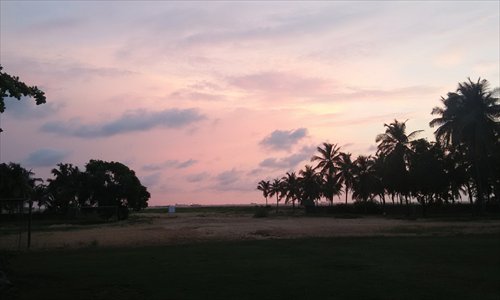
The sun sets near the port of Lomé, Togo. Photo: Meng Ying
Months ago, during a stuffy and hot weekday morning in Shenzhen, I was informed that I would be assigned to a city in West Africa that I had never heard of before. Although its name sounds very beautiful - Lomé - I was far from enthused.
Knowing so little, I began to collect some information about my destination.
"Famous for the friendliness of its people and the beauty of its countryside, Lomé is the perfect place to relax." "'The pearl of West Africa,' it retains a charm and uniqueness among West African capitals. You'll probably appreciate its human scale and unexpected treats from tasty food to colorful markets and palm-fringed boulevards."
The introduction to the city in my travel guide was very positive, but just as I was beginning to feel reassured, negative comments from my colleagues and friends came one after another: "Beware the local food, malaria, thieves…"
All these warnings once again made me unsure about this unknown West African city in the country of Togo, but I still got a feeling that I was in for a unique experience.
First contact
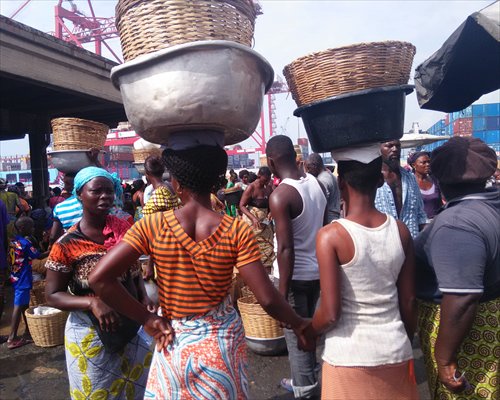
People visit a local market in Lomé. Photo: Meng Ying
Upon arrival my first impression was not that bad at all. I still remember how surprised I was when I saw all the colorful colonial-styled architecture, the small shops selling all kinds of goods and the coconut trees lining the beaches and courtyards.
Lomé emanated a feeling of tradition, a strong cultural atmosphere with a little European flavor. During the day, the main streets are very busy. You can see local people carrying huge baskets on their heads and selling everything you can imagine, from food and clothing to daily necessities. After sunset, the sky turned from bright blue to rosy pink and then black as scattered street lights illuminated a cozy night sky. You can hear sounds of African music from some remote corner as well as some singing and laughter. When the sea breeze blows, the coconut leaves also wave with the music.
It wasn't as hot as I had imagined. Walking along the beach, I could feel a fresh ocean breeze. Wandering along the street, I saw most people were wearing traditional colorful clothing, which matched very well with their braised (women) or short and curly (men) hairstyles and the big smiles on their faces. I could feel that everyone was very friendly and optimistic.
After two weeks, I found myself adapting well to life in Lomé. Besides the natural beauty and atmosphere, the people impressed me the most. I met some very interesting people who gave me some insight into the city.
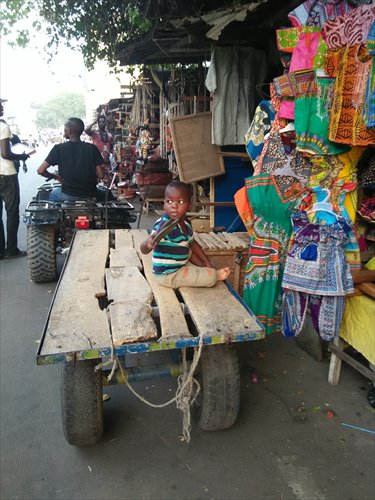
People visit a local market in Lomé. Photo: Meng Ying
Samuel
Samuel was one of the first people I met in Lomé. He was a colleague working in the IT department. One day, I asked him to fix the Internet connection on my mobile phone. He worked on it with a serious frown. After around 5 minutes he finally fixed it and his face immediately was lit up by a huge proud smile.
"You know Bella, this Chinese brand mobile is the most complicated one I have ever dealt with," he said.
"But I wonder, are Chinese people complicated too?"
This question was one I didn't see coming and it truly would have been a complicated answer. However, I think it might be true.
Senyo
I was told that local people tend to be very strict when it comes to social classes. Our driver Senyo was the perfect example of this. He spoke very little and every time he answered a question it was with a very respectful "Yes, Madame" or "No, Madame."
One day, when I heard some very beautiful African music on the radio I told him: "This is a nice song. You can dance to it." "Madame, do you like music and dancing? I admire this." His voice seemed more excited than usual.
One day weeks later, he came to me and took a deep breath as if he was going to say something very important.
"Madame, can I ask you something? My girlfriend is a dancer and she will perform this weekend. If you would like to watch, we will be very honored and glad."
I looked at him and saw in his eyes a combination of sincerity, caution and pride.
Of course I went to the performance. Although I thought it would be held in a stadium or on a stage, it turned out it took place in an open space next to a local market. I watched his girlfriend perform a local dance with other impressive dancers in front of happy and laughing spectators.
It goes to show that as long as you love life, any place can be your stage and anyone can be an excellent performer.
Carmen
I still remember how amazed I was by Carmen's beauty when I first saw her at a salsa dance party. She had a perfect body and extremely long legs. I never imagined such a beauty could be so friendly and easy-going. From our conversation I learned that she was a dance teacher who once lived in Paris. Last year she opened her own school when she returned to her hometown of Lomé. She is determined to make her school the best one in Lomé, keeping European style and targeting Lomé elites. I think she made it.
"I think your school will do very well. After all African people love dancing and music. This is sure to make things easier," I told her.
"It's not easy at all, my dear. The people of Lomé truly do love music and dancing, but they think they are born knowing how to dance, so they don't need to go to school to learn it."
Lomé people are confident and prefer to enjoy life in their own way. Follow the rules? No way!
I looked again towards the dance floor where I saw more than half the dancers were dancing in their own self-created styles. Their confident and joyful faces were something I had never seen elsewhere.
I feel lucky to meet Samuel, Senyo and Carmen, common people from different walks of life in Lomé. For me, other than the simple and direct, polite and cautious, beautiful and friendly natures they showed me, they showed me a side of the city that I appreciate very much: smart and humorous, sincere and brave, determined and persistent!
No barriers
Every time I travel to another land, I always feel the differences in culture and find myself amazed by the diversity that exists in the world. My stay in Lomé was truly an amazing experience.
One day when I mentioned that I was leaving Lomé in a couple of weeks, Samuel said that he was sad but he was sure that we would meet again in the future.
I mentioned that I didn't think it would be that easy.
To which he added, "Only the mountains cannot move, so they cannot see each other. But we are not mountains, we will find a way to meet."
Perhaps he's right and my departure won't be the last contact I have with this amazing land. And of course, no matter where I go, I will definitely miss these people who gave me such beautiful memories.
Rules of thumb:
Where to stay:
Hotel Mercure Sarakawa. It is the biggest hotel and one of the best ones in Lomé. It has a nice swimming pool and a good French restaurant. The price ($210 and up a night for a double room) is a bit high though.
Where to eat:
1. Belle Epoque. Good French cuisine with good service and artistic African and European fusion-style decorations. I highly recommend its daily menu of tasty and well-combined three course meals.
2. Alt Muchen. German and French food at a reasonable price. A cozy wooden house surrounded by a courtyard with palm trees.
Others: La Route des Vins and Côté Jardin for French cuisine. Les Nuit D'Orient for Mediterranean cuisine.
Where to shop:
The Grand Marché is Togo's most colorful and crowded market. You'll find everything there from Togol souvenirs to cheap clothes as well as vegetables, meat, fish and fruit. The Champion Supermarket sells imported products. Be sure to bargain a lot when you want to buy paintings or other products.
When to go:
Located along the equator, the heat in the city is stable and doesn't fluctuate much. Sometimes the breeze coming from the sea makes the weather quite pleasant. The average temperature is 23 - 30C. Lomé has two rainy seasons, the first starts in April and ends in July, then a second rainy season starts in early September and ends in late November. In December and January, the Harmattan, a dry wind from the Sahara, can bring the temperature down as low as 19C in the mornings, but the sky is not as blue and clear as the rest months of the year. So basically, any time of the year is fine for a visit.
Getting there:
Air France and Ethiopia Airlines run flights to the Lomé-Tokoin Airport (LFW) with transfers in Paris and Addis-Ababa respectively. In Lomé, moto-taxis are the most common means of transportation. Passengers ask for a ride on the back of a motorcycle for a small charge.
Newspaper headline: ‘Pearl of West Africa’