Journey into the past
The metropolis of Nanjing brings you a taste of ancient China
Being the second largest city in East China, Nanjing might at first seem of limited appeal to urban Shanghai dwellers who might be expected to prefer to spend their leisure time in nature or a tranquil retreat.
But if you are fascinated by Chinese civilization, Nanjing has a rich variety of ancient and historic attractions, having served as the capital for six Chinese dynasties.
Getting from Shanghai to Nanjing takes just 90 minutes on the bullet train, and the station is centrally placed, allowing you to get underway with the sightseeing as soon as you arrive, as Xuanwu Lake is right next to the station.
The lake formed around 6,500 years ago and the area around it made an attractive site for establishing settlements.

The calm waters of Xuanwu Lake cover some 5 million square meters.
Legendary waters
The calm waters of Xuanwu Lake cover some 5 million square meters. The area around it is a park, with pleasant walks, biking and boating on offer. It is hard to imagine the lake used to cover an even larger area, and was at one time linked with the Yangtze River.
It was also used for military drills, with many previous dynastic rulers using it to train their waterborne troops. As such, many military demonstrations were held here.
Nowadays, the lake is far more tranquil. A few small islands dot the waters with arched stone bridges and pavilions.
The lake was officially turned into a park in the early years of the Republic of China (1912-49). These days, the park is a popular venue for locals doing their morning exercises or taking a stroll along the banks.
If you have heard the story of the black dragon, you might gaze at the waters and wonder if the mysterious creature will raise its head through the surface.
Legend has it that during the Southern Dynasty (420-589), a black dragon was seen in the lake.
Chinese Taoists believed that the black dragon was a water god, and a divine animal whose shape is the combination of a turtle and snake. In ancient times, this animal was called Xuanwu, which is how the lake got its name.
As a scenic spot, it is best seen in combination with the ancient city walls built in the Ming Dynasty (1368-1644) that border the park to its south, and the Jiming Temple to the lake's southwestern edge.
During the Southern Dynasty, this temple was the largest and most important of the 480 temples across the nation, and renowned as the Buddhist center of China.
Some of Nanjing's oldest houses can be found close to the park, right up against the city walls. Walk along Kunlun Road and head for Jiefang Gate, and you will not miss these old structures that are ravaged with the marks of time.
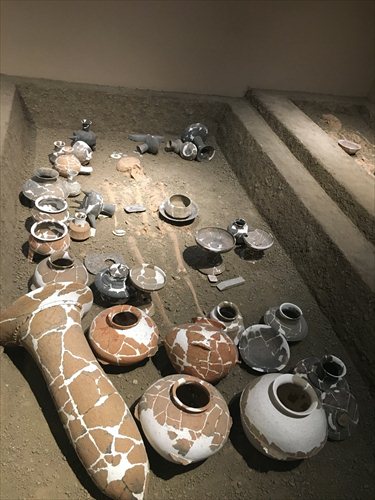
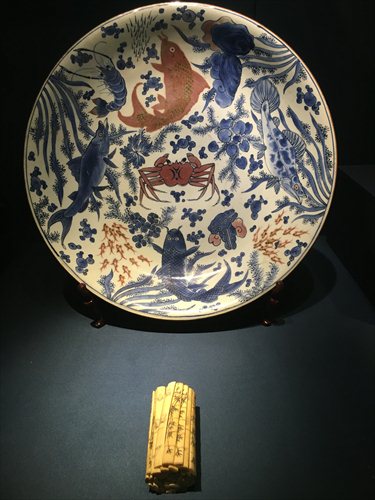
Porcelain and stoneware exhibited at Nanjing Museum Photos: Ni Dandan/GT and CFP
The first museum
Only 6 kilometers from Xuanwu Lake is Nanjing Museum, which is a must-visit place in the city.
Nanjing has some of the oldest and finest museums in China, including the China Modern History Museum in the Presidential Palace, the City Museum of Nanjing, the Nanjing Customs Museums, to name a few.
Nanjing Museum boasts one of the city's richest collections. Formerly known as the National Central Museum, it was the first modern comprehensive museum in China and remains the country's second largest museum today.
Like Xuanwu Lake Park, Nanjing Museum is open to all visitors for free. If you arrive on a workday, you will probably find it an extremely pleasant and spacious place to visit.
Sitting to the south of Zijin Mountain, the museum covers an area of 70,000 square meters with two main exhibition halls - the history exhibition hall, and the art exhibition hall.
Both have splendid palatial architecture resembling the structures of the Liao Dynasty (916-1125).
The museum has over 420,000 pieces that span the Paleolithic period to the contemporary era.
Pieces include stoneware, earthware, jade, bronze items, porcelain, inscriptions, paintings and calligraphy works, embroidery, bamboo carving and contemporary art.
Some of these collections were passed down ancient Chinese royal families, while others have been unearthed in archeological digs.
What makes Nanjing Museum a bit different is that it also includes some natural history elements.
At the very entrance, fossils of dinosaurs are showcased and human skeletons are also exhibited to show the evolution of mankind.
If you are spending more than a day in Nanjing, you should not miss the night views along the Qinhuai River in the city center.
This river is regarded as the cradle of Nanjing's ancient civilization. As far back as the Stone Age, human activities had appeared along its banks.
During the Six Dynasties (222-589), the Qinhuai River area was home to noble and distinguished families, and it was a flourishing area gathering business elites and men of literature.
After a period of decline, the area boomed in the Ming and Qing (1644-1911) dynasties. Spending a night along the river, you might be able to imagine a scene in which numerous fine buildings stand along the river and fancy boats decorate the waters.