There’s something about Sendai
A coastal Japanese city with literature connection and rich history
On the northern tip of Japan's main island lies Sendai, the largest city and the cultural and industrial center of the Tohoku region.
Far from a particularly popular tourist destination, the city is fairly well-known among Chinese people, for it is where Lu Xun, often referred to as the country's greatest modern novelist and essayist, studied in the 1900s. His stories set in Sendai feature in elementary and middle school textbooks.
To a long-time Lu Xun fan like me, there is no better way to start exploring Sendai than with the Katahira campus of Tohoku University - its medical school was once the Sendai Medical Academy, where Lu Xun was enrolled.
Walking past the main entrance and going straight ahead, I immediately saw a bust of the writer, in his middle-aged look, by the central green area. It was donated by the university's Lu Xun research club.
The university also named the 1904-built lecture hall where Lu Xun took classes after him, and the well-preserved place is open to visitors on Tuesday and Thursday afternoons, with the exception of public and university holidays.
For more back stories, I headed to the Tohoku University Archives' second floor, where an exhibition of Lu Xun and the university is on regular display.
It is a well-curated exhibition with interesting documents, for example Lu Xun's first semester examination scores (he mainly got Cs and Ds) and quitting letter.
Archives belonging to Genkuro Fujino, the anatomy lecturer who Lu Xun greatly respected and wrote of in his famous story Mr. Fujino are also a highlight. A page of a Japanese school textbook with the Japanese version of the story is on display next to a Chinese counterpart.
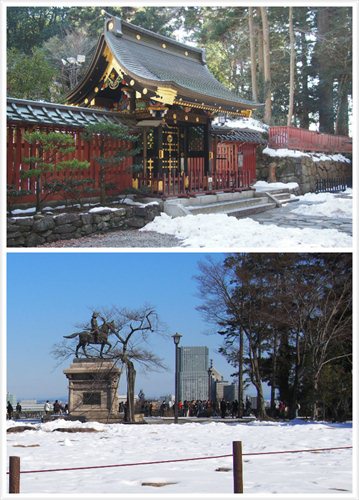
(From top) Zuihoden Mausoleum, the site of entombment of Masamune Date, and the Sendai Castle ruins on the top of Aoba Mountain Photos: Liao Fangzhou/GT
Historical sites
Of course, Sendai has far more to offer, not least its rich historical legacy. For centuries, the city was ruled by Masamune Date, one of feudal Japan's most powerful lords, and remaining sites related to the Date family continue to be the city's major attractions.
Fortunately, and rather miraculously, despite the fact that the epicenter of the Tohoku Earthquake in 2011 was off the coast of Sendai, the city suffered relatively little damage and these valuable properties remain intact.
Riding a Sendai Travel Loop Bus, I travelled between the city's most renowned sightseeing spots easily.
My first stop was Zuihoden Mausoleum, the site of entombment of Masamune Date.
The approach, rimmed by beautiful cedar trees, a symbol of the Date family, led to the ornate building featuring a rich variety of vivid colors, mainly yellow and blue, and intricate woodwork and decorations, especially along the beams.
His son and grandson are entombed nearby, in smaller mausoleums of the same style. Each site is introduced in eloquent English.
In the small museum just a step's away on the left of the mausoleum, I saw personal artifacts belonging to the Date family, and even specimens of their bones and hair, which were reportedly found during excavation.
There was a lot of walking involved as the mausoleum is on the top of a steep hill, but the meandering downhill exit path surrounded by dense wildlife plantations made such a pleasant journey.
But the real highlight of the trip has to be the Sendai Castle ruins on the top of Aoba Mountain overlooking the city, which was two bus stops away from the Zuihoden Mausoleum.
That might be hard to believe, since Masamune Date's castle built here was actually completely wiped out by war.
Yet, I was greatly impressed by the tall, handsome bronze statue of Masamune Date (pictured bottom), brandishing his sword on a horse, standing alone amid the spacious, vacant, snow-covered field.
This is also the place to enjoy a spectacular overview of the city - snow-tipped mountain views on the left, the Pacific Ocean afar, neat and lovely buildings in between, and the beautiful Hirose River that has become a symbol of the city and was used as a natural moat of the castle.
This is where I found myself really falling in love with Sendai.
Local cuisine
Sendai is famous for its beef. It tops the A5-ranked beef of the highest quality black hair Japanese beef.
More particularly, grilled thinly sliced beef tongue, aka gyutan, originated here. You can find it in freezers in souvenir shops all the time.
Beef restaurants are easy to find throughout the city, for example in shopping arcades and commercial streets around Sendai Station.
I had a casual beef set lunch that turned out to be surprisingly good and hearty. Apart from a bowl of rice and pickled vegetables, there was sliced beefsteak, curry gyutan and oxtail soup.
If you are a frequent diner at Shanghai's Japanese restaurants, nothing here will ever seem overpriced.
Ordering is not a big problem as menus are mostly complemented with pictures, but it would come in handy if you can pick up basic phrases in Japanese, such as how to order the bill, as well as saying thanks.