Wakening to the beauty of Kenya's capital of Nairobi
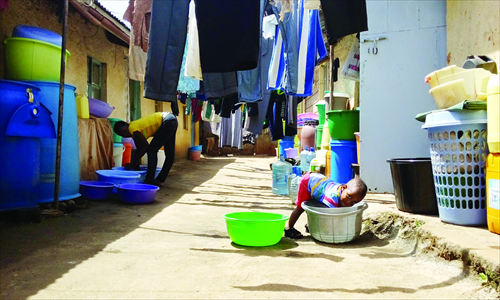
A child helps his mother wash clothes in Kibera, Kenya. Photo: Tiara Lin
For years I dismissed Africa as a travel destination because it freaked me out. It is often described as a land of war, poverty, HIV/AIDS and starving children.
It wasn't until I finally set foot on the African continent a few weeks ago that things finally changed. A week in Nairobi, capital of Kenya, totally altered my perception. On my way back home, I texted my Kenyan friends: "You can take a girl out of Africa, but you can't take Africa out of a girl."
First impressions
My first impression upon landing was that it was difficult to tell the difference between urban areas in Kenya and China. On my way from the Jomo Kenyatta International Airport to the hotel, I was stuck in a traffic jam for almost an hour. It truly was the dark side of urbanization. As we drove slowly through the capital city, I saw some billboards along the highway that were written in Chinese and new apartment buildings under construction that looked very similar to those seen in China… I told my taxi driver that if he were to come to China, he would feel right at home. "Well, who do you think built these?" he laughed.
Nairobi, home to 3.5 million people, sees traffic jams every day. According to Forbes, the city is the World's fourth congested city. About $600,000 is lost every day due to congestion on roads. If you plan to meet someone in Nairobi, be prepared for that person to probably show up an hour late.
My taxi driver seemed very patient. "You have watches, we have time," he said.
Worried about mosquitoes
January is a good time to visit Nairobi. The city sees a lot of sunshine during this time with maximum temperatures reaching into the high 20s.
Tourism takes up at least 12 percent of Kenya's GDP, but recent events have posed a problem.
Last year, visitors to Kenya dropped 25 percent as the country has been hit by a series of terrorist attacks in the past few years. About 67 people were killed in Nairobi Westgate mall by al-Shabab militants in 2013.
It seems that even US President Barack Obama's visit to Nairobi in July last year has failed to improve tourism.
Security is an issue everywhere nowadays. However, when Pope Francis visited Nairobi in November last year, he said jokingly he was more worried about the mosquitoes.
"You don't need to worry about a thing. You know kung fu," my Kenyan friend Evelyn tried to comfort me. She asked if I had a black belt when she saw me working out at the gym. One of the many stereotypes we have about Africa is many people believe Africa is just one big country; while one of the many stereotypes African have about China is they believe all Chinese are martial arts masters like Jackie Chan. Evelyn told me if anyone tried to rob me, I should just pretend I know martial arts and they would probably just run away. Note taken!
Safari trips
One of the best things about coming to Africa is having the chance to get a closer look at the wild animals that I've always dreamed about.
People often go to Kenya for safaris. The closest safari trip is a visit to the Nairobi National Park, an urban safari with really wild animals. The park covers an area of 117 square kilometers and is located 10 kilometers south of the city center. It is home to 100 mammal species including lions, buffalo, leopards, rhinos and more than 400 species of bird. The entrance fee for foreign adults is $50, while a half-day tour arranged by a local safari company costs at least $70 per person. The best time to take a safari is the first thing in the morning.
If you are not a morning person, you can visit the David Sheldrick elephant orphanage to play with baby elephants while the workers feed them at about 11 am. It is just 25 minutes from downtown and costs only $5. These babies, whose parents either have been killed or are sick, are kept until they are ready to survive on their own in the wild. Don't freak out if an elephant stop to smell you. Scientists say African elephants have the best sense of smell in the animal kingdom.
Later on I visited the Giraffe Center, which is not far away from the elephant orphanage. If you don't mind a foot-long tongue licking your mouth or the smell of a giraffe's musky breath, you can feed them with your mouth. I decided to use my hand instead.
After feeding the giraffes, I needed to feed myself. A meal of Kenyan street food contains rice, beans, vegetables and some meat. It costs about $1. If you want to sit in a restaurant, a meal costs about $10. I ordered a classic Kenyan dish Ugali, a thick porridge made from white cornmeal and served with mashed vegetables. Don't miss out on a cold bottle of Kenyan Tusker beer. I raised a bottle to my experience with my Kenyan driver Afya. Cheers!
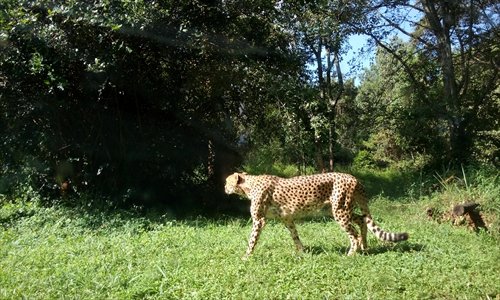
A cheetah walks through the grass at the Nairobi Safari Walk. Photo: Tiara Lin
In the afternoon, I continued explore at the Nairobi Safari Walk, a park where you can walk along and get to know the animals in a safe environment. At the gate, my tour guide stopped me and asked me to look at a box on which was posted a question: "Who poses the greatest threat to biodiversity? Please open to find out." I opened the box to see myself staring back in a mirror. Ah, I'm the threat! Indeed, here in Nairobi, the expansion of humanity has put heavy pressure on local wildlife.The safari walk really is much more a "walk" than a safari. The entire walk lasted about one hour. The entrance fee costs $25 for adult foreigners. Many visitors complain it is disappointing and overpriced. My suggestion is to have a guide take you around to meet the leopards, lions, rhinos and cheetahs in the park as they know all their names: That zebra is called Rose; this giraffe is Garissa; that leopard over there is Nabi. My guide pointed out the names of several animals, but none of them responded to being called.
The 'real' Nairobi
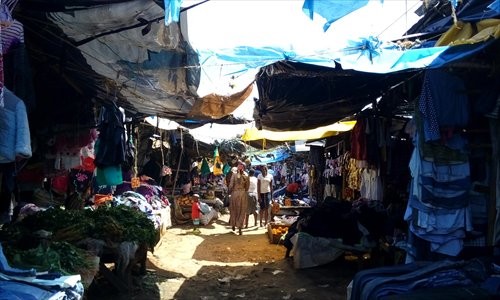
People stop at the Toi Market located in the outskirts of Kibera, Kenya. Photo: Tiara Lin
After spending the entire day doing touristy things, my expat friend suggested I have a look at the "real" Nairobi - Kenya's Kibera slum, home to a fifth of the city's population.Kibera, meaning forest in the local language, is located five kilometers from the city center. Covering an area of four square kilometers, there are about 1 million people living there. Kibera is infamous for its poverty and chaos, the ever-increasing cost of housing having pushed the country's poor into the area as they continue to migrate away from rural areas.
I was told it was not safe to wander the slum alone, so I signed up for a Kibera tour organized by locals. The three-hour tour cost $30, a contribution to support the majority here who live on $1 a day.
My tour guide, Richard, 33, was born and raised in Kibera. He said he has received over 100 foreign visitors since 2012. By bring visitors from outside, he wants to change the perception of the slum and promote Kibera as "a city of hope."
I first met Richard at the parking lot at Prestige Plaza, from there we hopped onto a mini-bus that was covered in graffiti, equipped with extra-loud horns and played noisy music. I was squashed between Richard and the driver on the front seat. Five minutes later, we arrived at Kibera.
I smelt Kibera before I saw it. It was a dense smell mixed with sweat, human waste, rubbish, street food and smoke. From what Richard told me, Kibera has seen a great improvements over the past decade. Flush toilets have replaced "flying toilets" - people used to use plastic bags to wrap up their waste and then throw them into the street. Instead of collecting rain water, clean water can now be gotten from huge water tanks or bought from vendors.
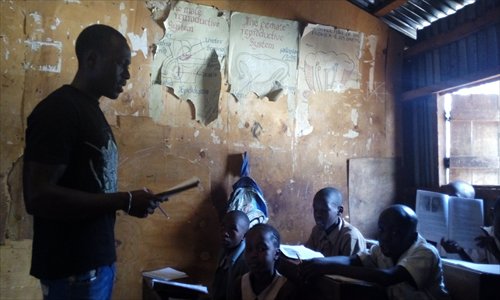
Students attend a class at a community school in Kibera, Kenya. Photo: Tiara Lin
My first stop was the Tunza Children Center, a community school for 140 children aged 3-15 with only eight teachers. Over the past decade, some 200 community schools have been built, but there are still not enough teachers. When I visited the kids in a dimly lit classroom, they greeted me in English and asked if I could teach them science and math.
With a 50% percent unemployment rate, young locals are trying to set up their own businesses. Our second stop was a workshop called Victoria Bones where 16 local artists turn cow and sheep bones into beautiful handicraft items and then sell them online. Together they earn around $100 a month.
And then I was welcomed in the Power Women Shop, which sells handmade jewels and clothes. It was set up by some HIV positive women in 2004, with the aim of reducing poverty and the stigma around HIV in the community. According to Kenya's Center for Disease Control, over 20 percent of Kibera's population is HIV positive. Rosemary, one of the founders, told me the neighbors used to be afraid of sharing food and shaking hands with her, now they feel comfortable enough to leave their babies at the shop while they are at work.
The only thing that I did not feel comfortable with was that I was constantly asked for donations everywhere. I didn't want to further the perception that tourists equal money, yet part of me felt bad about not helping them. At the end of the day, I chose to donate.
Resale markets
Do you know where your donated clothes end up? Here in Kenya! One person's trash is another person's treasure. Each year, tons of donated clothes are shipped here and then end up in resale markets like the Toi Market near the slum.
Kenyan love second-hand shopping. People can buy everything here: sweaters, shoes, socks, pants, bed covers and even bras and underwear. It is kind of trendy to shop at the second-hand market as people can find unique items and even have more to choose from than that found in local malls, even expats shop here sometime.
Bargaining at the Toi market is like a work out. You really need to spend time and energy to cut down prices, but at the end of the day you can find some really good bargains.
Rules of thumb:
Price:
Traveling in Nairobi is not cheap. It depends on your lifestyle. Costs for staying in Nairobi can run from $20 to $200 a day. A single entry visa costs $50.
Meals:
Street food costs $1 a plate. A meal in a restaurant costs about $10. Drinks cost from $2 to $5.
Transportation: Mini-buses are the cheapest way to get around. A ride costs half a dollar. Taxis do not have meters and they are very expensive. Negotiate the price before you go or ask your friend to recommend a trusted driver.
Safaris:
The cheapest one is at the Nairobi National Park, which is near the city. The entrance fee is $40. A 3-day safari tour organized by a safari tour costs $500.
Accommodation:
A bed at the youth hostel costs $10 per night, while a bed at a proper hotel might be 10 times higher.
Newspaper headline: A change of perception