HOME >> METRO SHANGHAI
Scholar in Shanghai offers new perspectives on wartime news reporting
By Yang Lan Source:Global Times Published: 2016-2-21 18:38:01
Shanghai has over the centuries historically been a harbor for Western information and communication. In the 1870s, Danish company Great Northern Telegraph Company built telegraph cables that connected Shanghai with Russia and Japan. Cables connecting British India and Shanghai were built by a British company. An American company also built cables connecting the US with Shanghai, and in 1914 Japan built its own cables to Shanghai and even set up their own telegraph office in the city. Because of its geographic location, Shanghai was eventually chosen by 20th century international news agencies such as Reuters and AP as their "base" in the Far East.
"War and communication are always very closely linked, especially in the age of telecommunications," said Yang Daqing, associate professor of History and International Affairs from the George Washington University, who recently gave a lecture organized by the Royal Asiatic Society China in Shanghai to share his research findings about wartime news reporting. "World War I was the first major war of propaganda as well as communication warfare," said Yang.
During World War II, Japan controlled the surrounding area in Shanghai where foreign telecommunication companies were located. It forced these foreign companies to allow Japanese censors to be embedded within their operations. According to Yang, it was the civilian bureaucrats who did the actual censorship although the Japanese military was in charge.
Changed to 'a large number'
Several hundred censored telegraphs from 1938 and 1939 were recovered by Yang at the office of the Great Northern Telegraph Company, which are owned by Chinese telecommunication companies now. For his research he conducted an analysis of the contents, which found that Japanese censors rejected some stories, and deleted or delayed others.
In 1938, a fleet of Chinese military aircrafts left Hankou and flew to Japan. They dropped thousands of antiwar leaflets in western Japan and then returned safely to China. The fact that Chinese planes flew to Japan under Japan's radar greatly embarrassed the Japanese military. It would have hurt the morale of Japanese residents and its invading army had this news been made public, so telegraphs on this topic were stopped before they were even sent.
"At that time, the major concerns of the Japanese military censoring the telegraphs were the secrecy of Japanese movements, such as the activities of high-ranking Japanese. The issue of morale was also a concern. Any news story that talked about major military setbacks would be censored," said Yang. "And then there was their reputation; various reports of military brutality and violence were censored."
On several occasions, the Japanese tried to persuade foreign journalists in China to edit their contents to be more pro-Japan. Australian reporter Harold Timperley, who worked for the Manchester Guardian newspaper's China office at that time, wrote investigative articles about the atrocities committed by Japanese troops during the Nanjing Massacre. His sources proved that over 300,000 innocent civilians were killed in the Yangtze Delta, however Japanese officials who did not want this revealed asked him to change the figure to "a large number." Timperley went to the British consulate to protest this request, and as a result had the word "worst" marked next to his name on Japanese official documents.
"Japanese censorship produced a backlash among foreign reporters like Timperley, who developed a very strong resentment against Japanese authorities who wanted to control information. Timperley even redoubled his efforts to disseminate the true information," said Yang.
"But coming back to the present, although it has become harder to control what people publish due to technology, there are still ways to censor the news and information," Yang told the Global Times.

Newspaper headline: The battle for information
"War and communication are always very closely linked, especially in the age of telecommunications," said Yang Daqing, associate professor of History and International Affairs from the George Washington University, who recently gave a lecture organized by the Royal Asiatic Society China in Shanghai to share his research findings about wartime news reporting. "World War I was the first major war of propaganda as well as communication warfare," said Yang.
During World War II, Japan controlled the surrounding area in Shanghai where foreign telecommunication companies were located. It forced these foreign companies to allow Japanese censors to be embedded within their operations. According to Yang, it was the civilian bureaucrats who did the actual censorship although the Japanese military was in charge.
Changed to 'a large number'
Several hundred censored telegraphs from 1938 and 1939 were recovered by Yang at the office of the Great Northern Telegraph Company, which are owned by Chinese telecommunication companies now. For his research he conducted an analysis of the contents, which found that Japanese censors rejected some stories, and deleted or delayed others.
In 1938, a fleet of Chinese military aircrafts left Hankou and flew to Japan. They dropped thousands of antiwar leaflets in western Japan and then returned safely to China. The fact that Chinese planes flew to Japan under Japan's radar greatly embarrassed the Japanese military. It would have hurt the morale of Japanese residents and its invading army had this news been made public, so telegraphs on this topic were stopped before they were even sent.
"At that time, the major concerns of the Japanese military censoring the telegraphs were the secrecy of Japanese movements, such as the activities of high-ranking Japanese. The issue of morale was also a concern. Any news story that talked about major military setbacks would be censored," said Yang. "And then there was their reputation; various reports of military brutality and violence were censored."
On several occasions, the Japanese tried to persuade foreign journalists in China to edit their contents to be more pro-Japan. Australian reporter Harold Timperley, who worked for the Manchester Guardian newspaper's China office at that time, wrote investigative articles about the atrocities committed by Japanese troops during the Nanjing Massacre. His sources proved that over 300,000 innocent civilians were killed in the Yangtze Delta, however Japanese officials who did not want this revealed asked him to change the figure to "a large number." Timperley went to the British consulate to protest this request, and as a result had the word "worst" marked next to his name on Japanese official documents.
"Japanese censorship produced a backlash among foreign reporters like Timperley, who developed a very strong resentment against Japanese authorities who wanted to control information. Timperley even redoubled his efforts to disseminate the true information," said Yang.
"But coming back to the present, although it has become harder to control what people publish due to technology, there are still ways to censor the news and information," Yang told the Global Times.
Professor Yang Daqing gives a lecure in Shanghai about wartime news reporting.
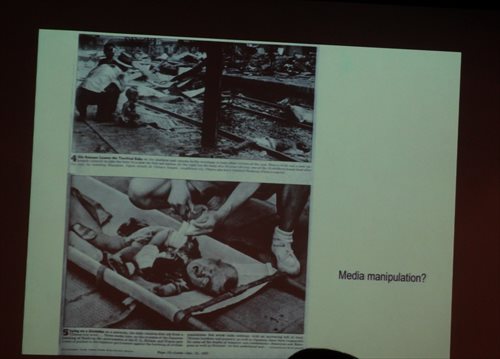
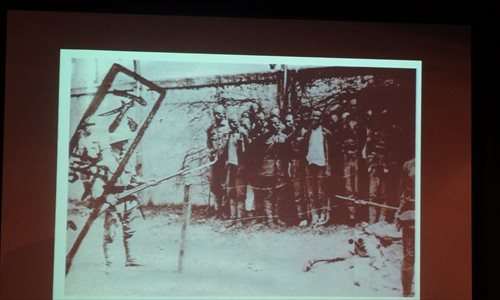
Historic photos of World War II shown by Yang during the lecture
Photos: Yang Lan/GT
Newspaper headline: The battle for information
Posted in: Metro Shanghai